Summer 2027 Marketing Internships: Opportunities and Application Guide
by Patrick Da Costa Guimarais • Last Updated 9/8/2026
Summer 2027 Marketing Internships: Opportunities and Application Guide
By Patrick Da Costa Guimarais, founder of LifeShack. Updated September 2026.
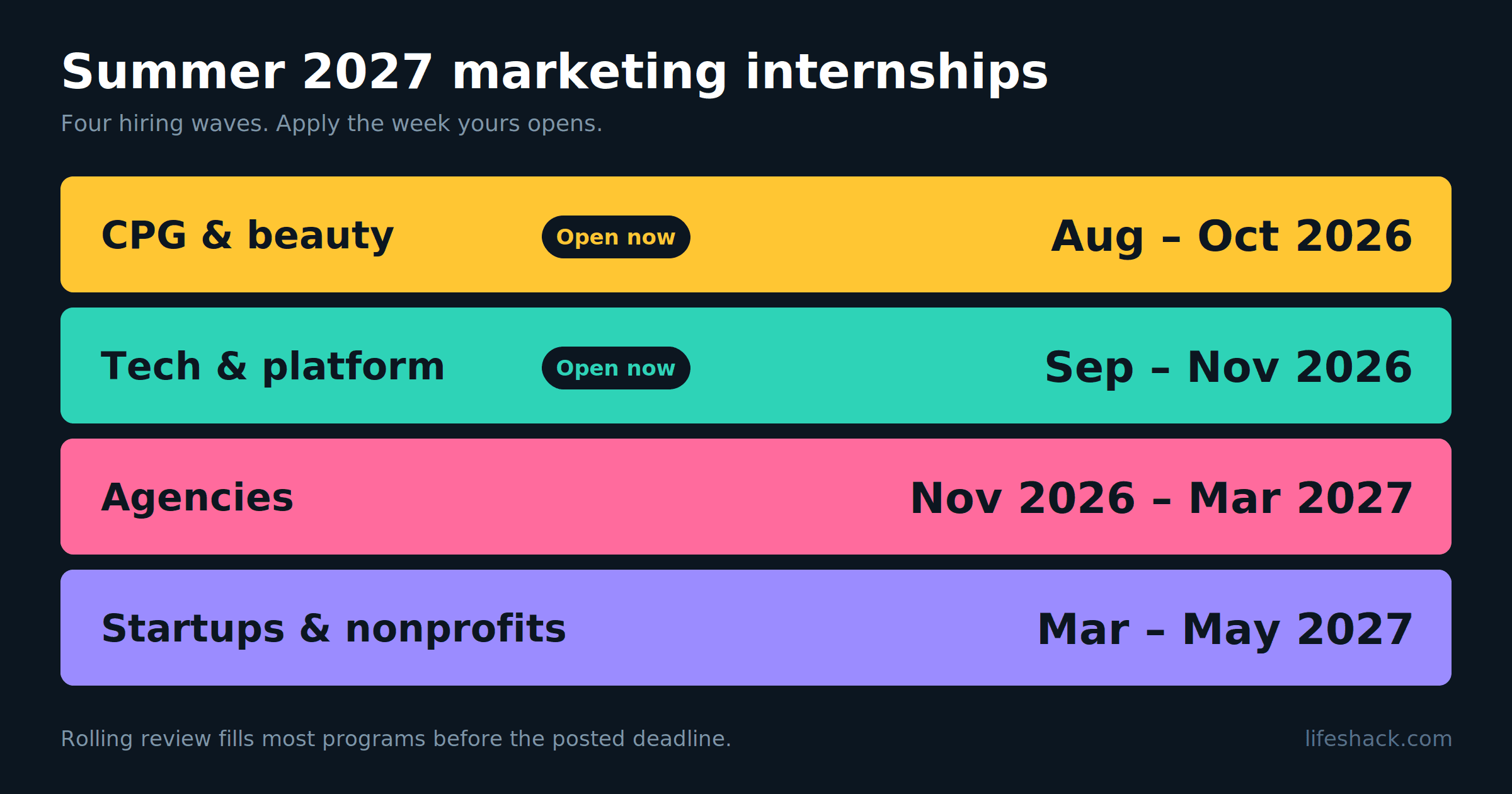
Marketing internship applications for summer 2027 open between August 2026 and March 2027. CPG and beauty brands go first, tech marketing follows in the fall, and agencies post last. Most programs review on a rolling basis, so the posted deadline is a backstop rather than the point at which decisions get made. If you are reading this in September 2026, you are early for most of the market and already late for a handful of programs.
The summer 2027 marketing internship timeline
Wave one: CPG and beauty, August through October 2026. This is the earliest and most structured part of marketing recruiting. SC Johnson has a Marketing BBA Internship for Summer 2027 live at its Racine, Wisconsin headquarters. Conagra posted summer 2027 requisitions in August 2026 and reviews them on a rolling basis through the winter. Estée Lauder opened its 2026 cycle on August 29 and its 2027 window is expected on roughly the same calendar, with the Lauder Summer Internship Program placing 90 to 150 undergraduates across more than 25 prestige brands each year. Colgate-Palmolive is expected to open around fall 2026 with deadlines landing in November and December. Watch P&G, Unilever, L'Oréal, General Mills, Kraft Heinz, Mars, PepsiCo, and Hormel in the same stretch.
Wave two: tech and platform marketing, September through November 2026. Google, Meta, Amazon, Microsoft, Adobe, Salesforce, and Spotify run product marketing, growth, and brand internships on the tech recruiting calendar rather than the CPG one. Their windows are short, and some close within a few weeks of opening.
Wave three: agencies and holding companies, November 2026 through March 2027. Ogilvy, VML, BBDO, DDB, OMD, Publicis, Havas, Dentsu, Edelman, and Weber Shandwick post later than brands do. Account management, strategy, social, and creative tracks all sit here. Agency programs are the most forgiving on major and the least forgiving on portfolio.
Wave four: startups, nonprofits, sports, and media, March through May 2027. Smaller teams hire closest to the start date because they staff against immediate need. If you miss the first three waves, these programs are still a reasonable path into a summer role.
Campbell's sits in the middle of the pack. Its window runs November 2026 through March 2027, its brand marketing track is 12 weeks, and its average time from application to offer is 13 days.
How rolling review changes your odds
Almost every program on this list uses rolling review. Requisitions fill as qualified applicants come in, and the posted close date functions as a backstop rather than a deadline. Colgate's own job descriptions say a role may close before its stated closing date and encourage candidates to apply as soon as possible. The working rule is to apply within the first two weeks of a window opening.
A strong application submitted in week one competes against a small pool. The same application in week eight competes against everyone else plus a recruiter who has already advanced five candidates to interview, which changes the odds without anything about the candidate having changed.
The volume problem
Handshake found that internship postings on its platform fell more than 15% between 2023 and 2025 while the average number of applications per posting more than doubled. Marketing postings now draw roughly 100 to 150 applicants each.
At LifeShack we watch applications move through more than 11 applicant tracking systems, including Workday, Greenhouse, Lever, iCIMS, and Ashby. A single marketing internship application takes 20 to 40 minutes once you include creating the account, retyping your work history into a form that already has your resume attached, answering the screening questions, and writing the "why this brand" response. Apply to 60 programs across four waves and that is 30 to 40 hours of unpaid administrative work spread across a semester, most of it duplicated.
Students respond to that math in one of two ways. Some apply to 12 places and treat each one as a lottery ticket, which fails on volume. Others apply broadly and start cutting corners on the parts that get read, which fails on fit.
Which marketing internship to target
"Marketing internship" covers at least seven jobs. Employers screen for different evidence in each one, and applying to all of them with a single resume is why strong candidates get filtered out early.
Brand management is the CPG track: consumer insights, positioning, P&L exposure, and cross-functional work with supply chain and sales. It screens for Excel, structured thinking, and a story about a brand decision you would make differently. Some programs, including Conagra's brand management track, are open only to MBA students, so undergraduates at those companies should target demand science, sales, or consumer insights instead.
Growth and performance marketing covers paid acquisition, landing pages, and channel testing. It screens for numbers, and a personal project with real spend behind it carries more weight than a coursework case study.
Lifecycle and CRM covers email, retention, and segmentation. Recruiters look for familiarity with Klaviyo, Braze, or HubSpot, plus comfort with cohort logic.
Content and social screens for a body of published work. Follower count matters less than evidence that you can hold a voice and ship on a schedule.
Marketing analytics screens for SQL, GA4, and the ability to explain what a number means to someone who does not want to open a dashboard.
Product marketing screens for positioning and writing. Most undergraduate PMM internships sit at tech companies and open in wave two.
PR and communications screens for writing samples and media literacy, and the agency side of it opens latest of all.
Two of these tracks is a reasonable target. Build proof for both, then apply to everything that sits inside them.
What employers screen for in 2026
NACE's Job Outlook data shows employers use GPA as a screening criterion far less than they used to, with 38.3% planning to filter on it. Internship experience, meanwhile, is cited as the top deciding factor when employers choose between two otherwise equal candidates.
That combination creates a problem for sophomores and juniors, who need experience to win the role that would give them experience. The way around it is proof you build for yourself.
Run a real campaign for a campus organization and report the numbers. Take over a local business's Instagram for a semester. Build a brand audit for a product you use and publish it. Ship a newsletter and grow it to 200 subscribers. Each of these gives you a resume line that survives a recruiter screen and a story that survives a behavioral interview.
Campbell's, Colgate, and most CPG programs run STAR-format behavioral interviews built around cross-functional teamwork and brand passion. Three well-told stories with numbers in them will cover most of what they ask.
The case for applying wide
NACE's 2026 Internship and Co-op Report projects employers will hire 3.9% more interns in 2025-26 than the year before, with 81% of participating employers planning to increase or maintain their intern class. Its spring 2026 update raised projected Class of 2026 hiring growth to 5.6%.
Graduates with internship or co-op experience were hired at 81.6% within three months, compared with 40.7% for graduates with no work experience. Marketing internships convert to full-time offers at roughly 55 to 65%, and NACE's data on in-person programs puts full-time offer rates to the intern class at 72%.
The practical conclusion is breadth. Enough applications across enough waves moves your odds more than one carefully polished submission to a single dream brand does.
What to do in September 2026
Build the target list this week. Twenty to thirty companies across the four waves, sorted by expected open date. Include five reaches, fifteen realistic targets, and ten smaller companies that hire late.
Set alerts on the sources that fire first. Company career pages, LinkedIn job alerts, and Handshake. Campus recruiting drives close to half of intern interviews at large CPG employers, so put career fairs on the calendar for September through November.
Get the assets done before the windows open. One base resume per track, a portfolio link that loads in under three seconds, and a LinkedIn profile that says what you want to do rather than what you have done.
Decide how you are going to handle volume. Whether that means blocking four hours every Sunday or automating the mechanical parts of submission, make the decision now. Students who wait until October to think about throughput end up applying to fewer places than they intended.
That last part is the bottleneck LifeShack was built for. We search, match, tailor, and submit applications across more than 11 ATS platforms, so the hours go into proof and preparation instead of retyping your address into Workday for the fortieth time.
Common mistakes
Waiting for the "official" deadline. Rolling review means requisitions fill well before that date arrives, so apply in the first week a role posts.
One resume for every track. A brand management resume and a growth marketing resume share maybe 60% of their content, and the remaining 40% is what decides the screen.
Skipping wave four. Startup and nonprofit marketing internships give you more ownership than a Fortune 500 program will, and they hire faster.
Ignoring campus recruiting. At large CPG companies it is the highest-conversion channel available to you, and it costs an afternoon.
Applying only to brands you love. Enthusiasm helps in the interview and does nothing at the filtering stage, so apply to the boring B2B manufacturer with a real marketing team.
Frequently asked questions
When do marketing internship applications open for summer 2027? Between August 2026 and March 2027. CPG and beauty open first in August and September 2026, tech marketing follows September through November, agencies post November 2026 through March 2027, and startups and nonprofits fill last from March to May 2027.
Is it too late to apply for a summer 2027 marketing internship in September 2026? No. Most programs have not opened yet. A few CPG and beauty windows are live now, so those should be your immediate priority.
Do I need to be a marketing major? No. Marketing programs accept any major, which is one reason application volume runs so high. Employers screen on evidence rather than coursework.
What GPA do marketing internships require? Most large CPG programs list a 3.0 minimum, including Colgate-Palmolive. Agencies and startups typically do not screen on GPA at all. Across employers generally, 38.3% plan to use GPA as a criterion.
How many marketing internships should you apply to? Enough that a single rejection does not change your outcome. Given roughly 100 to 150 applicants per posting and a conversion rate in the low single digits at the screening stage, most students need 40 to 80 applications across the full cycle to land multiple offers.
Do marketing internships turn into full-time jobs? Often. Marketing programs convert interns to full-time offers at roughly 55 to 65%, and NACE reports a 72% offer rate for employers running in-person programs.
Are marketing internships paid? At large companies, yes. Conagra's intern pay starts at $20 an hour with housing provided, and brand marketing intern roles at major CPG companies commonly post in the $22 to $28 range. Agency and nonprofit pay runs lower.