Summer 2027 Internship Timeline: When and How to Apply
by Patrick Da Costa Guimarais • Last Updated 9/14/2026
Updated September 2026. Current cycle: Summer 2027 internships.
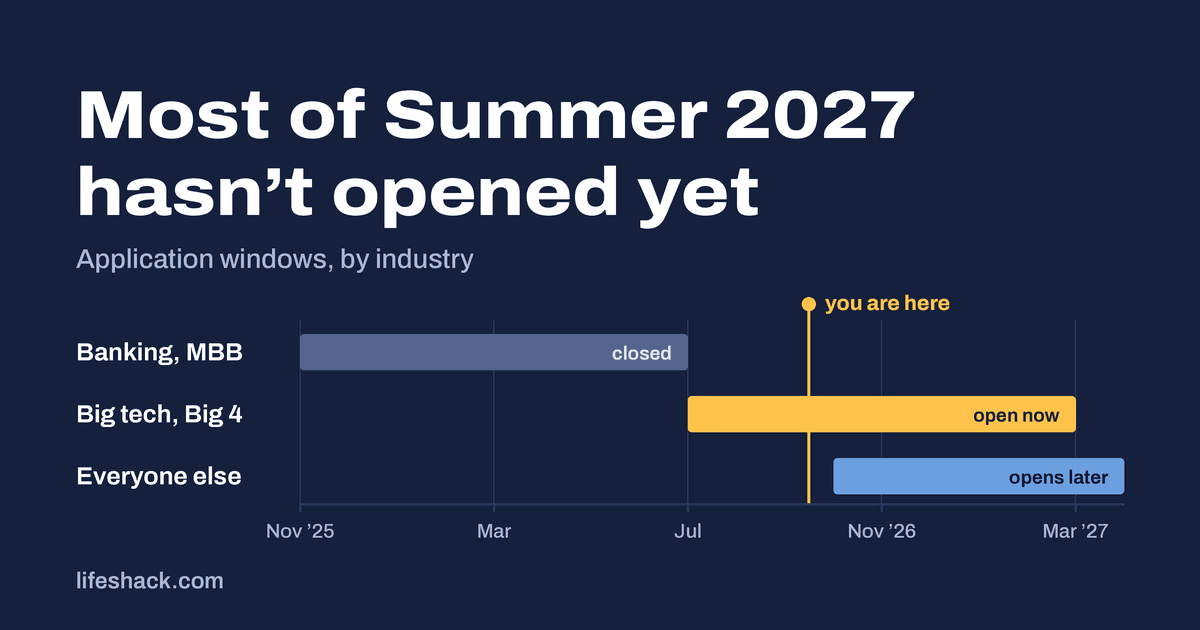
Summer 2027 internships start in June. On-cycle investment banking and MBB consulting have already closed their main rounds. Everything else is open now or opens between October and March, so for most students the season has not started yet.
Already closed. On-cycle investment banking, sales and trading, and asset management ran from roughly November 2025 through March 2026. MBB consulting opened in spring 2026 with deadlines as early as June. If banking or McKinsey, Bain, or BCG is what you have your eyes set on and you have not applied, unfortunately, the main round is gone for Summer 2027. However, boutiques, regional firms, off-cycle roles, and second-round consulting slots are your realistic path, and your on-cycle clock for Summer 2028 starts around October.
Open right now. Big Four and multiservice consulting run August through October. Big tech opened in July and runs through February on a rolling basis, though the earliest roles are already filled. Aerospace and defense opened in August. Large and mid-size tech and engineering are opening through the fall in waves rather than on one date.
Opening soon. Finance early-insight and sophomore programs run November through March. Healthcare, biotech, and research open October through February. Nonprofits, government, startups, and smaller employers are the January through March wave, which is the largest window outside the corporate cycle. Federal internships run on their own calendar through USAJOBS with hard deadlines.
These are general patterns, so verify each employer directly. Companies move their dates and some run several channels for the same role.
How rolling review works
Handshake's 2026 internship report found that recruiting now peaks in early fall across all class years. Seniors and underclassmen are entering earlier, and freshmen are submitting applications in their first semester.
Most competitive programs review applications as they arrive rather than after the deadline closes. Interview slots go to strong early applicants, so by the time the posted date arrives much of the class is already spoken for. A posting open until March with rolling review is functionally a January posting with a March safety net.
Apply within 48 to 72 hours of finding a strong-fit role. Do not lose a week rewriting one ordinary bullet. Delay only for a material problem: a wrong graduation date, a broken portfolio link, missing work authorization. Finish your resume now, before the October wave.
How competitive it is
Internship postings on Handshake drew an average of 109 applications each in 2024-25, up from 62 the year before and 43 the year before that. Technology internships averaged 273 applications per posting. Financial services drew 192. Over the same stretch, postings on the platform declined by double digits three years running.
Bachelor's-level interns earn $23.35 an hour on average, and 63.1% of eligible interns accepted a full-time offer in 2024-25, the highest conversion rate in five years. Both figures come from NACE's 2026 Internship & Co-op Report, a survey of 284 employers.
That 63.1% measures eligible interns, meaning those graduating and looking for full-time work at a company running a formal internship program. It is not your odds of turning any internship into a job. A structured program with a named intern cohort is a different proposition from an unpaid stint at a company that has never hired an intern before.
Getting an internship is harder than it was three years ago, and getting a job after one is easier than it has been in five years. Spend this fall on internship applications rather than entry-level ones.
Where to look
Company career sites are where postings originate. Most run through an applicant tracking system: Workday, Greenhouse, Lever, iCIMS, Ashby, SmartRecruiters, Taleo, SuccessFactors. Applying here means applying to the live posting rather than a copy of it.
University portals like Handshake are gated by school, so the applicant pool is smaller and the roles are often aimed at your institution specifically. Handshake's own data showed 41% of the class of 2025 applied to an internship through the platform, up from 34% for the class of 2023.
Aggregators such as Indeed, LinkedIn, Glassdoor, and Chegg Internships have the widest coverage and the most duplication and stale listings. Use them to find roles, not to apply to them.
Industry and niche sources include professional association boards, USAJOBS, state portals, and field-specific lists. There is less competition, but you have to go looking.
Find roles on an aggregator, apply on the employer's own career site, and set alerts now. In a rolling-review fall, spotting a posting in week one is worth more than any edit you make to the application itself.
Paid, unpaid, and what is legal
Unpaid internships still exist. Whether one is legal at a for-profit employer depends on the US Department of Labor's primary beneficiary test, set out in Fact Sheet #71.
Courts weigh seven factors: whether both sides understand there is no expectation of pay; whether the training resembles what an educational environment would provide; whether the internship ties to formal education through coursework or credit; whether it follows the academic calendar; whether its duration is limited to the period of beneficial learning; whether your work complements paid staff instead of displacing them; and whether both sides understand it does not entitle you to a paid job at the end.
No single factor decides it. Courts treat the test as flexible and assess each case on its own circumstances.
Academic credit alone does not make an unpaid internship legal, since credit is one factor out of seven. Nonprofits and government follow different rules, where unpaid internships are generally permitted when the intern volunteers without expecting pay.
State law can be stricter than federal law. Your career center and your state labor office are the places to check an arrangement that seems off.
How to apply without losing your semester
At 109 applications per posting, volume alone does not work, and neither does spending three hours on each one.
Answer the screening questions first. Graduation date, class year, work authorization, GPA, and location are structured fields that filter before anyone reads your resume. If one of them rules you out, nothing else on the application matters.
Never misstate your graduation date or work authorization. Both get verified, and both end the process at a worse moment than a rejection would.
Build one canonical data set. Dates to the month, institution name, degree field, expected graduation, references. Every form asks for the same things, and keeping them in one place removes most of the time cost. We built LifeShack to automate it: the same data carried across Workday, Greenhouse, Lever, and the rest so you are not retyping it at every one.
Match the posting's language. Recruiters filter their candidate database by the terms in the job description, so a resume without those terms never comes up in their results.
Use referrals where you have them. A referred application gets read. A cold one competes with the other 108.
Track what you sent. At this volume students duplicate applications and miss deadlines. A spreadsheet is enough.
What to do this fall, by year
Freshmen. Most structured programs require rising juniors, so target smaller employers, campus research, and nonprofits in the January to March wave. Aim for one line of relevant experience rather than a name.
Sophomores. Finance early-insight and sophomore programs open November through March. They are the feeder into junior-summer banking and they are consistently underapplied.
Juniors. This is your cycle. Tech, consulting, and engineering are open now, and juniors are the group that 63.1% conversion figure describes.
Seniors and recent grads. Entry-level and rotational programs recruit on a similar fall calendar and are the stronger target.
A note on remote
Remote and hybrid internships expanded after 2020 and remain common. NACE's prior-year data found employers running in-person programs averaged a 72% full-time offer rate, against roughly 56% for hybrid programs.
Remote widens the set of employers you can reach and appears to narrow your conversion odds. For students who cannot relocate, it is what makes the search possible at all.
Common questions
Is it too late to apply for a Summer 2027 internship? Only for on-cycle investment banking and MBB consulting. Big Four consulting, big tech, and engineering are open now, and most other employers open between October and March 2027.
What does rolling review mean? Recruiters assess applications as they arrive rather than after the deadline closes. Interview slots go to strong early applicants, so by the posted date much of the class is already committed. Apply within 48 to 72 hours of finding a strong-fit role.
How many applications does it take? No reliable per-student figure exists. Handshake recorded 109 applications per internship posting in 2024-25, up from 43 two years earlier. Technology roles averaged 273.
Do internships turn into full-time jobs? Often, inside formal programs. NACE found 63.1% of eligible interns accepted a full-time offer for 2024-25, a five-year high. Eligible means graduating and job-seeking at a company running a structured program, so it is not a general probability for every internship.
Are unpaid internships legal? At for-profit employers it depends on the Department of Labor's seven-factor primary beneficiary test. Academic credit alone is not sufficient. Unpaid internships at nonprofits and public sector organizations are generally permitted when the intern volunteers without expecting pay.
Can freshmen get internships? Yes, and more are trying. Most structured corporate programs require rising juniors, so freshmen do better with smaller employers, campus research roles, and nonprofits, which mostly post between January and March.
Sources
NACE 2026 Internship & Co-op Report (survey of 284 organizations, October 2025 to January 2026). NACE 2025 Internship & Co-op Report. Handshake 2025 Internship Index. Handshake Internship Report 2026. US Department of Labor, Fact Sheet #71: Internship Programs Under The Fair Labor Standards Act.