AI is More Expensive Than Humans
by Patrick Da Costa Guimarais • Last Updated 7/30/2026
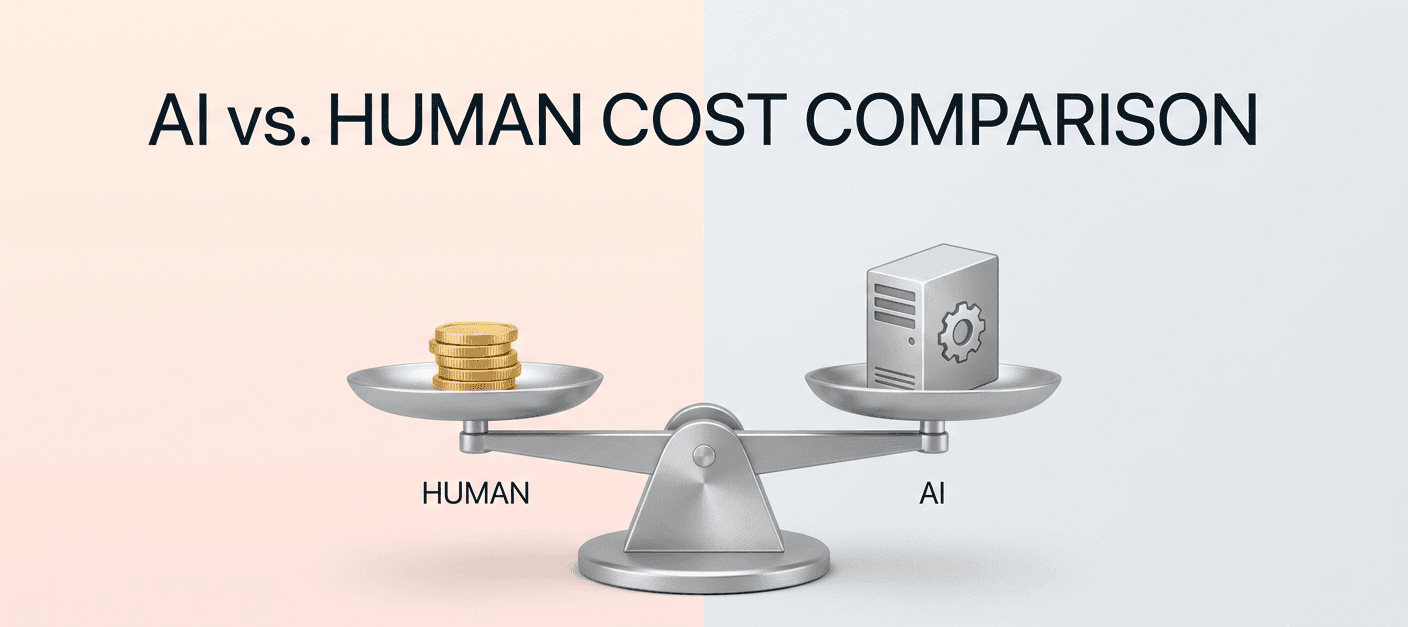
AI Is Getting More Expensive Than Human Workers, Forcing Companies to Rethink Automation and Hiring Strategy
For years, companies believed artificial intelligence would quickly replace human workers and dramatically reduce labor costs. That assumption is now being challenged by real-world economics, as AI systems are proving more expensive and operationally complex than expected.
Instead of eliminating jobs at scale, AI is increasingly reshaping how work gets done and creating new demand for hybrid human and automation roles.
This shift is changing how companies invest in AI tools, how they structure teams, and how job seekers should think about the future of work.
AI is not consistently cheaper than human labor
Executives across the industry are acknowledging a key issue: AI is not always a cost-saving replacement for employees.
Nvidia executive Bryan Catanzaro noted that in some cases, the cost of running AI systems, including compute and infrastructure, can exceed the cost of human labor itself.
This challenges one of the core assumptions behind AI-driven layoffs and automation strategies.
The hidden cost problem behind AI adoption
While AI tools have scaled rapidly across industries, the cost structure behind them is often underestimated.
Companies are now dealing with:
High GPU and cloud compute costs
Expanding inference usage expenses
Energy intensive data center infrastructure
Continuous model updates and maintenance
Human oversight required for quality control
According to industry reporting, many organizations are discovering that AI costs scale faster than productivity gains, especially in real-world workflows where accuracy matters.
AI-driven layoffs are not producing expected efficiency gains
Many companies initially reduced headcount under the assumption that AI automation would fully replace certain roles.
However, in practice, organizations are finding that:
AI still requires human validation and correction
Automation often introduces new workflow complexity
Output quality varies depending on task type
Cost savings are not consistent across departments
As a result, the expected efficiency gains from AI-first restructuring have been slower and less predictable than anticipated.
The shift toward hybrid human and AI workflows
Instead of full automation, companies are increasingly adopting hybrid systems where AI assists workers rather than replaces them.
This shift is creating demand for roles such as:
AI workflow operators
Employees who manage and optimize AI-assisted systems across teams.
Data quality and training specialists
Human input remains essential for model accuracy and refinement.
AI risk and compliance roles
Companies need oversight to manage legal, ethical, and operational risks.
Customer support escalation roles
AI handles basic queries while humans manage complex cases.
Automation integration specialists
Professionals who design workflows combining human and AI output.
Why AI is reshaping, not replacing, jobs
The early narrative of AI replacing large portions of the workforce is evolving into a more nuanced reality.
AI is primarily being used to:
Accelerate repetitive tasks
Improve productivity per employee
Assist decision-making processes
Reduce workload rather than eliminate roles
In many cases, AI is increasing the value of skilled human workers rather than replacing them.
The growing demand for AI-enabled job search and automation tools
As the job market shifts, individuals are increasingly turning to AI-powered tools to improve job search efficiency, resume targeting, and application automation.
Platforms like LifeShack reflect this broader trend, where AI is used not to replace workers, but to help job seekers navigate an increasingly complex and competitive hiring environment.
Instead of manually applying to hundreds of jobs, users are adopting AI-driven systems that:
Match candidates to relevant roles
Tailor resumes and applications automatically
Streamline job discovery and submission workflows
Reduce time spent on repetitive application processes
This category of AI tools sits directly at the intersection of job market pressure and automation adoption, reflecting the same macro trend affecting employers.
What this means for the future of work
The labor market is not simply shrinking due to AI. It is being reorganized.
The strongest opportunities are emerging in roles that combine:
Human judgment with AI-assisted tools
Domain expertise with automation systems
Communication skills with machine efficiency
Rather than eliminating jobs outright, AI is shifting demand toward workers who can operate, supervise, and optimize AI systems.
Conclusion
The assumption that AI will rapidly replace human workers is being reevaluated as companies encounter higher-than-expected costs and operational limitations.
Evidence from industry reporting shows that AI is not consistently cheaper than human labor when scaled across real business environments.
As a result, companies are shifting from aggressive replacement strategies toward hybrid models that combine human labor with AI augmentation.
At the same time, this transition is fueling demand for AI-powered job search and workflow tools like LifeShack, which help individuals adapt to a job market that is becoming more automated but not fully automated.