Apply to multiple jobs same company
by Patrick Da Costa Guimarais • Last Updated 11/12/2026
Can You Apply to Multiple Jobs at the Same Company?
By Patrick Da Costa Guimarais, founder of LifeShack. Updated November 2026.
Yes, and the thing worth understanding first is that they will be read together.
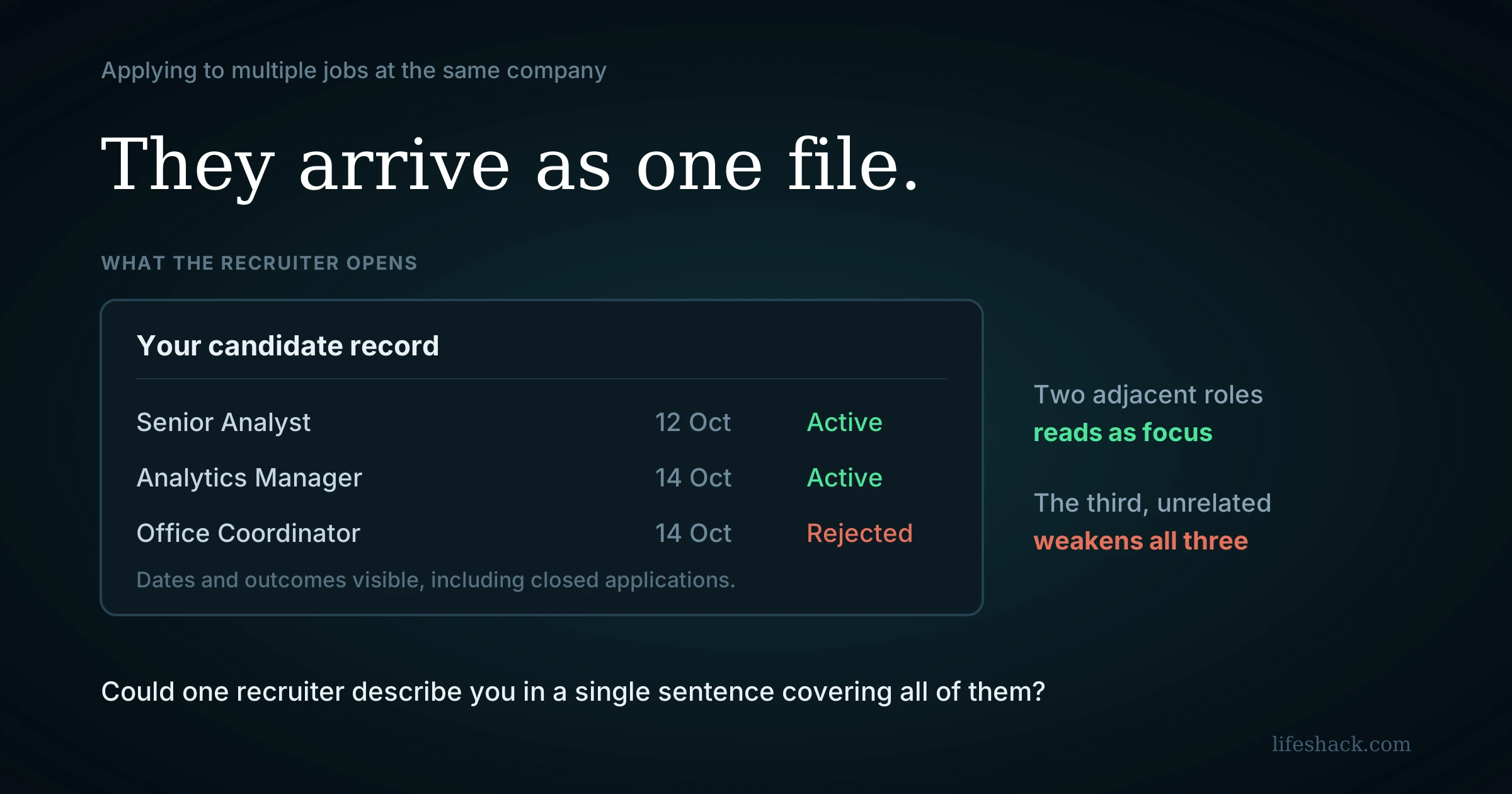
Most applicant tracking systems build one candidate record per company. A recruiter opening your file sees every role you have applied to at that employer, with dates, including the ones you were rejected from. Greenhouse's documentation describes hiring teams viewing all jobs attached to a candidate profile, and Workable detects multiple applications from the same email address and lists the other candidacies.
So the question is not whether you are allowed to apply to several. It is whether the set holds up when someone reads it as one submission.
The test that works better than a number
Could one recruiter describe you to a hiring manager in a single sentence that covers all of your applications?
A candidate who applied to Senior Analyst and Analytics Manager is one sentence. A candidate who applied to Senior Analyst, Office Coordinator and Account Executive is three sentences and a question about what they want.
Farah Sharghi, a career coach and former tech recruiter, puts the practical limit at two or three positions in your wheelhouse, and her reasoning is the mechanical part worth knowing. Most recruiters work on roles that are similar to one another, so the roles you would plausibly apply to at one company are frequently owned by the same person. Three applications to adjacent roles is three applications landing on one desk.
Roughly where the lines sit
One application needs no explanation. It is the default and nothing about it raises a question.
Two related roles is normal. Where the same experience suits both, it reads as interest in the company and a sensible hedge on level or specialism.
Three related roles is usually fine at a large employer and starts to look scattered at a small one, for reasons covered below.
More than three, or anything across unrelated functions, works against you. The pattern says you want the company and not any particular job, and a recruiter will frequently set the whole set aside instead of picking the best one.
Company size changes the answer
At a large company, separate functions run separate hiring pipelines with different recruiters who may never compare notes. Applying to a role in engineering and another in data science at a large employer is less likely to land in one person's view than the same pattern at a hundred-person company.
At a small company, one person usually handles all hiring. Every application you submit is visible to them, immediately, as a set. Two is the sensible ceiling.
Inside the same team, assume instant visibility regardless of company size. Two roles under one hiring manager is a judgment call they will make consciously.
Timing
Spacing applications does not hide the pattern, since the record shows dates. It does change how the set reads.
Gabby Davis, a career trends expert at Indeed, suggests waiting at least two weeks before submitting another application to the same employer. That gap turns three applications in a week into three considered decisions over six, which is a different impression of the same candidate.
If two roles are competing for your interest and you can only pick one, apply to the strongest fit first. You can apply to the second if the first closes without an outcome.
The cases that are not really multiple applications
The same role in different locations. Usually fine, since some employers post one requisition covering several sites. Check whether a single application already covers the locations you would accept before submitting three.
Reapplying after a rejection. A different role months later is a new application and reads as persistence. The recruiter will see the earlier one, which is a reason to have improved something in the meantime.
A role you were rejected from being reposted. Worth one application, and worth being candid in the cover letter that you applied before and what has changed.
If you do apply to more than one
Tailor each. Identical documents across two applications is the clearest possible signal that neither was considered. The same reader has both open.
Keep the facts consistent. Dates, titles, and numbers have to match across every application, since discrepancies between two documents in one file read as a credibility problem.
Answer screening questions per role. Systems store answers per application, and salary expectations or availability that differ between two submissions will be noticed.
Say it out loud if asked. Naming that you applied to both and why is stronger than letting a recruiter raise it, because they can already see it.
Rank them privately. If you get a screen for the weaker fit, you want to know in advance whether you would take it.
What applying to eight roles at one company usually means
If you find yourself submitting six or eight applications to a single employer, the useful read is rarely about that employer.
It generally means the target list is too short. The odds of any one application converting are low enough that a search needs breadth across companies, and stacking applications at one company does not substitute for that. It concentrates risk on a single hiring team's opinion of you while weakening every application in the stack.
The fix is more companies rather than more requisitions, and that is where the time goes. Each new employer means finding the roles, tailoring to each posting, answering their screening questions and creating another account in whichever system they run.
LifeShack handles that layer. It searches for roles matching your background and constraints across employers, tailors the resume and cover letter to each posting, submits across the eleven-plus applicant tracking systems employers run on, including Workday, Greenhouse, Lever, iCIMS and Ashby, and keeps every application in one place.
What stays with you is the judgment this page is about, which is deciding which roles at which companies are worth your name on them.
Frequently asked questions
Can you apply to multiple jobs at the same company? Yes. There is no universal prohibition, and applying to two or three closely related roles is normal. The applicant tracking system shows the recruiter all of your applications at that company, so they are read as a set.
How many jobs is too many at one company? More than three, or applications across unrelated functions. A former tech recruiter's rule of thumb is two or three positions within your wheelhouse, because most recruiters handle similar roles and will see the whole pattern.
Can recruiters see that I applied to multiple roles? Yes, at the same company. Most systems build one candidate record per employer, showing every application with dates, including rejected ones. They cannot see your applications at other companies, since each employer's system is separate.
Does applying to several roles hurt my chances? Two related roles generally does not. Three or more concurrent applications, particularly across different functions, weakens all of them, because the set reads as untargeted.
Should I space out applications to the same company? It helps. An Indeed career trends expert suggests at least two weeks between applications to the same employer. The dates are visible either way, and the spacing changes how the pattern reads.
Can I apply to the same role in different cities? Usually, though check whether one requisition already covers multiple locations before submitting several applications.
Can I reapply to a company that rejected me? Yes. A different role some months later reads as persistence. The recruiter will see the previous application, so it helps if something has changed in your profile since.
Should I mention that I applied to another role there? If it comes up, yes. The recruiter can already see it, so naming it is the stronger move.
Sources
Business Insider reporting on multiple applications to one employer, including guidance from career coach and former tech recruiter Farah Sharghi and Indeed career trends expert Gabby Davis. Greenhouse documentation on candidate profiles and attached jobs. Workable documentation on detecting multiple applications from one email address.