Applying for a job first time this century
by Patrick Da Costa Guimarais • Last Updated 10/5/2026
Applying for a Job for the First Time This Century
By Patrick Da Costa Guimarais, founder of LifeShack. Updated October 2026.
The last time you applied for a job, you printed a resume, handed it to someone, and had a conversation. A person was involved from the first minute.
Today you fill in a form on a company's website instead. Your resume goes into software, and that software decides whether a person ever sees it.
What happens to an application now
Every large employer uses software to collect and sort job applications. It is called an applicant tracking system, and recruiters shorten that to ATS. Workday, Greenhouse, Lever, iCIMS and Ashby are the common ones.
Five things happen, in this order.
You fill in a form on the employer's website. Your resume is attached, and you also type your work history into separate boxes on the screen.
The software reads your resume and pulls it apart. It takes your job titles, employers, dates and skills and files them separately. This is why the layout of your document matters now in a way it never did on paper. If the software reads it badly, your record comes out garbled.
The software compares your record against the job description. It looks for the exact words the posting uses. If the posting says inventory management and your resume says stock control, the software may not connect the two. It matches words. It does not understand what they mean.
A recruiter opens a filtered list. They do not read every application. They look at the ones the software ranked highest, which on a popular job might be twenty out of six hundred.
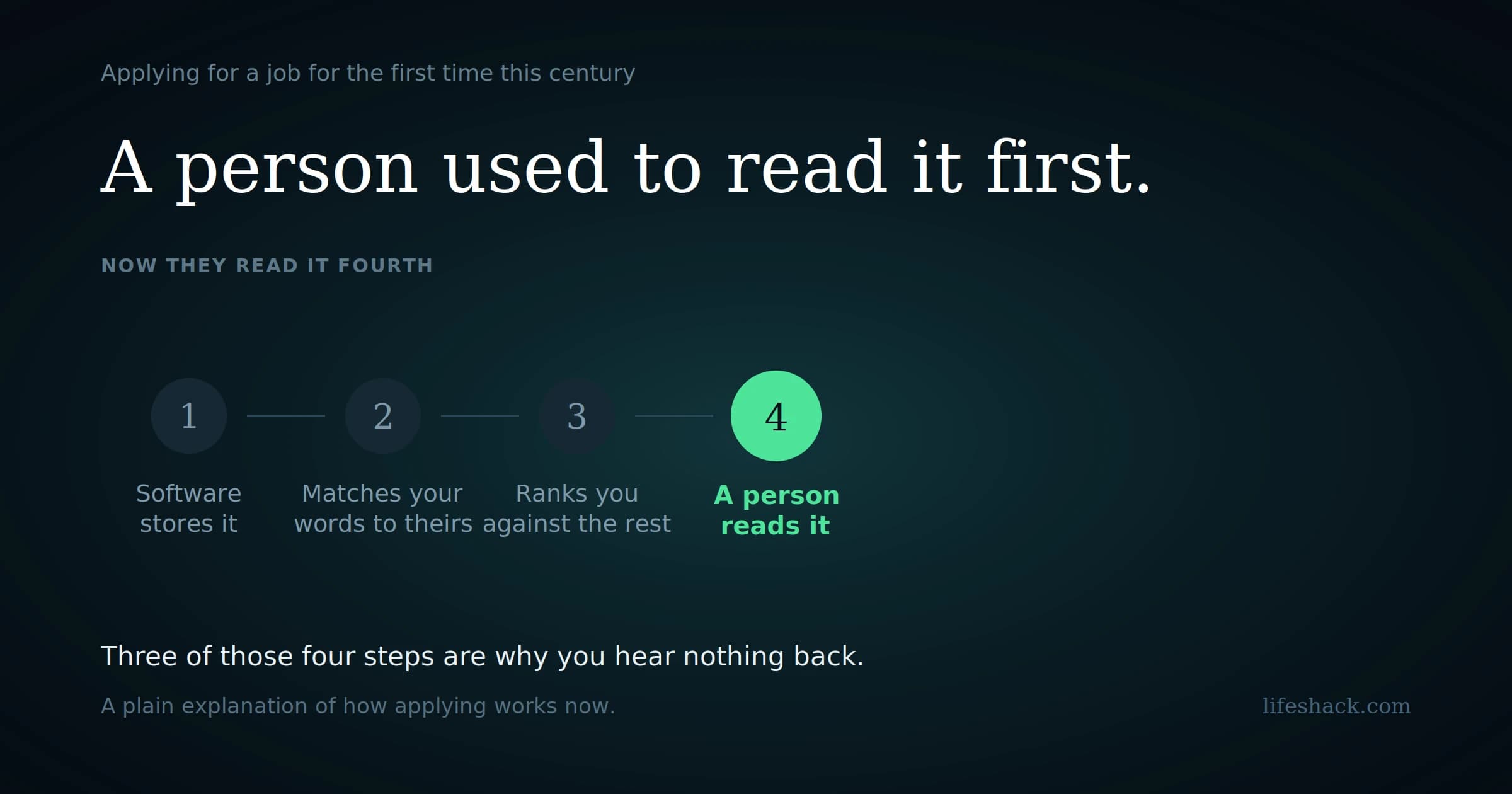
A person reads your resume only if you get that far. This is the part that changed most. In your last search, a person read your resume first. Now a person reads it fourth.
Four of those five steps happen without a person. That is why the whole thing feels so different before anything has gone wrong.
Why nobody calls back
This is the part that bothers people most. There are three reasons for it, and none of them is rudeness.
The volume is enormous. Greenhouse, which makes one of these systems, reported that the number of applications each recruiter handles rose from 146 a year in 2022 to 746 a year in 2025, with no increase in the number of recruiters. A single job posting commonly receives several hundred applications.
The software does not send rejections automatically. When a recruiter marks you as not moving forward, most systems send you nothing. An employer who wants to tell you has to write to you as a separate, deliberate act, and many never do.
There is often no phone number to call. Postings rarely list one, switchboards do not connect to recruiters, and the people reviewing applications do not take calls about them. Following up by phone was good advice once and it has no route in now.
Silence is the default outcome, not a verdict. Most applications from most people receive no response. It is not a judgment about your work or your worth, and reading it as one will make the search much harder than it needs to be.
The online application, step by step
These are the parts you will see, in the order they appear.
Create an account. Nearly every employer makes you register before you can apply, with an email address and a password. There is no universal account. Each employer keeps its own, so applying to ten companies means ten separate registrations, ten passwords, and ten confirmation emails. Write the passwords down somewhere you will find them, because you will need to log back in to check anything.
Upload your resume. Send a PDF unless the form specifically asks for a Word document. Name the file with your own name, as in "Jane Smith Resume.pdf", because the recruiter sees the filename.
Review what the autofill did. Most forms offer to read your resume and fill in the boxes for you. It gets some of it wrong, nearly every time. Dates land in the wrong fields, job titles get truncated, employers get merged. Read every box it filled and correct it, because the boxes are what gets stored and searched rather than the document you attached.
Type your work history. The form asks for employers, job titles, start and end dates, and sometimes responsibilities, even though your attached resume contains all of it. This feels like pointless duplication and it is. The software stores the typed version, so it has to be there.
Enter your education. Degree, field and institution. You can leave the graduation year out, and if your degree is more than fifteen years old you probably should, because it is the fastest way for a reader to calculate your age.
Answer the screening questions. These are short, usually yes or no, and they are filtered by the software before any person is involved. They typically ask whether you are legally allowed to work in the country, whether you need visa sponsorship, whether you can work at the listed location, when you can start, and sometimes what salary you expect. An answer that rules you out ends the application immediately, so read these carefully rather than clicking through them.
On the salary question. If a range is requested and you must answer, give a range rather than a single figure, and look up what the role pays in your area first. If the field is optional, you can leave it blank.
The voluntary self-identification section. Near the end you will be asked about race, gender, veteran status and disability. This confuses almost everyone applying for the first time in years. It is a legal reporting requirement for many US employers, answering is optional in practice as well as in name, the answers are kept separate from your application, and the hiring manager does not see them. Declining to answer does not count against you.
Submit, and expect a confirmation email. That email is automatic. It confirms the system received your application and tells you nothing about whether a person has looked at it.
Check the status later, and do not read much into it. The portal shows a status that a human being updates by hand, often in batches and sometimes never. A status can sit unchanged for weeks while decisions happen, or stay active long after the job is filled.
What your resume needs to look like now
The document itself has to be built so the software can read it.
One column, no tables, no text boxes. Content inside columns and tables gets scrambled or dropped when the software reads the file.
Standard section headings. Use "Work Experience," "Education," "Skills." Clever headings confuse the sorting.
A standard font and no graphics. No photo, no logos, no charts showing skill levels. The software cannot read any of it and a photo is not customary on a US resume.
Contact details at the top as plain text. Name, city and state, phone, email. A full street address is no longer expected. If your email address is from a provider you set up decades ago, make a new one, because it is a dated signal and costs nothing to change.
The last ten to fifteen years in detail. Everything before that can become a single line listing company names and titles without dates. A resume that runs back thirty years is rarely read as thorough.
Numbers in the bullets. How many people, how much money, how much faster, how much less waste. A sentence describing a duty is weaker than one describing a result.
Mirror the posting's words. If the job description says "scheduling" and you wrote "rostering," use their word where it honestly describes what you did. The software matches words.
What replaced the handshake
The conversation still happens, later in the process and in formats that may be new to you.
A recruiter phone screen. Fifteen to thirty minutes, usually to confirm the basics and your interest. A live conversation with a person, on the phone.
A recorded video interview. Increasingly common as a first step. You receive a link, see a written question on screen, and record your answer with no one on the other end. You usually get limited time to think and one or two attempts. It is uncomfortable for everybody. Prepare four answers in advance covering why you want the role, your background, a difficult problem you solved, and a time you worked with others. Keep each to about ninety seconds, look at the camera lens rather than the screen, and stop talking when you have finished the point.
Video interviews with people. Same as an in-person interview, conducted through a video call. Test the link the day before.
An in-person interview. Still happens, usually at the final stage rather than the first.
What to do when nothing happens
Keep applying while you wait. This is the habit that matters most and the one people find hardest. Each application carries poor odds on its own, so the response that works is holding several at once. Waiting on a single outcome makes every silence feel significant.
Follow up once, in writing, around day ten. Find the recruiter or someone on the team on LinkedIn and send three sentences. Name the role, say one specific reason you are a fit, and offer to answer questions. One message.
Ask people you know first. An introduction from someone inside a company does more than any number of applications from outside, because it gets your resume in front of a person rather than into the sorting software. Former colleagues, people from your industry, neighbors, anyone.
Expect it to take months. The time from a job being posted to someone starting now averages around sixty days at the employer's end alone. A search running three or four months is ordinary.
What thirty years buys you
The process above is impersonal enough to make anyone doubt themselves, so this part is worth stating plainly.
You have judgment that cannot be taught quickly. You have seen plans fail, watched decisions play out over years, and know what goes wrong in practice. The person with four years of experience has read about that.
You are evidence of reliability. Employers have been burned by short tenures. A long record reads well to a hiring manager, provided you present it as a choice rather than apologize for it.
You know how the work gets done in practice, as opposed to how it is described in a process document. That is rare and it is the most useful thing you will say in an interview.
The machinery described above is impersonal by design and impersonal with everybody, which means it is not measuring what you are worth.
The part that takes the longest
Everything above is one-time learning. You set up the resume once and you understand the steps once.
What repeats is the application. Each one takes roughly an hour, mostly spent creating yet another account and typing your history into yet another set of boxes. Because response rates are low, a serious search needs dozens of them, and that is where most people stop.
LifeShack handles that part. It searches for roles that match your background, adjusts the resume and cover letter for each one, fills in and submits the applications across the systems employers use, including Workday, Greenhouse, Lever, iCIMS and Ashby, and keeps everything in one place so you can see where each one stands.
What stays with you is the part that was always the work itself, which is the conversations, the judgment, and the experience you bring to them.
Frequently asked questions
What is an ATS? An applicant tracking system is the software an employer uses to collect and sort job applications. It reads your resume into data fields, matches that data against the job description, and gives recruiters a ranked list. Most employers of any size use one.
Why does nobody respond to my job applications? Volume and software defaults. Recruiters now handle several times the applications they did a few years ago, and most systems send no rejection notice unless the employer writes one deliberately. Silence is the usual outcome rather than a judgment.
Why do I have to create an account for every job? There is no shared account between employers. Each company runs its own instance of the software, and several use a separate system for each organization, so every application starts with a new registration.
Why do I have to retype my resume into the form? The software stores and searches the typed fields rather than your attached document. The attached resume is read by the person at a later stage, and the typed version is what the sorting runs on.
Should I put my graduation year on my resume? Not if your degree is more than about fifteen years old. It is the quickest way for a reader to work out your age and it adds nothing an employer needs.
What is the voluntary self-identification section? A legal reporting requirement for many US employers covering race, gender, veteran status and disability. Answering is optional, the responses are kept separate from your application, and the hiring manager does not see them.
Can I still call to follow up? Rarely, since most postings list no number and recruiters do not take these calls. One short written message around day ten, sent to the recruiter or a team member, is what replaced it.
How long should a job search take? Longer than it used to. The employer's own process from posting to start date averages around sixty days, and a full search of three to four months is within normal range.
Is a paper resume ever useful now? Bring printed copies to an in-person interview. For applying, everything goes through the employer's website.
Sources
Greenhouse recruiting benchmarks on application volume per recruiter and time to fill. SmartRecruiters 2025 Recruiting Benchmarks, covering 89 million applications across 95 countries. Published applicant tracking system documentation on candidate status visibility and notification behavior.