Your First Job Search Since the Pandemic: What Changed After the Hiring Boom
by Patrick Da Costa Guimarais • Last Updated 10/1/2026
By Patrick Da Costa Guimarais, founder of LifeShack. Updated October 2026.
If you last looked for work in 2020 or 2021, you searched in the most candidate-friendly market in modern American history, and you may not have known it at the time because it was the only recent market you had seen.
Recruiters found you. Processes moved in two or three weeks. Remote was the default assumption rather than a concession you negotiated for. People held multiple offers and used them. Counteroffers were routine, and so were double-digit pay increases for changing jobs.
Searching again now feels like the same activity producing a different result, and the natural conclusion is that something about you has slipped. The more accurate reading is that one variable moved, and most of what you remember was downstream of it.
The one variable
In 2021 and 2022, job openings and the quits rate hit record highs. Workers left voluntarily in enormous numbers, every departure created a vacancy, and employers competed for a limited pool of people willing to move.
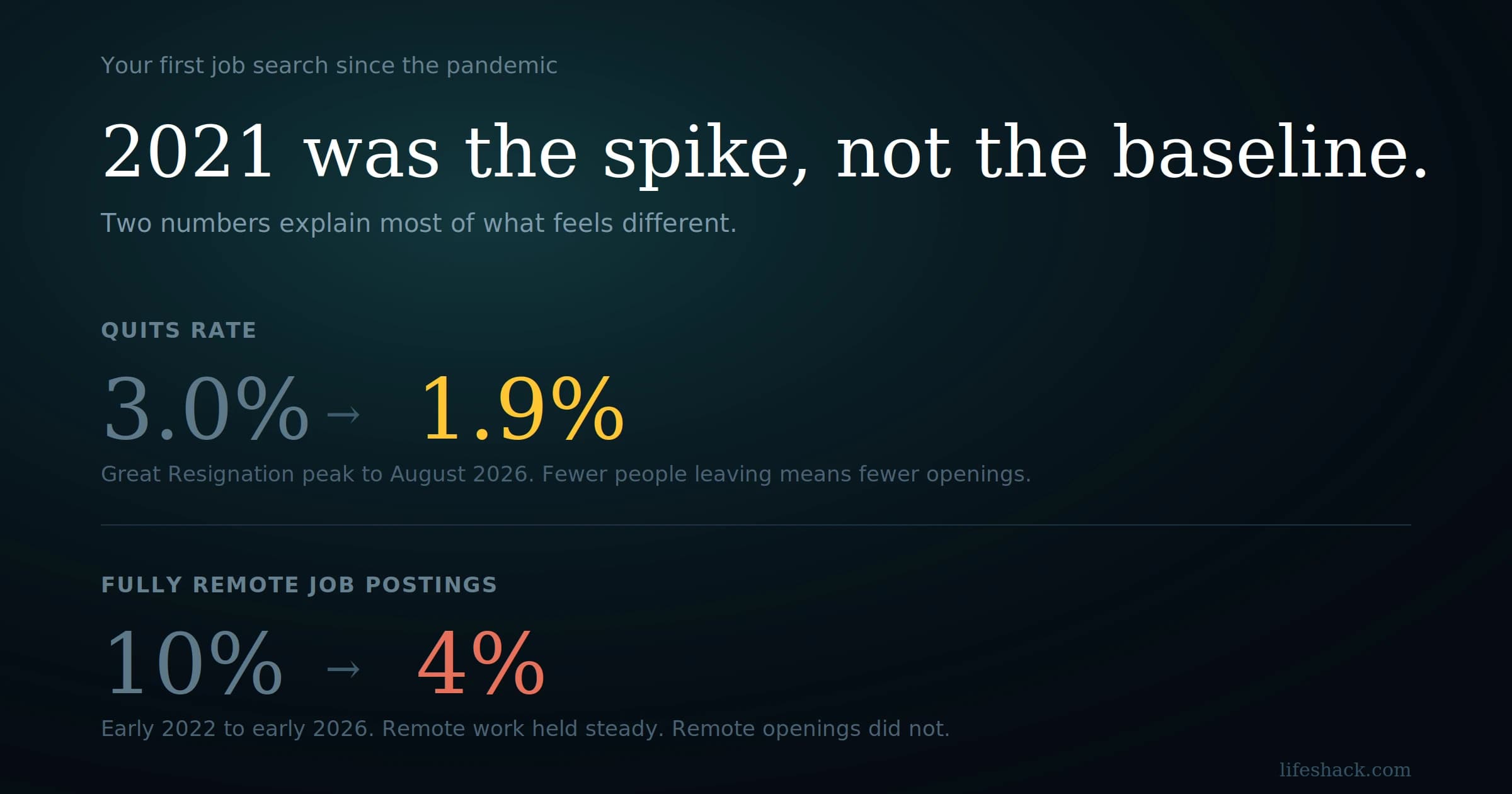
The Bureau of Labor Statistics put the quits rate at 1.9% in August 2026. At the peak of the Great Resignation it was around 3%. That is the whole story compressed into one number.
Fewer people quitting means fewer vacancies to fill. Fewer vacancies with the same number of job seekers means employers set the terms. Every specific thing you remember about 2021 came from candidates being scarce, and it reversed when they stopped being scarce.
What the leverage flip took with it
Recruiters reaching out first. In 2021, sourcing was how roles got filled, because posting a job and waiting produced too few qualified applicants. Inbound messages were a symptom of scarcity. With several hundred applicants arriving per posting, employers no longer need to go looking, so the channel that found you last time is largely closed and your search is entirely outbound now.
Speed. Greenhouse reports time to fill rose from roughly 44 days in 2022 to about 60 in 2026. When candidates were scarce, a slow process lost them. When candidates are plentiful, there is no cost to taking an extra two weeks, so processes expanded to fill the space available.
Counteroffers and competing offers. Both were tools of a scarce market. Holding two offers is now uncommon enough that planning a negotiation around it is a mistake.
The job-change premium. Switching employers reliably beat staying in 2021 and 2022. That gap narrowed substantially, which is part of why fewer people are quitting, which is part of why there are fewer openings. The loop reinforces itself.
Remote did not die, the remote job market did
This is the distinction that explains the most confusing part of searching now, and most coverage gets it wrong in both directions.
Remote work held. The telework rate has sat near 23% to 24% of employed adults and has barely moved since 2024, despite the volume of return-to-office headlines. Stanford's tracking has found that announced mandates reduce actual work-from-home rates by less than half a percentage point. People who have remote jobs largely kept them.
Remote postings collapsed. The share of US job postings advertising fully remote work peaked above 10% in early 2022 and had fallen to roughly 4% by early 2026. Robert Half's analysis of new postings in the second quarter of 2026 found 87% fully on-site, 10% hybrid, and 3% fully remote.
Those two facts are compatible, and together they describe your experience precisely. Remote work is common and remote openings are scarce, because the people holding remote jobs are not leaving them. The quits rate that fell across the whole market fell hardest in the roles people most want to keep.
So a remote search now means competing for a small and shrinking share of postings against everyone else who also wants one. Hybrid has become the realistic middle, and treating it as a compromise rather than a defeat opens roughly three times as many doors.
AI arrived on both sides
In 2021 this did not exist in any form that touched your search. It now operates at both ends.
Candidates generate applications at a speed that drove volume up sharply. Greenhouse reports applications per recruiter went from 146 a year in 2022 to 746 a year in 2025, against recruiting headcount that did not grow. On the employer side, ZipRecruiter's 2026 survey of more than a thousand talent acquisition professionals found 92% report some level of AI in their hiring process, with many systems ranking candidates before a recruiter opens the shortlist.
The practical effect is that your resume is screened by software before a person sees it, and that the generic application that would have been fine in 2021 now sits in a pile of several hundred that look like it.
Asynchronous video interviews, where you record answers with no interviewer present, have also become standard at the screening stage. If your last search involved only live conversations, prepare for that format specifically.
Why this is structural rather than personal
The reassuring part is in the layoffs number.
BLS put the layoffs and discharges rate at 1.0% in August 2026, which is low by historical standards. Hiring is slow and separations are also slow. This is a frozen market rather than a collapsing one, with people staying put, employers not replacing anyone, and very little movement in either direction.
That matters for how you read your own results. A low-hire market produces long silences for strong candidates, because the constraint is the number of open seats rather than the quality of applicants. A search that would have taken six weeks in 2021 taking four months in 2026 is the market working as it currently works.
The experience of being courted and then ignored is disorienting, and it is worth being clear that the courting was the anomaly. 2021 was not the baseline you fell from. It was a spike.
What to do differently
Treat the search as outbound. The inbound channel is closed, so build a target list of employers and check their careers pages directly on a rotation, rather than waiting on alerts and inbound messages.
Apply in the first few days. Median time to first review in the US is around six days, so a posting you get to in week three has usually produced a shortlist already.
Plan for more applications than last time. The response rate per application is lower, so reaching the same number of conversations takes two to three times the volume.
Widen on location before you widen on everything else. Moving from fully remote to including hybrid roles multiplies your available postings several times over, and it is usually a smaller concession than taking a role you want less.
Lead with evidence rather than seniority. With screening software between you and the recruiter, a bullet with a number attached does work that a job title no longer does on its own.
Use your network for the thing it is good at. Referrals operate on the resume screen, which is the stage volume made hardest to pass. One warm introduction is worth more than it was in 2021, because the pile it bypasses is larger.
The arithmetic
A well-executed application now costs around eighty minutes. Finding and verifying the role takes ten. Tailoring the resume to the posting takes twenty. Writing the cover letter and short-answer fields takes fifteen. Submitting through an applicant tracking system takes twenty to forty, because each employer runs its own instance and each wants an account created and a work history retyped into fields your attached resume already contains. Logging it takes two.
In 2021 you might have needed twenty applications. Now the same number of conversations takes sixty to ninety, which is eighty to a hundred and twenty hours compressed into a search that is already running longer than the last one did.
That is the gap between the search you remember and the search in front of you. The process itself is not harder to understand. It is the volume that broke it.
Doing it at the volume the market requires
LifeShack covers the mechanical half of that. It searches for roles matching your background and constraints, tailors the resume and cover letter to each posting, submits across the eleven-plus applicant tracking systems employers run on, including Workday, Greenhouse, Lever, iCIMS and Ashby, and keeps every application in one place. There is no queue of drafts waiting on your approval and no point where a form comes back to you.
What that leaves you is the work this market rewards, which is the referrals, the preparation, and the judgment about which roles are worth wanting.
Frequently asked questions
Why is it so much harder to find a job than it was in 2021? Because candidate leverage reversed. The quits rate was around 3% at the Great Resignation peak and was 1.9% in August 2026. Fewer voluntary departures means fewer vacancies, and with the same number of job seekers, employers set the terms.
Why aren't recruiters reaching out to me anymore? Sourcing was a response to candidate scarcity. With several hundred applicants arriving per posting, employers no longer need to go looking, so searches that used to be partly inbound are now entirely outbound.
Is remote work over? No, and the remote job market is a separate question. The telework rate has held near 23% to 24% since 2024, while fully remote job postings fell from above 10% in early 2022 to roughly 4% by early 2026. Remote work is common and remote openings are scarce.
How long does a job search take now? Longer. Greenhouse puts time to fill at about 60 days in 2026 against roughly 44 in 2022, and that measures the employer's requisition rather than your whole search. Four months is within normal range.
Is the job market bad or am I the problem? The layoffs and discharges rate was 1.0% in August 2026, which is low, while hiring is also slow. That combination describes a frozen market where few seats open rather than one where candidates are being rejected on merit.
How many applications should I expect to send? Two to three times what worked in 2021. A search that took twenty applications then typically takes sixty to ninety now to produce a similar number of conversations.
Should I still negotiate? Yes, and plan without assuming a competing offer. Multiple simultaneous offers were a feature of a scarce-candidate market and are uncommon enough now that building a strategy around one is risky.
Do I need to use AI in my applications? Employers now expect familiarity with it, and 92% report some level of AI in their own hiring process. Use it for research and for the mechanical work, and write the cover letter and short-answer fields yourself.
Sources
Bureau of Labor Statistics Job Openings and Labor Turnover Survey, August 2026. Greenhouse recruiting benchmarks. ZipRecruiter 2026 survey of talent acquisition professionals. Robert Half analysis of new job postings, second quarter 2026. Indeed data on the remote share of US postings. Stanford Work From Home Research on telework rates and return-to-office mandates. SmartRecruiters 2025 Recruiting Benchmarks.