Your Last Job Search Was 3 Years Ago. Here's What AI Changed.
by Patrick Da Costa Guimarais • Last Updated 10/1/2026
By Patrick Da Costa Guimarais, founder of LifeShack. Updated October 2026.
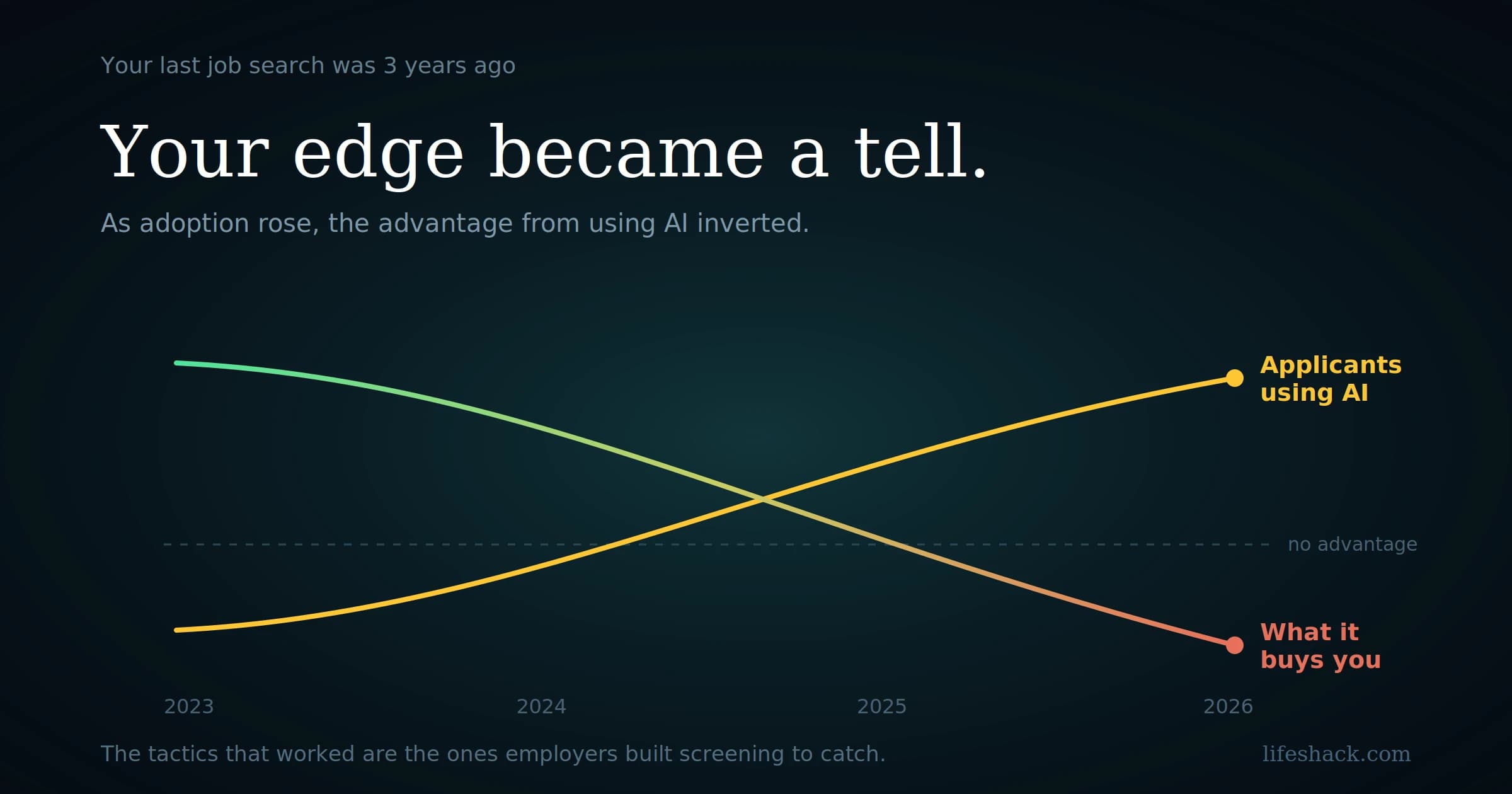
If you searched for a job in 2023, you were there for the interesting part. ChatGPT was a few months old, very few applicants were using it to write applications, and the ones who did had a quiet advantage. A generated cover letter read better than most of what employers received. A resume rewritten against a job description got through filters that were still matching keywords and little else.
Those tactics worked, which is the problem now. The same moves that gave you an edge in 2023 are the default behavior of several hundred other applicants per posting, and employers built screening specifically to handle them. The habits you formed in a market where you were early are the habits now working against you.
What matured on the employer side
AI screening went from experiment to standard. In 2023 a minority of employers were piloting AI in hiring and most screening was still keyword matching inside an applicant tracking system. ZipRecruiter's 2026 survey of more than a thousand talent acquisition professionals found 92% now report some level of AI in their hiring process. Many systems summarize and rank candidates before a recruiter opens the shortlist, which means a model reads and scores your application before a person decides whether to open it.
Volume rose faster than anything else. Greenhouse reports applications per recruiter went from 146 a year in 2022 to 746 a year in 2025, against recruiting headcount that did not grow with it. Ashby, drawing on more than 54 million applications, found applications per hire have roughly tripled since 2021. WIRED reported in August 2026 that pools at some software and enterprise employers moved from around a hundred per role to over a thousand in under eighteen months.
Employers got skeptical of documents. A 2026 Robert Half survey found 67% of hiring managers saying AI-generated applications have slowed their process and 65% saying skills have become harder to verify in AI-optimized resumes. The polished application stopped being evidence of anything, so weight shifted toward things harder to generate.
Interviews changed format. Asynchronous video screening, where you record answers with no interviewer present, is now common at the first stage, and some employers run AI-conducted first-round conversations. Neither was mainstream in 2023.
Platforms started flagging poor fits. LinkedIn began rolling out warnings in August 2026 telling apparently underqualified applicants they are probably not a fit, which is a response to the same volume problem.
The five habits that flipped
Using AI to send more applications. In 2023, generating applications quickly let you cover more ground than people writing each one by hand. Now the volume it enabled is the thing employers are defending against, and your generated application lands in a pile of several hundred that look like it. Volume without differentiation now lowers your conversion rate instead of raising it.
Generating the cover letter. A ChatGPT cover letter in 2023 was better than the average one a recruiter received, and it is now recognizable on sight. Resume Now's survey of HR workers found 62% are more likely to reject an unpersonalized AI-generated resume. The register that read as competent three years ago reads as unexamined now, and the cover letter is one of the few places left where a human forms an impression of you directly.
Loading the resume with keywords. Keyword density worked against 2023-era parsing, which matched terms without evaluating whether anything supported them. The layer above that now checks for evidence, and stuffing or hidden white text can flag an application as manipulative rather than simply failing to help. Mirroring the posting's language where you have the underlying experience still works. Adding terms you cannot defend does not.
Hiding that you used AI. In 2023 this was reasonable caution. Employers now expect candidates to work with AI-assisted tools, and familiarity has moved from a differentiator to a baseline. What gets evaluated is whether you can explain and verify the output, so naming the tools you use reads better than concealing it and getting caught in a follow-up question.
Applying when you got around to it. Timing mattered less when fifty people applied to a role. SmartRecruiters' benchmark data, built on 89 million applications across 95 countries, puts median time to first review in the US at around six days. With several hundred applications arriving in the first week, the shortlist frequently exists before the second week begins. An application sent on day twenty is competing for a seat on a list that was drawn up two weeks earlier.
What still holds from 2023
Not everything inverted, and the pieces that held are worth knowing so you do not throw out the parts that work.
Tailoring to the posting. Still correct, and now the baseline rather than an edge. The difference is that it has to be specific rather than merely generated.
Referrals. Unchanged and arguably stronger, since a referral operates on the resume screen, which is the stage volume made hardest to pass.
Evidence beats description. A bullet with a number attached outperformed a list of adjectives in 2023 and does so by a wider margin now that generated adjectives are free.
Networking before you need it. Conversations started months before you apply still convert better than cold applications, and that has not moved.
Interview preparation. Still the highest-return hours in a search, and now more so, because reaching the interview costs more than it used to.
What to do instead
Use AI on the parts no recruiter reads. Research, fit assessment, keyword extraction, interview preparation, and the mechanical work of submission. These produce no artifact a recruiter evaluates, so there is no downside to speed.
Write the parts people read. The cover letter, the short-answer fields, and anything that asks why this company. Two or three sentences that could only have been written about that employer separate you from hundreds that could have been written about anyone.
Verify everything a model tells you about an employer. Application windows, program names, eligibility rules, and compensation are exactly the kind of detail models state confidently and get wrong. Check the careers page.
Verify everything a model writes about you. A bullet claiming you grew a metric you never measured is something you will have to defend under follow-up questioning. Keep every number sourceable.
Apply inside the first few days. Set alerts, check target employers' own careers pages on a rotation, and submit within two or three days of a posting going live. It costs nothing and it moves more than any edit to the document.
The arithmetic that makes this hard
None of that is complicated on a single application. The cost shows up once you multiply it by the volume the market now requires.
A well-executed application costs around eighty minutes. Finding and verifying the role takes ten. Tailoring the resume takes twenty. Writing the cover letter and short-answer fields yourself takes fifteen. Submitting through an applicant tracking system takes twenty to forty, because each employer runs its own instance and each wants an account created and a work history retyped into fields your attached resume already contains. Logging it takes two.
With response rates per application lower than they were, a mid-level search now needs somewhere between sixty and ninety applications to produce the number of conversations thirty used to. At eighty minutes each, that is eighty to a hundred and twenty hours, compressed into the eight to twelve weeks a search runs.
So the choice is to run the right process on twenty roles, which is too few for the current odds, or to run a degraded version on ninety, which produces exactly the generated output employers built their screening to catch. That second option is the 2023 habit, and it is the one that stopped working.
Doing it properly at volume
LifeShack handles the part of this that does not reward your attention. It searches for roles matching your background and constraints, tailors the resume and cover letter to each posting, submits across the eleven-plus applicant tracking systems employers run on, including Workday, Greenhouse, Lever, iCIMS and Ashby, and keeps every application in one place. There is no queue of drafts waiting on your approval and no point where a form comes back to you.
What that frees is the eighty hours of account creation and retyping, which no recruiter ever sees. The judgment about where to apply, the conversations, and the preparation stay with you, because those are the parts the current screening is designed to reward.
Frequently asked questions
Do employers use AI to screen resumes? Most do in some form. ZipRecruiter's 2026 survey found 92% of talent acquisition professionals report some level of AI in their hiring process, and many systems rank candidates before a recruiter opens the shortlist.
Should you use AI to write your job applications? Use it for research, fit assessment, keyword extraction and interview preparation. Write the cover letter and short-answer fields yourself, since 62% of HR workers report being more likely to reject an unpersonalized AI-generated resume.
Can employers tell if you used AI on your resume? They recognize the register rather than detecting it technically. The output of an unedited generated application is familiar to anyone who has read several hundred of them, which is why the generic version now works against you.
Is it bad to admit you use AI tools? No. Familiarity with AI tools has become an expectation for most roles rather than something to conceal. What matters is being able to explain and verify what the tool produced.
Does keyword stuffing still work on applicant tracking systems? No. The screening layer above keyword matching now evaluates whether evidence supports the terms, and stuffing or hidden text can flag an application as manipulative.
What is an AI interview? An asynchronous video screen where you record answers to prompts with no interviewer present, or in some cases a first-round conversation conducted by an AI system. Both became common after 2023 and reward structure and concision, since you get no interviewer reaction to adjust against.
How much has application volume changed since 2023? Substantially. Greenhouse reports applications per recruiter rose from 146 a year in 2022 to 746 in 2025, and Ashby found applications per hire have roughly tripled since 2021.
What still works from three years ago? Tailoring to the posting, referrals, evidence with numbers attached, networking before you need it, and interview preparation. The tactics that inverted were the ones that depended on being early to AI rather than on being a good candidate.
Sources
ZipRecruiter 2026 survey of talent acquisition professionals. Greenhouse recruiting benchmarks. Ashby 2026 Talent Trends, covering more than 54 million applications. SmartRecruiters 2025 Recruiting Benchmarks, covering 89 million applications across 95 countries. Robert Half 2026 hiring managers survey. Resume Now HR workers survey. WIRED, August 2026. LinkedIn product announcements, August 2026.