Freelance to full time job
by Patrick Da Costa Guimarais • Last Updated 10/6/2026
From Freelance to Full-Time: Applying When Your History Is a List of Clients
By Patrick Da Costa Guimarais, founder of LifeShack. Updated October 2026.
A freelance history has a formatting problem before it has anything else.
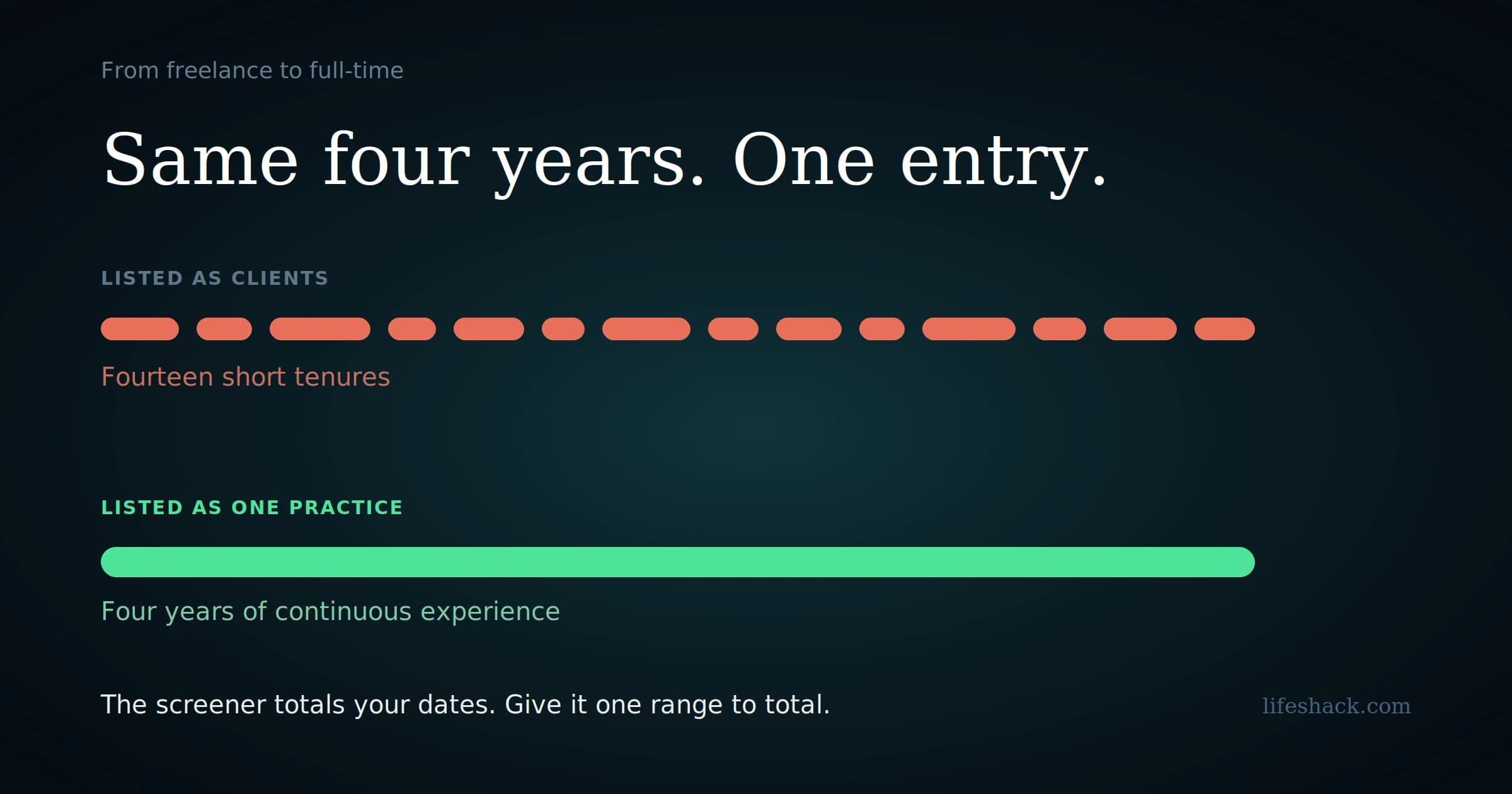
Four years of independent work might be fourteen clients. Listed the obvious way, that becomes fourteen entries with short date ranges, which the screening software reads as fourteen jobs and a recruiter scanning reads as someone who cannot stay anywhere.
The work itself was continuous. The resume says otherwise, and fixing that is mostly structural.
Build one umbrella entry
Group the whole period into a single entry rather than listing clients as separate jobs.
The structure is a job title, a company name, one continuous date range, bullets describing the work across clients, and a line naming selected clients underneath.
This matters mechanically. Applicant tracking systems extract a start and end date from every entry and total your months of experience. Fourteen short entries produce fourteen short tenures and a fragmented picture. One entry covering 2022 to present produces four years of continuous experience, which is what the period was.
ATS compatibility testing has found the single-entry format parses correctly across roughly 95% of major platforms, against about 88% for the per-client format, where some systems split entries unpredictably.
The umbrella also absorbs the gaps between contracts, which is the point. A month without a client inside a four-year practice is normal. A month between two listed jobs looks like a gap.
Always fill the company name field
This is the specific failure worth knowing about, because it is invisible when it happens.
Entries without a company name have been found to fail parsing around 40% of the time. Freelancers trigger this constantly, because the natural instinct is to write a title and dates with no employer, since there was no employer.
Put something there. Your registered business name if you have one, or your practice name, or Self-Employed, which every system recognizes. The field has to contain text.
What to call yourself
The title does two jobs. It has to match the keyword a recruiter searched for, and it has to signal that the tenure was contract work before anyone evaluates the dates.
Lead with the function. Independent Marketing Consultant. Freelance Software Engineer. Contract Financial Analyst. The function carries the keyword match and the modifier explains the structure.
Match the word to the industry. Consultant reads better than Freelancer at corporate and enterprise employers. Freelance is standard and well understood in design, writing, media and other creative fields. Contractor fits technical and engineering work, particularly where engagements were full-time hours.
Self-Employed is the safe fallback when nothing else fits, and it parses everywhere.
Label it explicitly somewhere in the entry. Contract, Freelance, Consulting or Independent, in the title or the company field. A reader who knows the tenure was contract work before they read the dates evaluates those dates differently.
Which clients to name
Name five to eight rather than all fourteen.
Lead with recognizable names, since a reader who knows one company gets a frame for the rest.
Include the ones relevant to the job you want, even if they are smaller. A client in the target industry does more than a famous client in an unrelated one.
Describe the rest by category. Six additional clients across healthcare and fintech. That communicates volume without a wall of unfamiliar names.
Check your agreements before naming anyone. Some contracts restrict this, and it is worth two minutes.
The awkward cases
Concurrent clients. Do not try to show the overlap on a timeline, since it looks like a formatting error. State it plainly in the entry: managed four to six concurrent client engagements.
The same client more than once. Consolidate into one line covering the full span with a note that it was multiple engagements. Repeat business is a strong signal and splitting it hides that.
Agency or staffing firm placements. List the agency as the employer and the client assignments underneath. That is the standard structure and recruiters read it fluently.
A long engagement among short ones. If one client ran a year or more and it is relevant, give it its own entry alongside the umbrella rather than burying it in a client list.
Periods with no work. Inside the umbrella they need no explanation. The entry covers the period and the bullets describe what you did across it.
Rewrite the bullets for a job rather than a project
Freelancers describe deliverables, because that is what the contract was for. Employers hire for ongoing ownership of a function, and the gap between those two framings is where applications quietly fail.
Describe the function you performed, then the result. "Ran paid acquisition for a DTC retailer, cutting cost per acquisition from $62 to $38 over two quarters" reads as a job. "Delivered a paid acquisition audit" reads as a project that ended.
Aggregate where you can. Across clients, fifteen site builds is a volume statement that no single engagement makes.
Show the long relationships. Eighteen months with one client says something about how you work with people that a list of three-month projects does not.
Use the posting's vocabulary. Where the underlying work matches, use their words for it rather than yours.
Answer the question they will not ask
Employers hiring a freelancer worry about three things, and they are unlikely to raise any of them directly.
Will you leave for a better contract. Can you work inside someone else's structure and priorities. Do you know how to be managed, having not been for several years.
Two sentences in the cover letter handle most of it. Say why you want employment specifically, framed around depth and continuity rather than around being tired of the uncertainty. Mention any long engagements, since an eighteen-month client relationship is evidence you can sustain one. And be concrete about what the role offers that client work does not.
Avoid saying you want stability. It is true and it reads as a position you will abandon when the market improves.
What a salary is worth against a billing rate
Freelancers consistently misjudge this, and it costs offers.
Your billing rate is not your salary equivalent, because you never billed every working hour. Utilization for most independent practitioners lands somewhere between half and three quarters of available hours, with the rest going to business development, invoicing, scoping and unpaid gaps.
Then the comparison needs adjusting on both sides. From your freelance income, subtract the employer half of payroll taxes that you were paying yourself, the health insurance you were funding alone, the retirement contributions with no match, and the weeks you took off unpaid. Add to the salary side the value of benefits, paid leave and the fact that income arrives whether or not a client renews.
Work out the real number before an application form asks for it, because several will, and a figure anchored to your headline rate will read as a candidate who has not done the arithmetic.
References and verification
References come from clients. Pick the ones who can speak to how you worked rather than only to the output. A client who can say you took feedback well and integrated with their team addresses the exact concern.
Expect employment verification to be awkward. Background check providers are built around employers confirming dates, and self-employment leaves no one to call. Have your business registration, tax filings or client contracts available, and tell the recruiter early that the period was self-employed so it does not surface as a discrepancy.
The part that repeats
The resume restructuring is one-time work. Build the umbrella entry once and it carries across every application.
What repeats is the application itself, at close to an hour each between finding the role, tailoring, the screening questions and creating another account with another employer's system. A move from freelance into employment usually takes more applications than an employed-to-employed move does, because you are also overcoming the formatting problem above on every one.
LifeShack handles that layer. It searches for roles matching your background and constraints, tailors the resume and cover letter to each posting, submits across the systems employers use, including Workday, Greenhouse, Lever, iCIMS and Ashby, and keeps every application in one place.
What stays with you is the client relationships, the references and the conversations, which is where a freelance record argues best for itself.
Frequently asked questions
How do you list freelance work on a resume? As one umbrella entry with a functional title, a company name, one continuous date range covering the whole period, bullets describing the work across clients, and a selected clients line naming five to eight. Listing each client as a separate job produces short tenures that read as instability.
Does freelance work look like job hopping to employers? It can, when each client is listed as a separate entry. Grouping the period into a single entry with the clients named underneath presents it as what it was, which is one continuous practice.
How do applicant tracking systems read freelance work? They extract start and end dates from each entry and total your months of experience. Testing has found the single-entry format parses correctly across roughly 95% of major platforms, against about 88% for per-client entries. Entries with no company name fail to parse around 40% of the time.
What should you put as the employer for freelance work? Your registered business name, your practice name, or Self-Employed. The field needs text in it, because leaving it blank is one of the most common parsing failures for independent workers.
Should you say freelancer, contractor or consultant? Consultant reads better at corporate employers, freelance is standard in creative fields, and contractor fits technical work and full-time engagements. Self-Employed is the universal fallback.
How do you show overlapping client work? State it in the entry rather than trying to represent it on the timeline. Something like managed four to six concurrent engagements communicates it without confusing the dates.
How do you explain wanting a full-time job after freelancing? In two sentences framed around depth and continuity. Cite any long client relationships as evidence you sustain them. Avoid leading with wanting stability, which reads as a position you will leave when the market turns.
How do you compare a salary to a freelance rate? Your billing rate covers only billable hours, which for most practices is between half and three quarters of working hours. Adjust for the payroll taxes, health insurance and retirement contributions you were covering alone, the unpaid time off, and the income arriving regardless of client renewals.
Sources
Applicant tracking system compatibility testing on resume entry formats and parsing rates. Published recruiting guidance from Indeed and staffing firms on contract and consulting resume structure. SmartRecruiters 2025 Recruiting Benchmarks on review timing and application volume.