Military to civilian job search
by Patrick Da Costa Guimarais • Last Updated 10/8/2026
Military to Civilian: Applying for Jobs in the AI Hiring Era
By Patrick Da Costa Guimarais, founder of LifeShack. Updated October 2026.
Veterans find work. A market analysis by RecruitMilitary and Findem found 60% of them report underemployment, meaning an involuntary mismatch between their skills, education or pay and the job they end up in. Unemployment is not the number that describes this problem.
That gap is a translation problem. The work you did maps cleanly onto civilian roles, and the words you used to describe it do not map onto anything a screening system is looking for.
Why a military resume fails keyword matching
Screening software compares the words on your resume against the words in the job description. It has no understanding beneath that comparison.
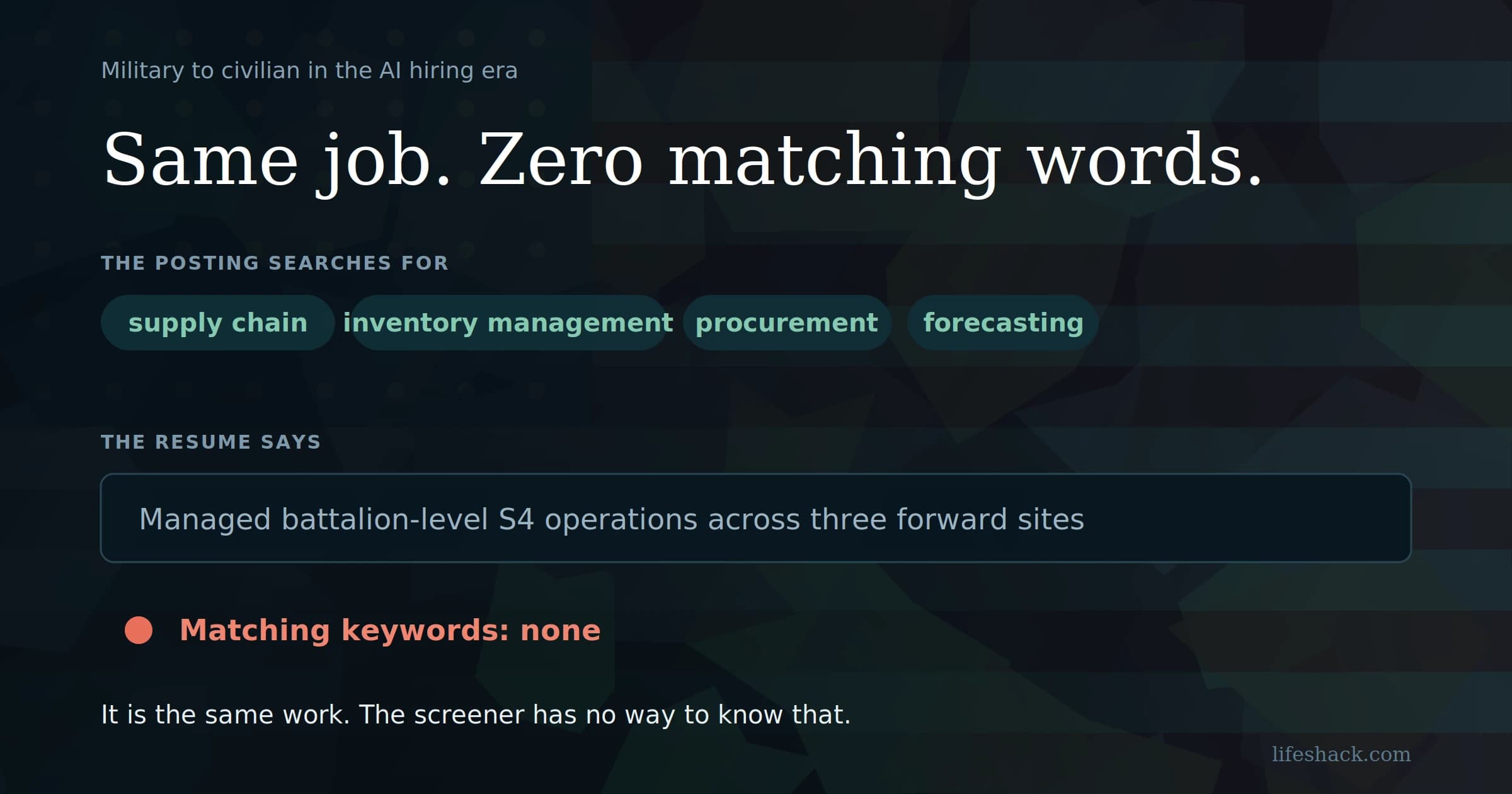
A civilian posting for a logistics manager searches for supply chain, inventory management, vendor relations, procurement, forecasting. A resume line reading managed battalion-level S4 operations across three forward operating bases contains none of those terms. The experience is a direct match and the vocabulary overlap is zero.
The system does not know that S4 is the logistics function. It does not know that 92Y is a supply specialist, that 3D0X2 is systems administration, or that an NCOIC ran a department. That is a vocabulary gap rather than an intelligence one, since the codes are internal to an organization the software has never indexed.
The AI layer sitting above keyword matching in many modern systems does not fix this either. A model summarizing your application still works from the words you gave it, and an untranslated military resume gives it very little to work with.
Translate the code, and use the official tools
The Department of Labor maintains free crosswalk tools built for exactly this, and they are more reliable than guessing.
O*NET Military Crosswalk. Enter your MOS, AFSC, NEC or rating and it returns matching civilian occupations with the associated skills and typical employers. It is available through O*NET Online and through My Next Move for Veterans.
CareerOneStop's military to civilian occupation translator, also from the Department of Labor, does the same mapping with a different interface and sometimes surfaces occupations the other misses.
Run your code through both. Take the civilian job titles that come back and compare them against actual postings you want, because the crosswalk gives you the family and the postings give you the exact phrasing employers use.
Then apply the title rule. Lead with the civilian title and put the military designation in parentheses. IT Systems Administrator (MOS 25B). Logistics Operations Manager (MOS 92Y). The civilian half matches what a recruiter searched for, and the military half stays accurate for anyone who reads further, including the veteran hiring managers who will recognize it instantly.
Translate rank into scope
Rank is the hardest part of the record to convey and it carries the most once it lands.
An E-7 with sixteen years has usually managed more people, more equipment and more operational risk than a civilian middle manager with the same tenure. Staff Sergeant communicates none of that outside the service, and civilian readers frequently misjudge enlisted seniority in both directions.
Replace the rank with the numbers behind it. People directly supervised. People in the wider organization you were accountable for. Dollar value of equipment or inventory maintained. Budget administered. Number of locations or units coordinated. Readiness, uptime or completion rates you were measured on.
Supervised 24 personnel, maintained $18M in equipment at 97% readiness, ran operations across three sites. That gives a civilian reader a frame. Staff Sergeant gives them nothing.
The vocabulary swap
Go through the resume and replace the internal word with the civilian one. The common swaps are below.
Soldiers, sailors, airmen or Marines become staff, team members or personnel. Regulations and instructions become policy or standards. Commander, Chief or Sergeant becomes Director, Manager or Supervisor. Mission becomes project, objective or program. Deployment becomes assignment or operational tour. Reconnaissance becomes assessment or analysis. Subordinates becomes direct reports. After action review becomes post-project review or retrospective. Operational order becomes project plan. Combat becomes high-pressure or time-critical, depending on what the line is demonstrating.
Strip the acronyms entirely unless they are standard in the industry you are targeting. NCOIC, OIC, TDY, PCS, AAR and OPORD mean nothing outside, and expanding them helps less than replacing them with the function.
The exception is defense and government contracting, where the vocabulary is an asset and the people reading your resume served, so keep two versions of the document.
The modesty problem
Military culture trains people out of claiming individual credit, and that training is a liability in civilian hiring.
Resumes come out written in the collective voice, with the unit as the subject and the individual contribution invisible. Assisted with and supported appear where led and built belong. Achievements get described at the level of the mission rather than at the level of the person being hired.
A civilian hiring manager is hiring one person and needs to know what that person did. Nothing about writing it down diminishes the unit.
Rewrite in the first person with specific verbs. Led, built, designed, negotiated, reduced, trained. Then attach the number.
Security clearance
An active clearance carries measurable market value, because sponsoring a new one costs a company twelve to eighteen months and substantial money.
List it near the top with the level and the adjudication date when you are targeting defense, intelligence, government services or any employer with federal contracts. Recruiters at those firms filter on clearance before reading anything else.
For employers with no government work it does less, and it can read as a signal you intend to go back. Move it into a skills line there, or leave it off.
Clearances lapse after a period without sponsorship, so the timing of your move matters more than people expect.
Programs built for this transition
SkillBridge. The Department of Defense program that lets you spend the final stretch of active duty working with a civilian employer while still drawing military pay and benefits. It is the best-designed part of the transition system and it goes underused because people learn about it too late. Start looking at it well before your separation date.
Veteran hiring programs. Most large employers run them, and they exist because veteran hiring carries reputational and in some cases tax benefits for the company. These pools are smaller and the people reading your resume are usually trained to read it.
Defense and government contractors. They employ people who read military experience fluently and who value the clearance, so almost no translation is required. A few years there converts your record into civilian employment history for a later move into general industry.
Using AI for the translation, carefully
This is the part of the AI hiring era that works in your favor, because a language model is good at the specific task of rewriting military experience in civilian vocabulary. Give it your bullet, the target job posting, and an instruction to use the posting's own terminology where the underlying work matches. It will produce a usable draft in seconds.
Two cautions. Verify every civilian title it suggests against the official crosswalk, since models invent plausible-sounding equivalents that overstate the role. And check that it has not inflated the scope, because an exaggerated number is something you will have to defend in an interview with someone who knows how to ask follow-up questions.
The translation is the task to automate, and the judgment about whether it came out accurate stays with you.
The volume problem
Translation is one-time work. Build the civilian version of the resume once, with the crosswalked titles and the scope numbers, and it carries.
What repeats is the application, at roughly an hour each between finding the role, tailoring to the posting's vocabulary, the screening questions and creating an account with another employer's system. Transitioning service members usually need more applications than they expect, both because of the translation penalty and because civilian hiring runs on parallel volume in a way the assignment system never did.
LifeShack handles that layer. It searches for roles matching your background and constraints, tailors the resume and cover letter to each posting, submits across the systems employers use, including Workday, Greenhouse, Lever, iCIMS and Ashby, and keeps every application in one place.
What stays with you is the translation judgment and the interviews, which is where sixteen years of running things stops needing a translator.
Frequently asked questions
Should you put your MOS on a civilian resume? Lead with the civilian job title and put the military code in parentheses, as in IT Systems Administrator (MOS 25B). A recruiter and a screening system both read a bare code as noise, and the parenthetical keeps it accurate for anyone who recognizes it.
How do you translate an MOS into a civilian job title? Use the Department of Labor's O*NET Military Crosswalk or CareerOneStop's military to civilian occupation translator. Both are free, both accept MOS, AFSC, NEC and rating codes, and both return civilian occupations with associated skills. Then compare those titles against live postings for the exact phrasing employers use.
How do you put military rank on a civilian resume? Convert it to scope. People supervised, equipment value maintained, budget administered, locations coordinated, and the readiness or completion rates you were measured on. Civilian readers cannot calibrate rank and can calibrate numbers.
Why do veteran resumes get filtered out by applicant tracking systems? Because keyword matching compares your words against the posting's words, and military vocabulary has almost no overlap with civilian job descriptions even when the underlying experience is a direct match.
Is veteran unemployment the real problem? Underemployment is the larger one. A RecruitMilitary and Findem analysis found 60% of veterans report underemployment, meaning a mismatch between their skills or pay and the work they are doing.
Should you list a security clearance on a civilian resume? Near the top with the level and adjudication date when targeting defense, intelligence or government contracting, where recruiters filter on it first. For employers with no government work, move it to a skills line or leave it off.
What is SkillBridge? A Department of Defense program allowing service members to spend their final stretch of active duty working with a civilian employer while still receiving military pay and benefits. It is the most useful mechanism in the transition system and it requires planning months ahead of separation.
Can you use AI to translate a military resume? Yes, and it is well suited to this task. Give the model your bullet and the target posting and ask it to use the posting's vocabulary where the work matches. Verify the civilian titles against the official crosswalk and check that it has not inflated any numbers.
Sources
Department of Labor O*NET Military Crosswalk and CareerOneStop military to civilian occupation translator. RecruitMilitary and Findem market analysis on veteran underemployment. Department of Defense SkillBridge program guidance. SmartRecruiters 2025 Recruiting Benchmarks on review timing and application volume.