You've Never Formally Applied for a Job. Here's How It Works Now.
by Patrick Da Costa Guimarais • Last Updated 10/6/2026
By Patrick Da Costa Guimarais, founder of LifeShack. Updated October 2026.
Every role you have held came through someone who knew you. A referral, an internal move, a family business, a former colleague who called when they needed you.
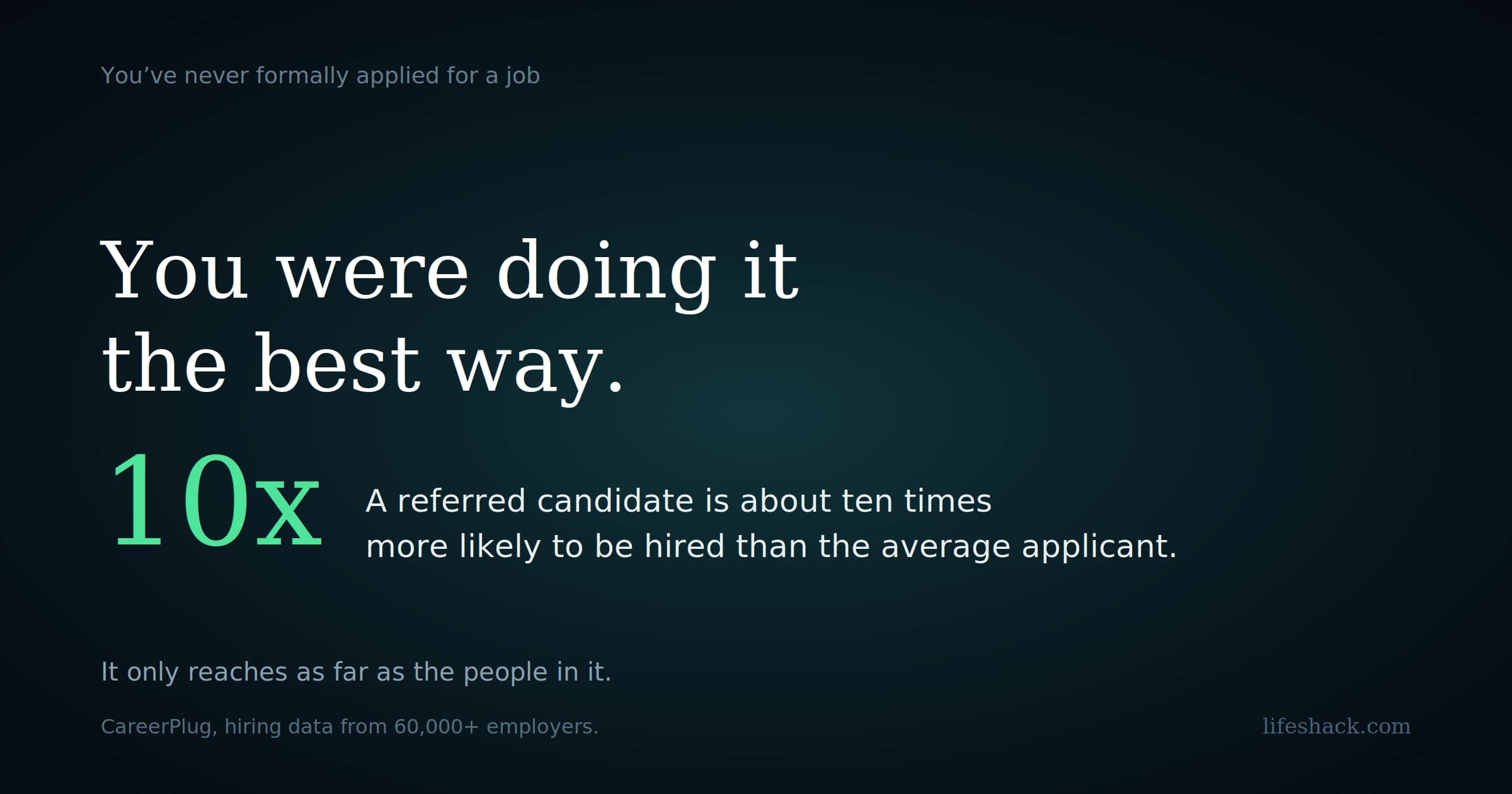
That is not a gap in your experience. Referrals are the highest-converting route into a job by a wide margin.
CareerPlug's analysis of hiring across more than 60,000 small businesses found referrals accounted for 2% of applicants and 11% of hires, which makes a referred candidate roughly ten times more likely to be hired than the average applicant. Longstanding industry figures put referrals at around 7% of applications and close to 40% of hires. Referred candidates also move faster, with time to hire running near 28 days against 39 to 55 days through other channels.
So the method you have used your whole career is the one recruiters wish more people used, and its limitation is narrower than it looks.
Where your method stops
A referral network reaches exactly as far as the people in it. That boundary moves with your career and it has edges you cannot see from inside it.
It covers your industry and not the one you want to move into. The further the role sits from what you have done, the less your network knows anyone there.
It covers your city. Relocation puts you outside it entirely.
It thins as people retire or leave. A network built over fifteen years loses density every year you do not maintain it.
It cannot reach companies where you have no connection at all, which for most people is almost all of them.
Keep the referral route as your first channel and build a second one for everywhere it does not reach, since that second channel is a mechanical skill you have never had reason to learn.
Building a resume from nothing
You may not have one. People who have never formally applied frequently do not, or have something assembled years ago for a board bio or a conference program.
One page per decade of work, up to two pages. Two is normal at senior level and a third is not.
Contact block at the top. Name, city and state, phone, email, LinkedIn URL. No street address.
Skip the objective statement. It went out of use years ago and uses the most valuable space on the page.
Experience, newest first. Company, title, dates, then three to six bullets. If you held several roles at one employer, list each separately under the company name so the progression is visible rather than flattened into one block.
Bullets describe outcomes rather than responsibilities. What changed because you were there, with a number attached. Revenue, headcount, cost, time, percentage. This is the part people who have never written a resume find hardest, because internally everyone already knew what you did.
Education at the bottom, with the degree and institution. Leave the year off if it was more than fifteen years ago.
Skills as a short plain list, using the words job postings use.
Save as PDF with your name in the filename. Software reads single-column documents with standard headings and standard fonts. Columns, tables, text boxes and graphics get scrambled.
Write the long version first, with everything you have ever done, then cut. Cutting is easier than remembering.
What happens when you apply cold
Applications now go into software the employer uses to collect and sort them. It is called an applicant tracking system, usually shortened to ATS, and the large ones are Workday, Greenhouse, Lever, iCIMS and Ashby.
The sequence is short and worth knowing in full.
The software reads your resume into data fields. Titles, employers, dates, skills, stored separately from the document you attached.
It matches those fields against the job description, looking for the words the posting uses rather than the meaning behind them.
A recruiter sees a ranked shortlist, not every application. A posting that draws six hundred applicants might produce a list of twenty.
A person reads your resume at that point, having had no sight of it earlier.
Two consequences follow. Your resume has to use the posting's own vocabulary to survive the matching step. And the first human judgment anyone makes about you happens after a machine has already formed one.
The rejection that will surprise you
At some point in the next few weeks you will be rejected by a company you were obviously qualified for, within hours, without speaking to anyone.
This happens to everyone who applies cold and it is worth being ready for, because nothing in a career built on reputation prepares you for it.
The usual causes are mechanical. A screening question ruled you out, meaning location, salary expectation, work authorization, or a required certification. The software could not parse your resume. Your experience was described in words the posting did not use. Or the role was filled from an internal candidate or a referral before your application was read.
None of those is an assessment of your work. The machinery cannot assess your work, because it has no access to the thing your whole career has rested on, which is that people who worked with you know what you are like.
Two things follow from that. Apply through the employer's own careers page rather than a job board wherever both exist, since CareerPlug's data found careers page applicants about four times more likely to be hired. And treat each cold application as a low-probability ticket rather than a referendum on your career.
Your reputation does not travel
This is the adjustment senior people find hardest, and it is not about the resume.
Inside your company, your reputation did the work. People knew what you had handled, how you behaved under pressure, and what you were worth. You never had to say it because saying it would have been strange.
Outside, none of it is visible. A stranger reading two pages has no access to fifteen years of accumulated credibility, and the modesty that served you internally reads externally as a thin record.
Say the thing you would never say internally. Scope, budget, headcount, outcomes. State it plainly rather than implying it.
Give the number. "Grew the division" is what you would say to a colleague who already knows the number. A stranger needs the number.
Explain context a stranger lacks. A title that meant a great deal at your company may mean nothing elsewhere. Describe the scope rather than relying on the title.
Prepare the stories. Interviewers ask for specific situations. People who were promoted internally are frequently out of practice at narrating their own work, because it was observed rather than described.
What you are worth
If you have never been hired through an open process, you have probably never had your pay set by the market. Internal raises compound from wherever you started, which means a long tenure can leave you well below or occasionally above market for your scope.
Find out before anyone asks. Look at posted ranges for the role you want in your city, since pay transparency laws now require ranges in many states. Ask two people in your field what the band looks like. Decide on a number before an application form asks you for one, because several will.
Running both channels
Most job search advice assumes cold applications are all you have, which makes the standard plan the wrong one for you.
Lead with the network, deliberately. List everyone who could introduce you somewhere, tell them specifically what you are looking for rather than that you are looking, and ask for introductions rather than jobs. This remains your highest-converting channel.
Use cold applications for the territory your network does not cover. New industries, new cities, and companies where you have no connection.
Apply on careers pages where you can. Four times the hire rate of job board applications in the data above.
Expect the ratio to be lopsided. A handful of warm paths may produce more interviews than fifty cold applications. That is the expected outcome rather than a sign the cold applications are failing.
The part that becomes a second job
The network side takes conversations, which you are good at, while the cold side takes volume, which is where this stalls.
Each cold application takes roughly an hour. You create an account with that employer, because there is no shared profile between them. You retype your work history into boxes even though your resume is attached. You answer the screening questions, adjust the resume to the posting, and log what you sent.
Covering the territory your network does not reach takes dozens of these, and the hour each is why most people abandon the second channel and go back to waiting on the first.
LifeShack handles that side. It searches for roles matching your background and constraints, tailors the resume and cover letter to each posting, submits across the systems employers use, including Workday, Greenhouse, Lever, iCIMS and Ashby, and keeps every application in one place.
That leaves you running the channel you have always been good at, with the second one covered rather than abandoned.
Frequently asked questions
Is it bad that I have never formally applied for a job? No. Referrals and internal moves are the highest-converting routes into a job. CareerPlug found referrals made up 2% of applicants and 11% of hires, and industry figures put referrals at roughly 40% of all hires despite around 7% of applications. The gap is a mechanical skill rather than a career problem.
How do I write a resume if I have never had one? Two pages at most. Contact block, experience newest first with outcomes and numbers in the bullets, education with the degree and institution, and a short plain skills list. Write everything down first and then cut.
What is an ATS? The software employers use to collect and sort applications. It reads your resume into data fields, matches those fields against the job description, and produces a ranked shortlist for a recruiter. Workday, Greenhouse, Lever, iCIMS and Ashby are common ones.
Why was I rejected within hours without talking to anyone? Usually a screening question ruled you out on location, salary, work authorization or a certification, or the software could not match your experience to the posting's wording. It is a mechanical outcome rather than an assessment.
Should I apply on a job board or the company's website? The company's own careers page where both exist. CareerPlug's data found careers page applicants roughly four times more likely to be hired than job board applicants.
Should I keep using referrals or learn to apply properly? Both, with referrals first. Your network remains the highest-converting channel, and cold applications cover the companies and cities your network does not reach.
How do I talk about my accomplishments without sounding arrogant? State scope and outcomes as facts with numbers attached. The restraint that works internally, where people already know what you did, reads as a thin record to a stranger with two pages in front of them.
How do I know what salary to ask for? Check posted ranges for the role in your city, since many states now require them in job postings, and ask two people in your field. Decide the number before an application form asks, because several will.
Sources
CareerPlug Recruiting Metrics Report, based on hiring data from more than 60,000 small businesses. Jobvite and subsequent industry benchmarking on referral share of applications and hires. SHRM and vendor benchmarking on time to hire by source. SmartRecruiters 2025 Recruiting Benchmarks on applicant volume and review timing.