Returning to Work After a Caregiving Break
by Patrick Da Costa Guimarais • Last Updated 10/6/2026
By Patrick Da Costa Guimarais, founder of LifeShack. Updated October 2026.
The advice you have probably been given about the gap is split between two bad options. Hide it with a functional resume format, or explain it at length and hope for sympathy.
Neither works, and the reason is mechanical rather than attitudinal.
What the software does with a gap
Most of the fear here attaches to applicant tracking systems, and it is largely misplaced. Two separate layers are involved and people conflate them.
The parsing layer does not have a gap rule. When your resume enters an employer's system, the software extracts your employment dates, stores them, and totals your months of experience. It matches keywords from your resume against the job description and produces a score. There is no instruction anywhere that says a gap of more than six months triggers a rejection, because these systems organize and rank rather than decide.
What a gap does affect is the arithmetic. Your total months of experience is a number the system can calculate, and a two-year break makes that number smaller. If a role screens on years of experience, that matters. The gap itself does not get flagged as a defect.
The newer AI layer is less settled. Many employers now run a language model over applications to summarize and rank them before a recruiter opens the shortlist. That layer is less transparent than keyword matching, and whether it treats gaps neutrally is an open question rather than a resolved one. Treat it as a reason to label the break clearly rather than a reason to hide it.
Human review is where a gap gets read. It becomes visible when a person looks at your dates, which is the stage where the explanation matters.
The practical conclusion is that your energy belongs on keyword match and on labeling the break, rather than on concealment.
Why hiding it backfires
The standard advice for gaps is the functional resume, which organizes your experience by skill category rather than chronologically, and it is the wrong move.
Hiring managers distrust the format precisely because it is associated with concealment, and applicant tracking systems parse it badly, since they are built to read a chronological work history. You lose on both layers at once.
Using years only instead of month and year is the other common trick, and it tends to surface anyway. A recruiter who notices inconsistent date formatting across a resume reads it as something being managed rather than something being reported.
Consistent month and year throughout, with the break listed, is the version that holds up.
Putting the break on the resume
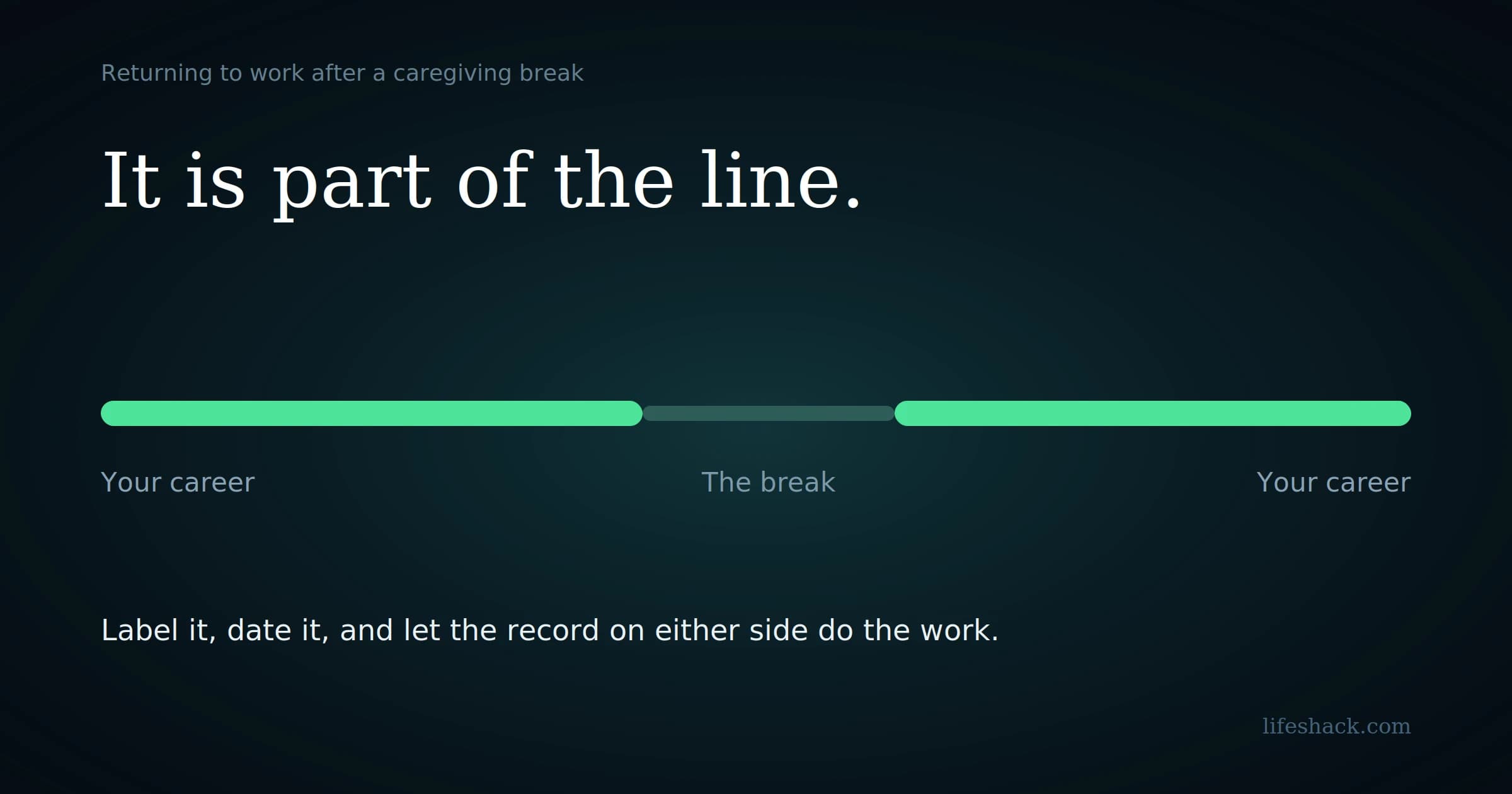
List it as an entry. A line in your work history reading Career Break, with the dates and a short descriptor such as full-time family caregiving. Two to six words. It occupies the space, it explains the dates, and it stops a reader from wondering.
Put anything structured underneath it. Volunteer roles, freelance or contract work, courses, certifications, board or committee positions. One line each. This is the part that does genuine work, because it shows the dates are not empty.
Keep the rest of the resume conventional. Reverse chronological, standard section headings, single column, saved as a PDF. Your break is one entry in a normal resume rather than the thing the resume is organized around.
Lead with your pre-break record. That is the asset. Years of professional work do not evaporate, and a hiring manager reading a strong track record followed by a labeled break reads a career with an interruption in it.
Use LinkedIn's career break feature. The platform added a dedicated option in 2022 covering categories including caregiving, specifically to normalize this. It appears in your experience section as a legitimate entry rather than a hole.
What to claim from the break, and what to leave out
Do not translate domestic work into corporate language. Household budgeting is not financial management, and a family calendar is not program management. Recruiters have read these and they recognize the inflation. It also makes a strong candidate look like a weak one, because inflated claims invite scrutiny that genuine ones do not.
Do claim anything structured that you would describe the same way to a colleague.
Volunteer work that carried responsibility. A treasurer role, a committee you chaired, a program you ran, a fundraising target you hit. Describe it the way you would describe a job, with scope and outcomes.
Freelance, contract or part-time work, however small. Two clients is two clients.
Courses, certifications and licenses. These do double duty, since they put current keywords on the page.
Professional association membership, conference attendance, anything that kept you connected to the field.
Complex care coordination counts when it was substantial. Managing a parent's treatment across multiple providers, appealing insurance decisions, administering benefits and finances for someone unable to do it themselves. That is substantive administrative and advocacy work. Describe it plainly rather than dressing it up, and only claim it if it was the scale of thing you would mention to a peer.
What did not happen does not go on the resume. A break that was consumed by caregiving with no room for anything else is a normal thing, and padding it is worse than leaving it plain.
Saying it out loud
You will be asked, so prepare two sentences and deliver them without apology.
Name the reason briefly, say it has concluded, and move to what you want next. "I took two years out to care for my father full time. That ended last spring and I'm looking to get back into operations work, which is what I did for the eleven years before that."
Three things to avoid. Do not over-explain, because length signals discomfort. Do not apologize, because there is nothing to apologize for. And do not volunteer current caregiving obligations you have not been asked about, since your availability is a fair question and your family circumstances are not.
If you are asked whether you can commit to the role, answer that question directly rather than the one underneath it.
Return programs exist
A number of large employers run formal return-to-work programs, sometimes called returnships, designed for people coming back after an extended break. They typically run a few months, pay, and convert to permanent roles at a reasonable rate.
They are concentrated in finance, technology, consulting, engineering and pharmaceuticals, and they are far less competitive than a general opening because the eligible pool is small. If your break was over a year, search for these specifically alongside standard applications, since they are the one route built for your exact situation.
What changed while you were out
If your break ran more than two or three years, the mechanics of applying shifted underneath you.
Applications now go into software the employer runs, usually Workday, Greenhouse, Lever, iCIMS or Ashby. You create an account with each employer rather than having one profile. You retype your work history into fields even though your resume is attached. Screening questions covering location, salary and work authorization filter mechanically before anyone reads anything. Rejections generally produce no notification at all, so silence is the normal outcome rather than a signal.
Applying early also matters more than it used to. Median time to first review in the US is around six days, and a posting you reach in week three has usually produced a shortlist already.
The volume problem
Returning after a break usually means applying more widely than you did last time, both because you are re-establishing and because response rates per application have fallen generally.
Each application runs close to an hour once you count finding the role, tailoring the resume, the screening questions and creating another account. Doing that forty or sixty times is where a return to work stalls, particularly when the caregiving that caused the break has not entirely ended.
LifeShack handles that layer. It searches for roles matching your background and constraints, tailors the resume and cover letter to each posting, submits across the systems employers use, including Workday, Greenhouse, Lever, iCIMS and Ashby, and keeps every application in one place.
What stays with you is the two sentences, the conversations, and the record you built before the break.
Frequently asked questions
Do applicant tracking systems reject resumes with employment gaps? No. The parsing layer extracts your dates, totals your experience and matches keywords against the job description. There is no rule that rejects a resume for a gap. A gap does reduce your calculated total experience, and it becomes visible to a person during review.
Should you hide a career gap on your resume? No. The functional resume format usually recommended for this is distrusted by hiring managers and parses badly in applicant tracking systems, and inconsistent date formatting tends to surface anyway. List the break as an entry with consistent month and year dates.
How do you list a career break on a resume? As a work history entry reading Career Break with the dates and a short descriptor such as family caregiving, with any volunteer work, contract work, courses or certifications listed underneath it.
How do you explain a caregiving gap in an interview? In two sentences. Name the reason briefly, say it has ended, and move to what you want to do next. Length reads as discomfort and an apology invites a problem that was not there.
Can you put caregiving on a resume as experience? Claim structured activity, meaning volunteer roles, contract work, courses, and substantial care coordination such as managing treatment across providers or appealing insurance decisions. Avoid translating ordinary household work into corporate titles, which recruiters recognize and discount.
Do employers care about career gaps in 2026? Far less than they did. Attitudes shifted substantially after 2020, and LinkedIn added a dedicated career break feature in 2022 covering caregiving among other categories, which is a reasonable indicator of how normal this has become.
What is a returnship? A paid return-to-work program for people coming back after an extended break, typically running a few months and converting to permanent roles. They are concentrated in finance, technology, consulting, engineering and pharmaceuticals, and the applicant pools are small.
How long a gap is too long? There is no threshold at which a break disqualifies you. What matters is that it is labeled, that anything structured you did during it is listed, and that your record before it is presented strongly.
Sources
LinkedIn career break profile feature, introduced 2022. Published guidance from applicant tracking system vendors and recruiting practitioners on resume parsing, date extraction and experience calculation. SmartRecruiters 2025 Recruiting Benchmarks on review timing. Greenhouse recruiting benchmarks on application volume.