Data Science Internships: Opportunities and Application Guide
by Patrick Da Costa Guimarais • Last Updated 9/28/2026
By Patrick Da Costa Guimarais, founder of LifeShack. Updated September 2026.
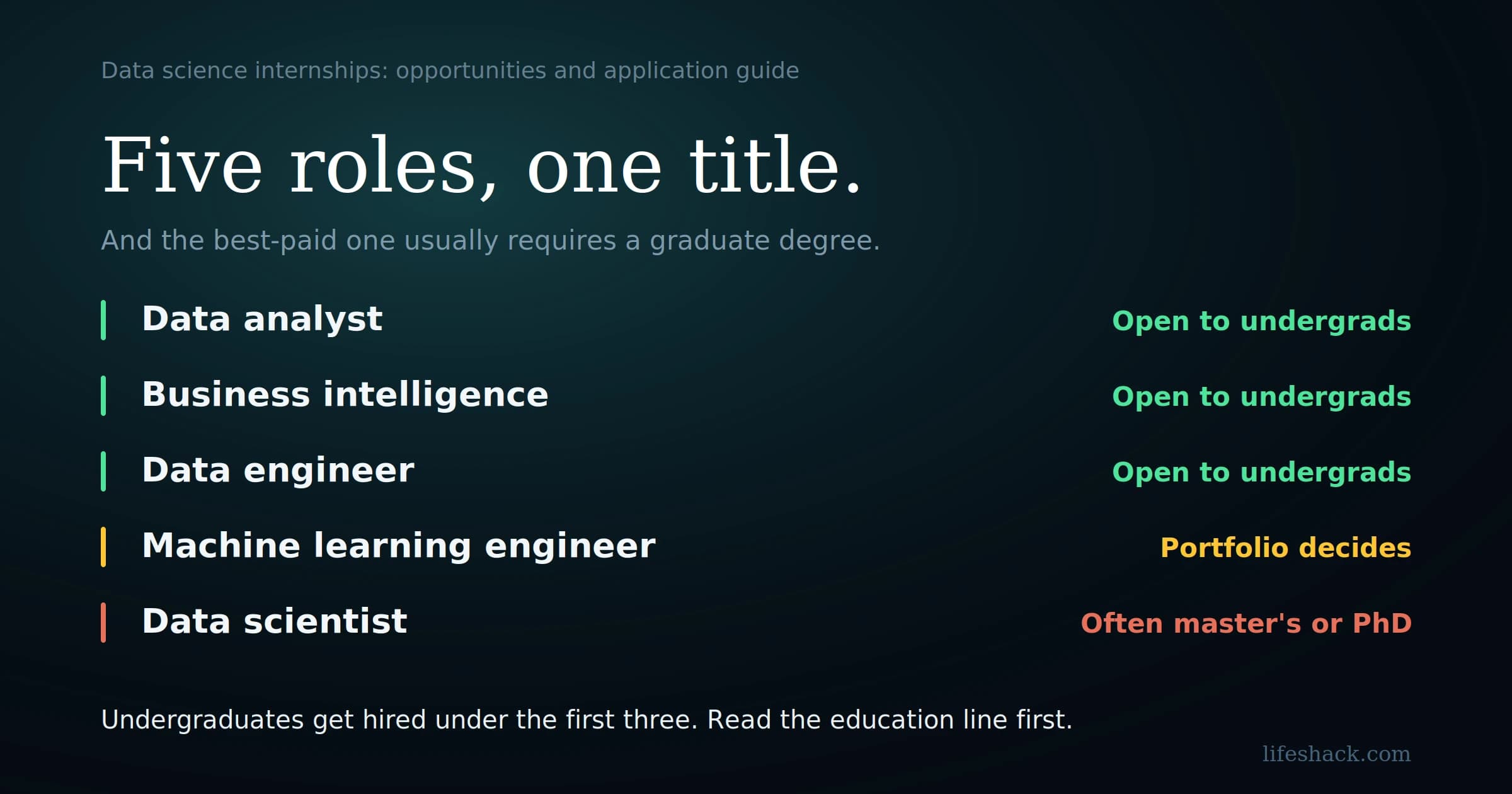
"Data science internship" is not one job. At least five distinct roles recruit under that phrase, they screen for different things, and the one titled data scientist is frequently the one an undergraduate is least eligible for.
That mismatch is the most expensive mistake in this track. A student spends a semester building deep learning projects, applies to roles requiring a master's degree, and never finds out why nothing came back. The roles hiring undergraduates in volume sit under different titles, screen for a skill that student underweighted, and go to people who understood the distinction.
This guide covers which of the five you should be applying to, the skill stack weighted by what gets tested, what makes a portfolio project count when every applicant has the same three, and how AI tooling changed what employers expect this cycle.
The five jobs hiding under one title
Data analyst. SQL, Excel, and a visualization tool like Tableau or Power BI. The question is what happened and why. This is the most accessible path for undergraduates from any quantitative or business major, and entry-level compensation runs roughly $60,000 to $75,000.
Data scientist. Python or R plus statistical modeling and machine learning. The question is what will happen next. Entry-level compensation runs roughly $90,000 to $110,000, and postings frequently prefer or require graduate coursework in statistics, machine learning, or computer science.
Machine learning engineer. Building, training, and deploying models. Deeper mathematics, meaning linear algebra and probability, plus framework knowledge in PyTorch or TensorFlow. According to Extern's job data from August 2026, machine learning interns showed a median of roughly $88,400 annualized across 55 postings that disclosed salary, against roughly $52,000 for data science interns.
Data engineer. Pipelines, warehousing, and infrastructure. Heavier on software engineering than on statistics, and consistently underapplied relative to how many openings exist.
Business intelligence and analytics. Dashboards, reporting, and metrics definition. Closest to the business, lightest on modeling, and a common entry point that converts well into data science roles later.
The salary ordering explains the behavior. Students target the titles that pay most and apply hardest to the ones they are least likely to get.
Which one you are eligible for
Read the education line before anything else. The wall in this track is stated plainly in postings and ignored just as plainly.
Databricks' data science intern posting, as one example of the pattern, specifies graduation with a master's or PhD in a quantitative field. Roles like that are not a stretch for a strong undergraduate. They are a filter that runs before anyone reads your portfolio.
If you are an undergraduate, your highest-conversion targets are data analyst, business intelligence, and data engineering roles, plus data science internships explicitly labeled for undergraduates. Apply to a handful of the harder ones, and do not build the search around them.
The reassuring part is that the accessible path is not a lesser version of the field. Most data analytics interns come from business, economics, mathematics, psychology, and engineering backgrounds rather than from data science programs specifically. The degree title matters far less than the demonstrated skill.
And the ceiling is not what it looks like. An internship titled data analyst that gives you production SQL against real data and a stakeholder to present to produces a stronger second-year application than a data science title with no output. The first internship buys you the second one.
The skill stack, weighted honestly
Students consistently over-invest in the top of this list and under-invest in the bottom, which is the reverse of how technical screens are weighted in practice.
SQL is first and it is not close. It appears in nearly every posting across all five roles, it is what most technical screens test, and it is the skill students most often claim at a level they cannot defend. Joins, aggregations, window functions, and CTEs. If you cannot write a query returning the second-highest value in a table without looking it up, start here regardless of what else is on your resume.
Python second. Pandas and NumPy for manipulation, matplotlib or seaborn for visualization. R is fine and Python is the safer single bet.
Statistics third. Distributions, hypothesis testing, confidence intervals, regression. Interviewers ask about these because they separate people who ran a model from people who understood it.
Visualization and communication fourth. Tableau or Power BI, plus the ability to explain a finding to someone who does not want to open a dashboard. This is the most underrated item on the list because it is the one that determines whether your analysis gets used.
Machine learning fifth. Necessary for machine learning engineer roles and considerably less central than students assume for data science and analyst roles. A well-executed regression you can explain beats a neural network you cannot.
Cloud and big data tools last. Spark, Snowflake, dbt, and similar. Worth listing if you have used them and not worth a semester before the four items above are solid.
What makes a portfolio project count
Two to three real projects on GitHub is the standard expectation, and the word doing the work in that sentence is real.
Every reviewer in this field has seen the Titanic survival model, the iris classification, and the MNIST digit recognizer several hundred times. They demonstrate that you followed a tutorial. They are not portfolio projects and including them is mildly negative, because it signals you did not know the difference.
Four properties separate a project that counts.
The data is messy and you got it yourself. Scraping, an API, a public records request, a municipal open data portal. The cleaning is where the skill shows, and a dataset that arrived clean skipped the part being evaluated.
There is a question, not just a technique. "I predicted X" is a method. "I wanted to know whether Y affects Z, and here is what the data says" is an analysis. The second is what the job is.
There is a written conclusion in plain language. A README explaining what you found, what surprised you, and what the limitations were. Most portfolios are code with no argument, which fails the communication test before an interview happens.
Somebody could act on it. A finding with an implication attached reads as professional work. A model with an accuracy score reads as coursework.
One project meeting all four beats five that meet none. If you want a shortcut to the first property, use data from a domain you already know, since domain knowledge is what lets you spot the question worth asking.
AI tooling changed what is expected
This is the part of the field that moved most recently and the part most guides have not caught up to.
Through 2025, using AI assistance on technical work was treated as suspect. That position has collapsed. Employers now expect interns to work with AI-assisted analysis and coding tools rather than writing every query from scratch, and familiarity with them has moved from a differentiator to a baseline.
The practical implications are specific.
Use the tools and understand the output. The failure mode in interviews is a candidate who produced something they cannot explain line by line. The screen has shifted toward judgment and verification rather than recall.
Name them where you used them, the same way you would name any tool in your stack. Hiding it reads worse than using it.
The skill being evaluated moved up a level. Writing a join is now cheap. Knowing which join, spotting when the result is wrong, and catching a subtle error in generated code is the thing being tested.
What did not change is that you still have to know SQL. AI tooling raises the floor on output and raises the bar on verification, and a candidate who cannot read a query cannot verify one.
The technical screen
Most processes in this track run some version of the same sequence.
A SQL assessment, frequently timed and frequently the first gate. Joins, aggregation, and window functions dominate.
A take-home or case, where you are given a dataset and a loosely specified question. Scoring weights your framing and your written conclusion at least as heavily as your technique, and a large share of candidates spend all their time on modeling and submit no written summary.
A technical interview covering statistics fundamentals, your projects in depth, and sometimes live coding. The project questions are where thin portfolios fail, because a project you did not really do cannot survive four follow-up questions.
A behavioral round on collaboration and communicating with non-technical stakeholders.
Prepare in that order, since the SQL gate eliminates candidates before anything else is observed.
Timing and where these are posted
Data roles do not run a centralized recruiting calendar the way consulting and banking do, which cuts both ways.
Large technology employers open summer internship applications roughly August through October of the preceding year, with some windows short enough to close within weeks.
AI labs and research groups post on a rolling basis with brief windows and no predictable season.
Startups and mid-size companies hire year-round and post four to eight weeks before a start date, which makes them the largest and least visible part of the market.
Non-technology employers hiring analysts, including banks, insurers, healthcare systems, retailers, and government agencies, run their own calendars and are consistently underapplied. A retailer's pricing analytics team is doing real data work and receiving a fraction of the applications a technology company's posting attracts.
Because there is no central calendar, alerts and direct career-page checking matter more here than in any other track. Community-maintained repositories tracking technical internship postings are also unusually good in this field, frequently surfacing roles before the large aggregators index them.
The volume problem in this track specifically
Technology internships drew an average of 273 applications per posting in Handshake's 2024-25 data, the highest of any category and more than double the all-internship average of 109.
Two things follow. Your conversion rate per application is structurally lower here than in any other track, so the number of applications required to produce interviews is higher. And the sourcing burden is heavier, because the postings are scattered across company career pages, rolling AI lab windows, startup listings, and non-technology employers who never appear on a technical job board.
So the working plan is a wider target list than other tracks require, refreshed constantly, with applications going out in the first days of a posting rather than the third week.
Each application runs roughly an hour once you count finding the role, tailoring, and the twenty to forty minutes every applicant tracking system takes, since each one wants an account created and a work history retyped into fields your attached resume already contains. Eighty applications is eighty hours, which is not a thing a student carrying a full course load has available alongside building the portfolio that gets them hired.
LifeShack handles that layer end to end. It searches for roles matching your background and constraints, tailors the resume and cover letter to each posting, submits across the eleven-plus applicant tracking systems these employers run on, including Workday, Greenhouse, Lever, iCIMS, and Ashby, and keeps every application in one place. There is no queue of drafts waiting on your approval and no point where the form comes back to you.
What stays with you is the portfolio, the SQL, and the ability to explain what you found. Those are what the screens test, and they are where a semester is worth spending.
Frequently asked questions
What do you need for a data science internship? SQL first, Python second, statistics fundamentals third, and a portfolio of two or three projects using data you sourced and cleaned yourself. Machine learning matters less than students assume for analyst and data science roles and is central for machine learning engineering.
Can you get a data science internship as an undergraduate? Yes, and many roles titled data scientist specify a master's or PhD, so read the education line first. Data analyst, business intelligence, and data engineering roles hire undergraduates in far greater volume and build the same foundation.
Do you need a data science degree? No. Most data analytics interns come from business, economics, mathematics, psychology, and engineering backgrounds. Demonstrated skill and a portfolio outweigh the degree title.
What projects should be in a data science portfolio? Projects where you sourced messy data yourself, asked a specific question rather than demonstrating a technique, wrote a plain-language conclusion, and produced a finding someone could act on. Avoid Titanic, iris, and MNIST, which every reviewer has seen hundreds of times.
Is SQL or Python more important for data science internships? SQL, by a clear margin at the internship level. It appears in nearly every posting and it is what most first-round technical screens test.
Is it acceptable to use AI tools in data work now? Yes, and employers increasingly expect it. What gets evaluated is whether you can verify and explain the output, which means you still need to know the underlying skill well enough to catch an error.
When do data science internship applications open? Large technology employers open roughly August through October for the following summer. AI labs post on a rolling basis with short windows. Startups and non-technology employers hire year-round, frequently four to eight weeks before a start date.
How competitive are data science internships? Technology postings averaged 273 applications each in Handshake's 2024-25 data, against an all-internship average of 109. Expect a lower conversion rate per application than in other tracks and plan a wider target list accordingly.
How much do data science interns get paid? Compensation varies widely by role and employer. Extern's August 2026 job data showed machine learning interns at a median of roughly $88,400 annualized across postings disclosing salary, with data science interns closer to $52,000. Analyst roles generally sit below data science roles, and large technology employers pay well above these medians.
Sources
Handshake 2025 Internship Index and Handshake Internship Report 2026. NACE 2026 Internship & Co-op Report. Extern Job Data Center, August 2026, on disclosed intern compensation. Published internship postings from Databricks and other employers referenced as examples of stated requirements.