Founder going back to full time job
by Patrick Da Costa Guimarais • Last Updated 10/6/2026
Going Back to a Full-Time Job After Running Your Own Business
By Patrick Da Costa Guimarais, founder of LifeShack. Updated October 2026.
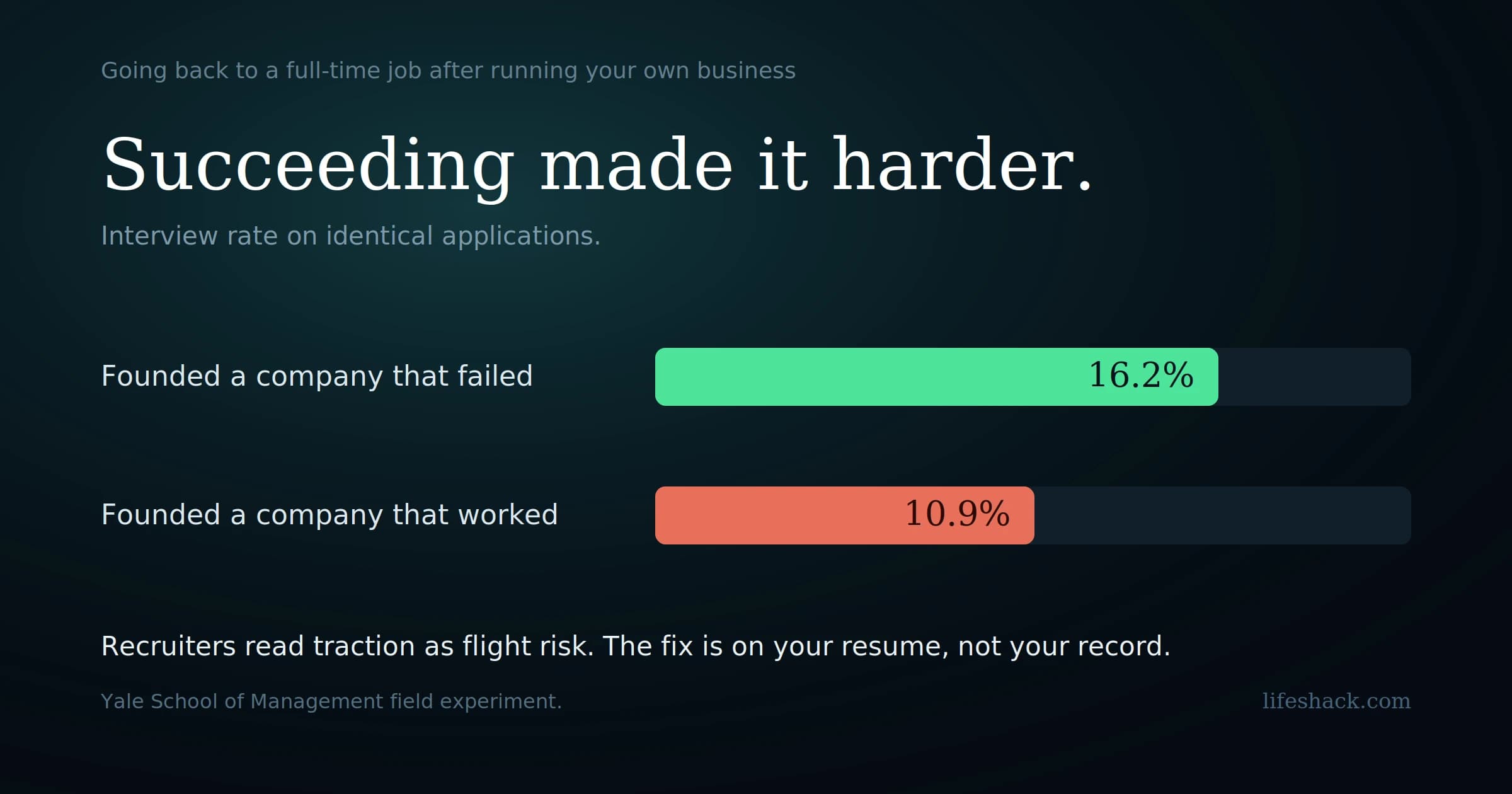
A Yale School of Management field experiment sent applications to real job openings using profiles that were identical except for founder experience. Candidates who had founded a successful startup received interviews 10.9% of the time. Candidates who had founded a failed startup did better, at 16.2%. Candidates with no founder experience did better than both.
Success made it worse, which is the opposite of what most founders assume and which tells you what the resume has to solve.
The disadvantage is well documented beyond that single study. Research from London Business School found former entrepreneurs roughly 35% less likely to receive an interview. A Rutgers study found 60% of recruiters responded less favorably to the mock resume of a former entrepreneur.
What recruiters are worried about
The concern is fit and commitment rather than capability. Nothing in these studies suggests recruiters doubted that founders can do the work. A recruiter is measured on the quality and retention of the people they hire, and a founder reads as someone who will struggle to take direction and may leave within a year to start something else. One recruiter in the Yale research described founders as looking like aliens.
That explains the success paradox. A founder whose company did well reads as more likely to go back and do it again, and as more likely to have fixed ideas about how things should be run. Traction, which is the thing you are proudest of, is the thing amplifying the concern.
So the work ahead is removing ambiguity about scope and answering the commitment question before anyone has to ask it, rather than proving you are capable.
The title decision
Your entry says Founder, or Owner, or CEO. That single word is doing several unhelpful things at once. It conveys no scale, it suggests you will not report to anyone, and it does not match the keyword a recruiter searched for.
Lead with the function and keep the ownership as a tag. Head of Operations and Co-Founder. Founder and Head of Product. Owner and General Manager. The functional half matches what the posting is hiring for and gets you through keyword matching. The founder half keeps it accurate.
Do not delete the ownership entirely. Older advice says to call yourself a manager and leave the founding out. That advice predates the era when your LinkedIn profile, your company registration and your public history are a search away, and a discrepancy found at reference stage costs you more than the title ever did.
Match the functional title to the role you are applying for, within the bounds of what is true. If you ran everything and you are applying for a finance role, the finance work was part of your job and leading with it is honest.
Supply the scale the title hides
Founder is unreadable without numbers. The same word covers a side project with no revenue and a company with eighty employees, and a screener has no way to tell which you were.
Put the scale in the first line under the company name. Revenue or revenue range. Headcount including contractors. Customers or clients served. Funding raised, if you raised. Years in operation. Markets or locations.
A reader who knows you ran a company doing $4M with eleven people has a frame. A reader who sees Founder and CEO with no numbers assumes the smallest version, because that is the most common one. It takes ten minutes to fix and it changes how every bullet beneath it reads.
Translate what you did into the language of the job
Founders write resumes in founder language. Built, launched, bootstrapped, scaled, wore every hat. None of that matches a job description, and the breadth that feels like your strongest asset reads as unfocused to someone hiring for one function.
Pick the function the job is hiring for and write to it. If you are applying for a head of operations role, the bullets should be the operations work: the processes you built, the vendors you managed, the margins you moved, the systems you implemented. The rest of what you did goes in a shorter supporting section or comes out.
Use the posting's vocabulary. You ran demand generation and called it getting customers. A posting says demand generation. Where the underlying work matches, use their words.
Attach numbers the way an employee would. Give the functional result rather than the whole-business framing a founder reaches for. Cut cost of delivery by 22%. Grew recurring revenue from $300K to $1.1M over two years. Reduced churn from 9% to 4%.
Cut the parts that were thin. A founder who lists everything invites the reader to notice which lines are hollow. Three strong functional areas beats nine shallow ones.
Answer the commitment question before it is asked
This is the specific thing the research says is blocking you, and it is the thing founders most often leave unaddressed because raising it feels like conceding a weakness.
Put two sentences in the cover letter and have a longer version ready for the interview. Say why the business ended or why you left it. Say what you want now, in terms of depth rather than relief. And be concrete about what the role gives you that running your own thing did not.
"I ran the business for six years and sold the client list last spring. What I missed was working on one problem at the level you can only reach with a team around you, which is what this role is." That answers the question without apologizing for the six years.
Two things to avoid. Do not say you are tired of the risk, since it implies you will return to it when you recover. And do not oversell how much you loved being your own boss, which confirms the concern precisely.
Where founder experience helps
The same body of research found former entrepreneurs face less bias when applying to roles that look entrepreneurial, meaning the stereotype works in your favor. Recruiters who have founded something themselves were also the most open to hiring founders.
That is a target list rather than a consolation prize.
Early-stage and growth-stage companies, where the founder is still in the building and the hiring manager has lived your last five years.
Roles with general management scope, where breadth is the requirement rather than a liability.
New business lines and zero-to-one roles inside larger companies, which are explicitly looking for someone who has done it without infrastructure.
Functions where your business was the customer. If you bought the software, sold to the industry, or worked the supply chain, you know the buyer better than most candidates will.
Companies founded by former operators, which you can usually tell from the leadership page in two minutes.
A general application to a mature enterprise is the hardest version of this. Weight your list toward the contexts where your history reads as evidence.
References when you never had a boss
You have no manager to call, which the process assumes you do.
Investors and board members, if you had them. Major customers or clients, who can speak to delivery and reliability better than a manager often can. Vendors and partners you worked with over years. Senior contractors or employees who reported to you, which is unusual as a reference and speaks directly to whether you are workable.
Line these up before you need them and tell each person what the concern is likely to be, so they can address it rather than only praising you.
What the role should pay
Founders frequently have no calibration here, because they were either paying themselves nothing or taking distributions that bear no relation to a salary band.
Look up posted ranges for the role in your city, since many states now require them in postings. Ask two people doing the job. Decide your number before an application form asks for it, which several will.
Be ready for the number to be lower than your best year and higher than your worst. Neither is a judgment about the business.
The part that takes the longest
Everything above is one-time work. The title, the numbers, the translation, the two sentences.
What repeats is the application, at roughly an hour each once you count finding the role, tailoring, the screening questions and creating another account with another employer's system. With founder experience working against your interview rate before you have said anything, the volume you need is higher than it would otherwise be, and that is where this stalls.
LifeShack handles that layer. It searches for roles matching your background and constraints, tailors the resume and cover letter to each posting, submits across the systems employers use, including Workday, Greenhouse, Lever, iCIMS and Ashby, and keeps every application in one place.
What stays with you is the judgment about where to aim, which given the research is the decision that matters most here.
Frequently asked questions
Does having founder on your resume hurt your chances? Yes, measurably. A Yale School of Management field experiment found successful startup founders received interviews 10.9% of the time against 16.2% for failed founders, with non-founders higher than both. London Business School research put former entrepreneurs around 35% less likely to get an interview.
Why do successful founders do worse than failed ones? Recruiters are measured on retention and fit, and a founder whose company succeeded reads as more likely to leave and start another one, and as more set in their own methods. The concern is commitment rather than capability.
Should you remove "Founder" from your resume? No. Lead with the functional title and keep the ownership as a secondary tag, such as Head of Operations and Co-Founder. Deleting it entirely creates a discrepancy against your public history that surfaces at reference stage.
How do you put running your own business on a resume? Give the functional title, then the scale in the first line, meaning revenue, headcount, customers, funding and years. Write the bullets to the function the job is hiring for, using the posting's vocabulary and functional metrics rather than founder language.
How do you explain why you are leaving entrepreneurship? In two sentences, framed around depth rather than relief. Say what ended and what you want now. Avoid saying you are tired of the risk, which suggests you will return to it, and avoid dwelling on how much you enjoyed autonomy.
What jobs are easiest to get as a former founder? Roles that look entrepreneurial, where the research shows less bias. Early and growth-stage companies, general management scope, zero-to-one roles inside larger companies, functions where your business was the customer, and companies run by former operators.
Who do you use as references if you were self-employed? Investors or board members, major customers, long-term vendors or partners, and senior people who worked for you. Brief each one on the commitment concern so they can speak to it directly.
Will I have to take a pay cut going back to employment? Possibly in either direction. Founder pay rarely tracks a salary band. Check posted ranges for the role in your city, since many states now require them, and settle on your number before an application asks.
Sources
Tristan Botelho, Yale School of Management, field experiment on founder experience and callback rates. London Business School research on interview rates for former entrepreneurs. Rutgers University School of Management and Labor Relations study on recruiter response to former entrepreneur resumes. US Department of Labor guidance on skills-first hiring.