How to Job Search After 10 Years at One Company
by Patrick Da Costa Guimarais • Last Updated 10/5/2026
By Patrick Da Costa Guimarais, founder of LifeShack. Updated October 2026.
Ten years of tenure means your last job search happened around 2016. That is a longer gap than it feels like, because almost every mechanical part of applying changed in that window, and none of it was announced.
Most of what you need to fix is formatting and translation rather than substance. The ten years are an asset that is currently packaged in a way that hides what is inside it.
Your resume reads as one job
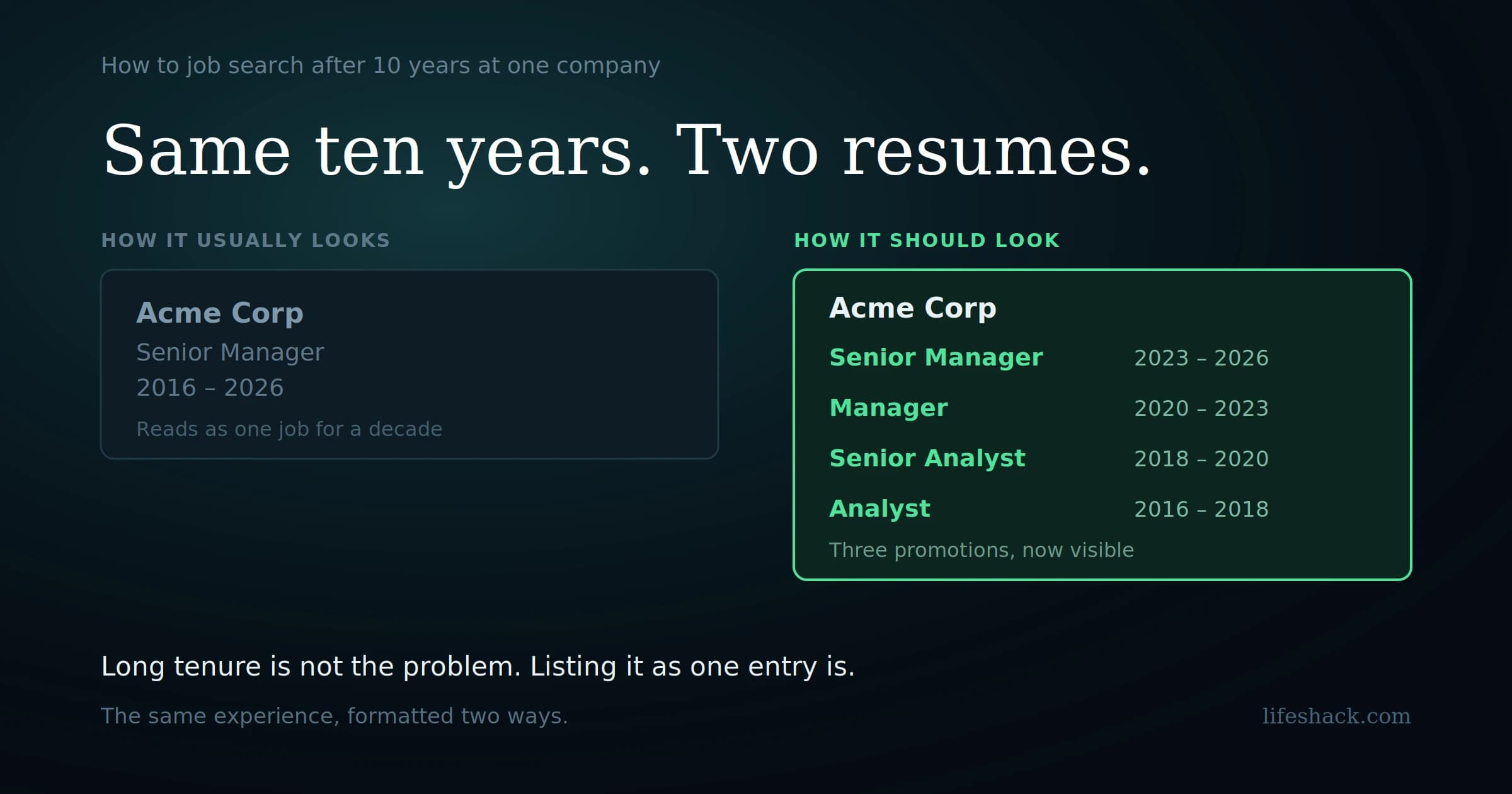
This is the change that moves the most and it rarely gets mentioned. A decade at one company usually appears on a resume as one entry, one date range, and one list of bullets. A recruiter reading it sees a person who did one job for ten years. What likely happened is that you held three or four distinct roles, took on more scope each time, and were promoted at least once.
The fix is to split it. List the company once, then list each role beneath it with its own title, date range and bullets. Promotions become visible, scope growth becomes visible, and the person reading it sees a progression rather than a plateau. The same block of experience converts very differently depending on whether that structure is there.
For each role, write the bullets to the scope you held at that level. The analyst-level bullets should sound like analyst work and the manager-level bullets should sound like manager work. Flattening ten years into one voice loses the arc.
Lead the current role with scale. Team size, budget, systems owned, revenue touched. Seniority is hard to infer from a job title alone when the title is internal to one company.
Your expertise is written in a language only your employer speaks
Ten years inside one organization means you absorbed its vocabulary without noticing. Internal system names, project codenames, team names, and the company's own terms for standard functions all feel like plain English to you and are invisible to everyone else.
Keyword matching does not recognize your internal name for a process. A recruiter does not know what your in-house platform was. Translating this is tedious and it is most of the gap between a strong candidate and a strong application.
Translate every internal term into the industry standard. If your company called its CRM by a codename, write the function and the underlying platform. If a project had an internal name, describe what it was.
Name the tools by their market names. You may have spent years in a system your employer licensed under a different label. Find out what it is called elsewhere and use that.
Benchmark your title. Internal titles drift from market norms over a decade. Look at how the same scope is titled at three other companies and describe yourself in terms a recruiter searching for that role would type.
What changed about resume format since 2016
The objective statement is gone. It occupied the most valuable space on the page to tell the reader you were seeking a role, which they knew. If you keep anything there, make it two or three lines of specific positioning.
Two pages is fine at your level. The one-page rule applies to people early in a career. Ten years of progression justifies two, and compressing it into one usually means cutting the evidence.
References available upon request is gone. It has been assumed for years and it uses a line you need.
Graphics, columns, skill bars and photos work against you. Parsers scatter or drop content inside tables and multi-column layouts, and a skills rating graphic conveys nothing a machine can read. Single column, standard section headings, standard fonts.
The address line is now city and state. A full street address reads as dated and serves no purpose.
Bullets need numbers. This changed in emphasis rather than in kind. A bullet describing a responsibility is weaker than one describing an outcome with a figure attached, and the gap between the two widened considerably.
LinkedIn works as a recruiter database
You almost certainly have an account, used the way most long-tenured people use it, as a contact list and a place to accept connection requests.
Recruiters use it as a database. They run searches with filters for title, skills, location and seniority, and your profile either appears in those results or it does not. That changes what the profile is for.
Treat the headline as a search field. Put the role you want and the two or three skills you want to be found for, in place of your internal title.
The About section should read as plain positioning. Three or four sentences about what you do and at what scale, since a wall of text here goes unread.
Skills are literal match criteria. Add the ones you have that appear in postings you want. This is one of the few places where listing a skill does mechanical work.
Turn on the setting that signals you are open to opportunities. You can restrict visibility to recruiters, and it changes whether you appear in the filtered searches they run.
Post or comment occasionally in the months before you search. Activity affects whether your profile surfaces, and a dormant account is a weaker search result than an active one.
What applying looks like now
In 2016 you emailed a resume or filled in a short form. Now nearly every employer runs an applicant tracking system, and the experience is heavier than you remember.
You create an account per employer, since there is no single profile that follows you between them. Workday in particular runs a separate tenant for each company, so applying to ten employers who use it means ten separate registrations.
You retype your history into fields. The form asks for your work history, dates and education even though your resume is attached and contains all of it. It is the largest recurring cost in a modern search and it produces nothing new.
You answer screening questions. Work authorization, salary expectation, location, notice period, sometimes a certification. These are structured fields filtered mechanically before anyone reads your resume, so getting one wrong voids the application regardless of fit.
Status updates mean very little. Portals show you a status that is manually updated, frequently in batches, and often not at all. Rejection generally generates no notification in these systems unless the employer sends one deliberately.
Apply early. Median time to first review in the US is around six days. A posting you get to in week three has usually produced a shortlist already.
One-way video interviews
This format did not exist in any mainstream way in 2016 and it is now common at the screening stage.
You are sent a link, given a set of prompts, and asked to record your answers with no interviewer present. You typically get limited preparation time per question and one or two takes.
It is uncomfortable for everyone and it is especially so for people used to reading a room.
Prepare the answers in advance. The standard prompts cover why this role, walk me through your background, a time you solved a hard problem, and a time you worked across teams. Write and rehearse those four.
Structure out loud. Say what you are going to cover, cover it, and stop. Without an interviewer nodding along, rambling has nothing to interrupt it.
Aim for 90 seconds to two minutes. Longer answers lose the reviewer, who is watching many of these in sequence.
Set up once, properly. Camera at eye level, light in front of you, plain background, and look at the lens rather than your own image on screen.
Your network is inside the building you are leaving
A decade at one employer builds deep relationships with people who cannot help you leave. The colleagues you know best are the ones you would be leaving, and the people who could refer you are former colleagues you have not spoken to in years.
Start with the leavers. Anyone who left your company in the last five years is both a warm contact and someone who has made the exact transition you are making.
Reconnect before you need something. A message asking how someone is finding their new company is a conversation. The same message with a request attached is a transaction.
Referrals do more than they used to. They operate on the resume screen, which is the stage application volume made hardest to pass, so one warm introduction is worth more now than it was in 2016.
What the ten years buy you
It is worth being clear about the other side of this, because long tenure gets discussed as a liability and it is not one.
You have depth that job-hoppers do not. You have seen decisions play out over years, watched initiatives fail slowly, and know what a system looks like after it has been in production for a decade. That is rare and it is interview material.
You are evidence of reliability. In a market where employers worry about retention, ten years is a strong signal, and a hiring manager will read it that way if you do not apologize for it.
You have institutional knowledge of an industry, not only of a company. Separate the two in how you present yourself and most of it transfers.
Treating the tenure as something to explain away is the mistake. It is the reason you are worth more than your title suggests, provided you give the evidence.
The part that takes the time
Everything above is one-time work. Rewrite the resume once, fix the LinkedIn profile once, prepare the four video answers once.
What repeats is the application itself. Each one costs around eighty minutes, because of the account creation, the retyping, the screening questions and the tailoring, and a search in this market needs considerably more applications than it did in 2016 to produce the same number of conversations.
That is where a search after long tenure usually stalls, since it collides with a full-time job you still have.
LifeShack covers that layer. It searches for roles matching your background and constraints, tailors the resume and cover letter to each posting, submits across the eleven-plus applicant tracking systems employers run on, including Workday, Greenhouse, Lever, iCIMS and Ashby, and keeps every application in one place. There is no queue of drafts waiting on your approval and no point where a form comes back to you.
What stays with you is the translation work, the conversations with former colleagues, and the interviews, which are the parts where ten years of depth is an advantage.
Frequently asked questions
Does staying at one company for 10 years look bad? No, and how you format it matters more than the fact itself. List each role you held separately under the company so promotions and scope growth are visible, since a single undifferentiated block reads as one job rather than a progression.
How do you write a resume after 10 years at one company? Split the tenure into separate role entries with their own titles, dates and bullets. Write each one to the scope you held at that level, translate internal terminology into industry-standard language, and attach numbers to outcomes.
Should a resume be one page or two after 10 years? Two is appropriate. The one-page guideline applies to people early in a career, and compressing a decade of progression usually means cutting the evidence that makes you competitive.
What resume elements are outdated now? The objective statement, "references available upon request," a full street address, photos, skill rating graphics, and multi-column or table layouts that applicant tracking systems parse badly.
How do you use LinkedIn to find a job if you never have? Treat the profile as a search result rather than a biography. Put the role you want and your key skills in the headline, fill the skills section with terms that appear in postings you want, switch on the open-to-opportunities setting, and be active in the months before you search.
What is a one-way video interview? A screening format where you record answers to set prompts with no interviewer present, usually with limited preparation time and one or two takes. Prepare four standard answers in advance, keep each to about 90 seconds, and look at the camera lens.
Why do I have to create an account for every job application? Most employers run their own instance of an applicant tracking system, and several, including Workday, use a separate tenant per company. There is no shared profile across employers, which is why the same information gets retyped repeatedly.
How long should a job search take after long tenure? Longer than you expect. Time to fill across employers runs around 60 days, and that measures the employer's requisition rather than your whole search. Several months is within normal range.
Sources
Greenhouse recruiting benchmarks on time to fill and application volume. SmartRecruiters 2025 Recruiting Benchmarks, covering 89 million applications across 95 countries. Published applicant tracking system documentation on candidate account structure and status visibility.