Leaving government for private sector
by Patrick Da Costa Guimarais • Last Updated 10/8/2026
Leaving Government Work for the Private Sector
By Patrick Da Costa Guimarais, founder of LifeShack. Updated October 2026.
A federal resume and a private-sector resume are two different documents that happen to share a name.
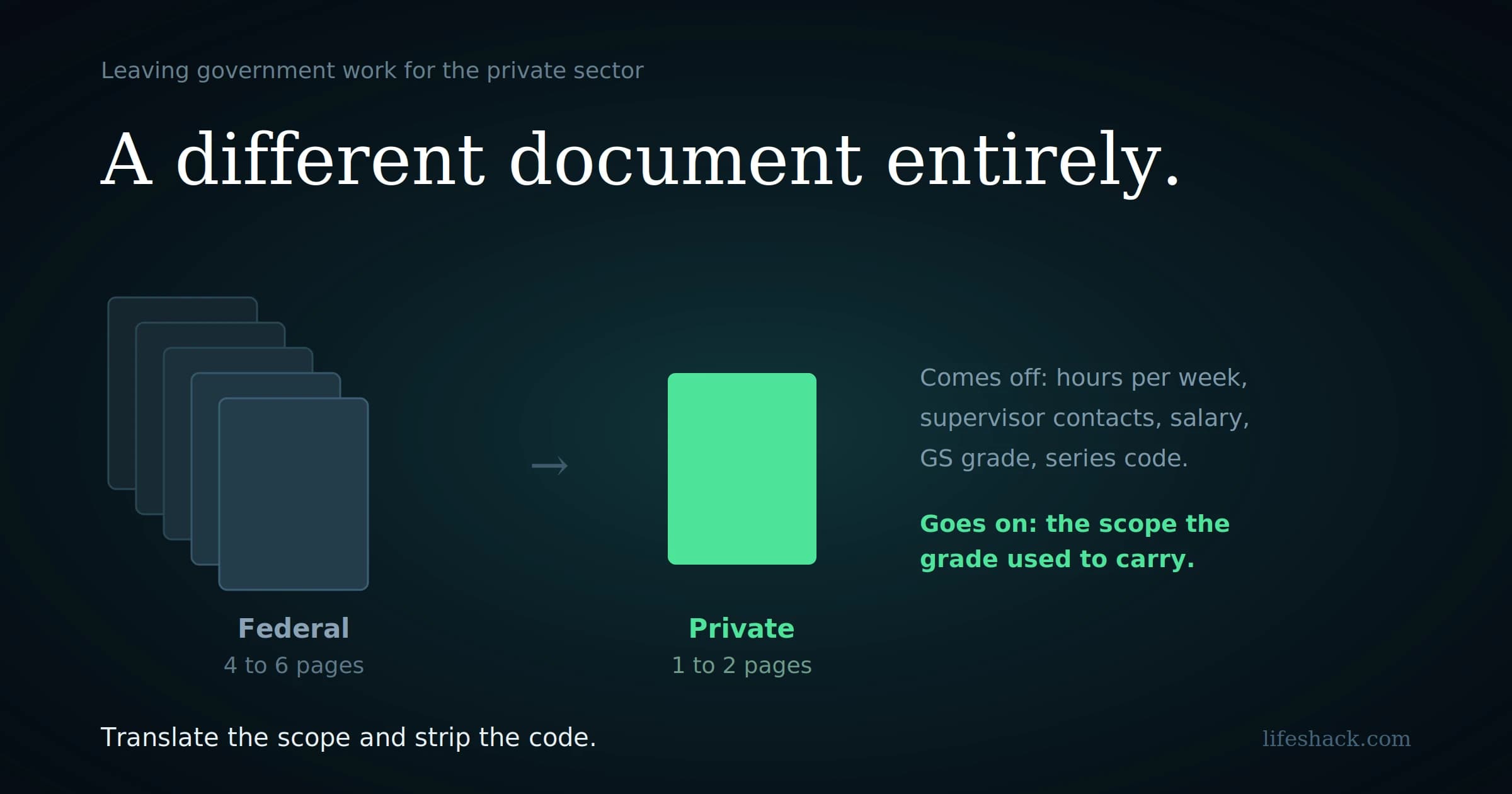
Yours probably runs four to six pages. It lists hours worked per week for every position, your supervisor's name and phone number, your GS grade and step and series code, full employer addresses, your citizenship, and your veterans' preference. Every one of those fields is required on USAJOBS, and a private-sector resume submitted there would be rated ineligible for leaving them out.
Send that same document to a corporate recruiter and it does not get read. The requirements run in opposite directions, and the translation is concrete work with a checklist behind it.
What comes off the page
Hours per week. Private resumes never include this.
Supervisor names and phone numbers. References are handled separately and later.
Salary and GS grade, step and series code. These do not translate and the codes mean nothing outside the system.
Full employer addresses. City and state is the convention.
Citizenship and veterans' preference. Unless a posting specifically asks, these come off. Clearance is the exception and is covered below.
Four pages of duty descriptions. Federal resumes describe duties exhaustively because an HR specialist rates them against a crediting plan. Private screening works nothing like that, and recruiters spend seconds on a first pass.
What is left should be one or two pages, led by accomplishments with numbers attached.
Translate the scope, strip the code
GS-14 means nothing to a corporate recruiter, and neither does a series code like 0343. The grade carries real information about your level, and none of it survives the translation unless you do the translation yourself.
Rough equivalents, which vary by agency and function and should be treated as a starting point only. GS-7 through GS-9 sits around junior level. GS-11 and GS-12 land in the mid-range. GS-13 maps to senior manager or associate director territory. GS-14 reads as director level. GS-15 and SES sit at director and executive level.
The better move is to lead with the corporate-equivalent title and keep the federal context as a parenthetical. Director of Program Operations, GS-14, Department of Defense. The recruiter sees a title they recognize first, and the federal detail is there for anyone who wants it.
Then supply the scope the grade used to carry. Budget owned. Headcount, including contractors you directed. Contract or program value. Number of stakeholders or agencies coordinated. Those numbers are what a private reader uses to calibrate seniority, and a federal resume frequently omits them because inside the system the grade already said it.
Stop writing "we"
This habit is cultural, and it costs more than it looks like it should.
Federal writing emphasizes the team and the office. Resumes come out full of we managed, the team delivered, our division coordinated. In context that is appropriate modesty about collective work. To a private hiring manager reading two pages, it makes your individual contribution invisible, and they are hiring one person.
Rewrite every line in the first person with a specific action. Instead of our office reduced processing time, write reduced processing time by 31% by redesigning the intake workflow. The work was still collective, and the resume has to say what you did inside it.
Cut the acronyms, and then cut more
Government runs on acronyms and they are invisible to the people who use them daily. Your resume probably contains a dozen that mean nothing outside your agency.
Spell out anything that is not universally known, and for most of them, replace the acronym with the work it describes. A private reader does not need to know what the acronym stood for. They need to know what the work was.
The same applies to program names, directive numbers, and internal systems. Describe the function. If you managed compliance with a specific federal regulation, say what the compliance work involved and what it protected. Leave the citation out.
The exception is terminology that is standard in the industry you are targeting. Federal contracting language belongs on a resume aimed at a contractor. It does not belong on one aimed at a consumer products company.
Security clearance is an asset, conditionally
An active clearance has genuine market value, because sponsoring a new one takes a company twelve to eighteen months and substantial cost. Recruiters at firms doing government work filter on clearance level before reading anything else.
If you are targeting employers with government business, put it near the top in a standard format, giving the level and the adjudication date. Security Clearance: Top Secret / SCI, adjudicated January 2023.
If you are targeting employers with no government ties, it does little and can read as a signal that you intend to go back. Move it to a skills line or leave it off.
Keep it current if you can. Clearances lapse after a period without sponsorship, and the window matters more than people expect when planning a move.
The contractor bridge
The most direct route out of federal service usually runs through the contractor market rather than straight into general industry.
Government services firms, including Booz Allen Hamilton, Leidos, SAIC, Deloitte and Accenture Federal Services, hire former federal employees continuously, and they value exactly what the private market struggles to read: agency knowledge, process familiarity, and an active clearance.
Two things make it a useful first move. The translation problem is smallest, since these firms employ people who read federal resumes fluently and know what a GS-14 did. And a few years on the contractor side converts your record into private-sector employment history, which makes the next move considerably easier.
The tradeoff is that you remain inside the same ecosystem, which is a reason to treat it as a bridge if full separation is the goal.
The concern that goes unstated
Private employers worry that people from government move slowly, defer to process, and need authorization before acting. It is a stereotype and it is widely held, and it is sitting in the room during your interviews whether or not anyone mentions it.
Arguing against it does not work, and evidence does.
Lead with things you delivered under constraint. Federal work is full of hard deadlines, statutory requirements and resource limits, which is the same shape as commercial constraint even though the vocabulary differs.
Use speed numbers where you have them. Cut a cycle from ninety days to thirty. Launched in one quarter. Those lines do more than any claim about adaptability.
Name decisions you made rather than processes you followed. The stereotype is about agency, so describe the moments you exercised it.
Avoid the word compliance as a main theme unless you are applying for a compliance role. It confirms the frame even when the work behind it was substantive.
State and local is a different case
Most of the above is written for federal employees, because the federal resume format is uniquely demanding. State and local government resumes are usually closer to private-sector norms already.
The parts that still apply are the jargon, the team-voice habit, the missing scope numbers, and the speed stereotype, which attaches to public-sector work generally rather than to federal service specifically.
The part that repeats
The rewrite is one-time work. Build the two-page version once, with the title translation and the scope numbers in it, and it carries across every application.
What repeats is the application itself, at roughly an hour each once you count finding the role, tailoring, the screening questions and creating an account with another employer's system. Private hiring also runs on volume in a way federal hiring does not, since a single federal announcement with a long review process is a very different thing from fifty applications moving in parallel.
LifeShack handles that layer. It searches for roles matching your background and constraints, tailors the resume and cover letter to each posting, submits across the systems employers use, including Workday, Greenhouse, Lever, iCIMS and Ashby, and keeps every application in one place.
What stays with you is the translation judgment and the interviews, which is where agency experience argues for itself once someone is listening.
Frequently asked questions
How is a federal resume different from a private-sector resume? A federal resume runs four to six pages and requires hours per week, supervisor names and phone numbers, GS grade and step and series code, salary, full employer addresses, citizenship and veterans' preference. A private resume is one to two pages and includes none of those. They are built for opposite screening processes.
Should you put your GS grade on a private-sector resume? No, as the primary descriptor. Lead with the corporate-equivalent title and keep the grade as parenthetical context, such as Director of Program Operations, GS-14. Then supply the budget, headcount and program value the grade used to communicate.
What is a GS-13 or GS-14 equivalent in the private sector? Roughly senior manager or associate director for GS-13 and director level for GS-14, with GS-15 and SES at director and executive level. These vary by agency and function, so the scope numbers matter more than the mapping.
How long should a resume be when leaving government? One to two pages. The federal length requirement works against you in private screening, where recruiters spend seconds on an initial pass.
Should you list a security clearance on a private resume? Yes if you are targeting employers with government business, placed near the top with the level and adjudication date. Sponsoring a new clearance takes a company twelve to eighteen months and significant cost, so an active one carries real value. For employers without government ties it does little.
What jobs do former federal employees move into most easily? Government services and consulting firms, which hire former federal staff continuously and read federal experience fluently. It is the shortest translation and it converts your record into private-sector employment history for a later move.
How do you overcome the stereotype that government workers are slow? With evidence. Arguing the point does not move it. Lead with work delivered under hard deadlines and resource constraints, use cycle-time numbers where you have them, and describe decisions you made instead of processes you followed.
Do you need a different resume for every private-sector job? You need one strong base version and targeted adjustments per posting, since private screening matches your wording against the job description. This is the opposite of the federal approach, where one exhaustive document is tailored to the announcement's specialized experience statements.
Sources
Office of Personnel Management and USAJOBS guidance on federal resume requirements. Published federal-to-private transition guidance from career practitioners and federal workforce publications on grade translation, format conversion and clearance value.