Best Remote Jobs for College Students
by Patrick Da Costa Guimarais • Last Updated 9/28/2026
By Patrick Da Costa Guimarais, founder of LifeShack. Updated September 2026.
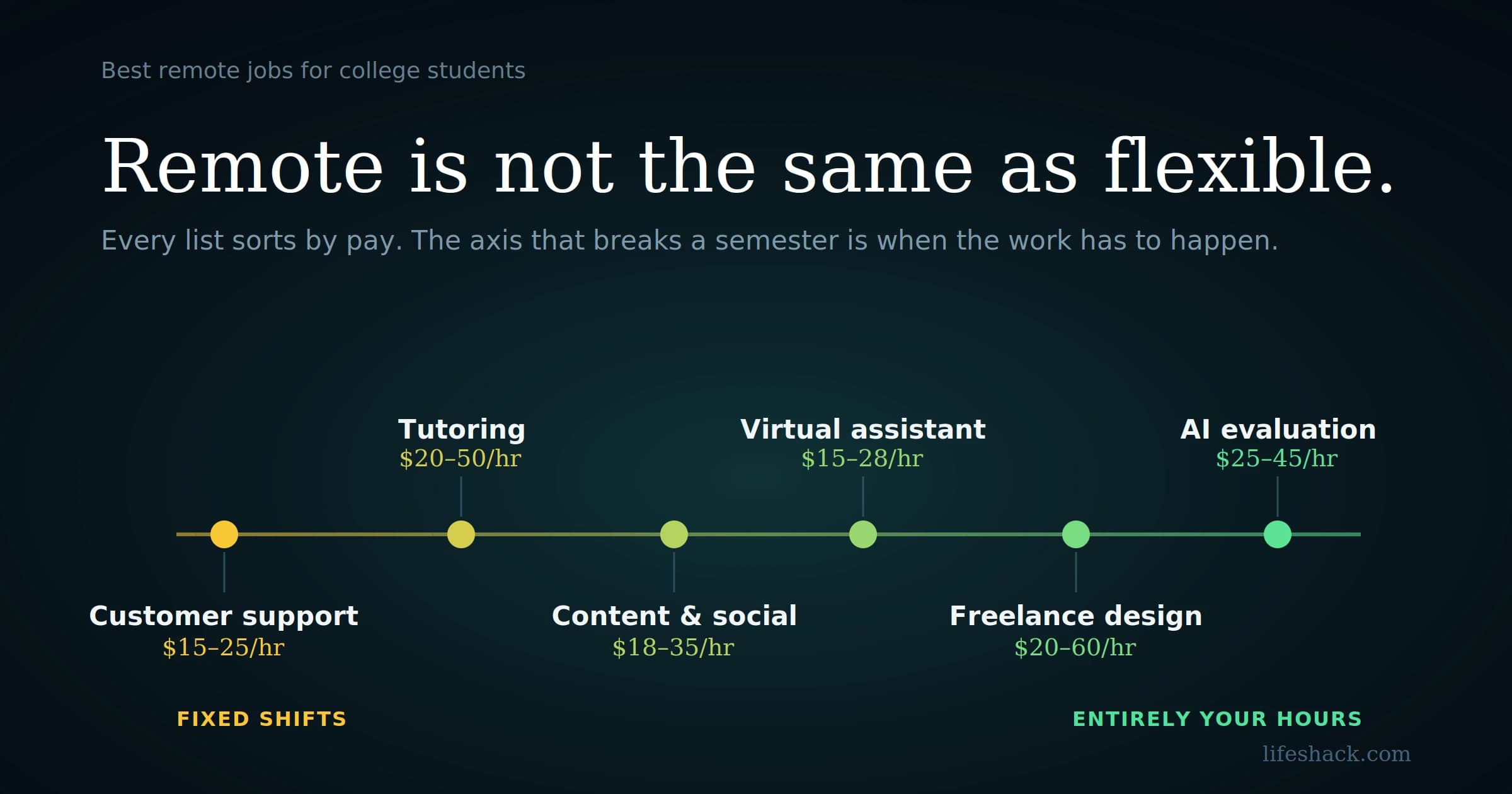
Remote and flexible are not the same thing, and lists of student jobs treat them as if they are.
A remote customer support role runs on scheduled shifts you cannot move. Freelance design is entirely flexible and pays nothing for the first two months. Both are remote. Only one of them fits around a Tuesday lecture you cannot skip.
The axis that decides whether a job works during a semester is when the work has to happen, and pay is the axis every list sorts by. This covers nine categories that hire students, ranked on all three things that matter, with the downside each one carries and the rate you will clear rather than the one advertised.
The three things to weigh
When the work happens. Fixed shifts, client deadlines, or entirely your choice. This is the constraint that breaks a semester, and it is invisible in a pay figure.
What you clear per hour. Platform work pays per task, so the effective rate lands well below the posted one. More on that below.
What it leaves behind. Some of these produce a resume line with a number attached. Some produce money and nothing else. Both are legitimate, and knowing which you are signing up for prevents a wasted year.
The categories that pay well and fit a semester
Online tutoring, roughly $20 to $50 an hour. The strongest rate on this list for anyone with genuine strength in maths, sciences, or standardized test subjects. Test prep pays at the top of that range.
The catch is scheduling. Sessions get booked around the student's availability rather than yours, and evenings and weekends are when demand concentrates. The better-paying platforms also want verified subject expertise or credentials, so the on-ramp is slower than it looks.
AI evaluation and prompt review, roughly $25 to $45 an hour. Reviewing and rating model output against guidelines, comparing responses, and explaining judgments. It rewards strong writing and subject knowledge, and it sits well above general labelling in both pay and interest.
The catch is the onboarding. Approval routinely takes weeks, platform communication ranges from slow to absent, and task availability arrives in waves rather than steadily. Treat it as a channel you open early and use when work appears.
Research assistance, roughly $18 to $30 an hour. Literature review, data cleaning, coding transcripts, and managing samples for faculty projects. The strongest resume outcome on this page by a wide margin, because it produces both a reference and work you can describe in an interview.
The catch is that it is almost never advertised. These roles go to students who emailed a professor in the first three weeks of a term, which makes the acquisition cost an email rather than an application.
Freelance design and development, roughly $20 to $60 an hour. The highest ceiling here for anyone with a portfolio, and fully flexible on timing.
The catch is that unpaid pitching is part of the job, and the rate only holds once you can show finished work. The first two months are mostly finding clients.
The categories that start fastest
Data annotation and labelling, roughly $12 to $22 an hour. Tagging images, text, and audio to train models. The easiest entry point available and legitimate at the established platforms.
The catch is where the category is heading. Generalist labelling rates are under pressure as platforms shift budget toward specialist tiers requiring verifiable expertise. It works as a side channel and it is a weak primary plan, which is the opposite of how it is usually marketed to students.
Transcription and captioning, roughly $12 to $22 an hour. Fast to start and requires nothing but accuracy and typing speed.
The catch is the pay structure. You are paid per audio minute rather than per working hour, and a minute of audio takes several minutes to transcribe cleanly, so the effective rate can be half the posted one.
Virtual assistant and admin work, roughly $15 to $28 an hour. Scheduling, inbox management, research, and data work for small teams and solo founders.
The catch is scope creep. Write down what the role covers before you start, because these expand steadily and quietly.
The categories with a scheduling cost
Customer support by chat and email, roughly $15 to $25 an hour. Many employers now run text-only support with no phone work, which makes it workable alongside classes in a way phone support never was.
The catch is that it is the least flexible category on this page. Shifts are scheduled in advance and covering them is the job, so a midterm week is a problem you solve with a swap rather than a skip.
Content and social media, roughly $18 to $35 an hour. Writing, editing, and running accounts for small businesses and creators. It produces portfolio pieces with numbers attached, which is unusual for work at this pay level.
The catch is that you are finding clients as well as doing the work, and client deadlines are less movable than they sound.
Why the advertised rate is not the rate
For anything paid per task rather than per hour, the number on the listing is the best case.
The effective rate for platform work typically lands 20% to 40% below the headline once you count unpaid screening, time spent hunting for available tasks, rejected submissions, and the stretches where the queue is empty. A platform advertising $25 an hour is frequently a $16 to $20 an hour job in practice.
That is not a reason to avoid the category. It is a reason to compare it honestly against a campus job that pays $17 with no unpaid overhead, and to be suspicious of any figure quoted without that adjustment.
Hourly employment does not have this problem, which is part of why tutoring, support roles, and research assistance compare better than their headline rates suggest.
How to tell a scam
This search attracts more fraudulent listings than almost any other students run, and the pattern is consistent enough to filter reliably.
One rule catches most of it. A legitimate employer never charges you to begin work. No training fees, no starter kits, no software you must buy, no refundable deposit.
The rest of the list, any one of which is enough to stop:
They offered the job without a real interview or a test task. Payment runs through gift cards or cryptocurrency, or you are asked to receive money and forward it on. They want bank details or a Social Security number before a written offer exists. The advertised wage is far above the range for the work while the description stays vague. All contact happens through a messaging app with no company email domain. You are told to buy equipment and claim it back later. You are pressured to decide today.
None of these is a yellow flag. Each one on its own is sufficient reason to stop and report the listing to the platform you found it on.
Choosing by situation
You need money within two weeks. Transcription or data annotation, accepting the low ceiling. Both approve quickly relative to everything else here.
You want the highest rate you can reach this semester. Tutoring if you have the subject strength, AI evaluation if you write well. Both take a few weeks to get through onboarding, so start now rather than when you need the money.
You want the internship to lead somewhere. Research assistance or a remote internship. These produce references and a resume line, and they are the only categories here where the work itself is the credential.
Your schedule changes week to week. Anything paid per task, and specifically not customer support.
You have a portfolio already. Freelance design or development, and price accordingly rather than at student rates.
The part that takes the time
Gig platforms you join once. The roles worth having, meaning remote internships, part-time positions at real companies, and research roles, work like any other job application.
Remote widens your reach and widens the competition at the same time. Applying to a local part-time job means competing with people who can drive there. Applying to a remote one means competing nationally, which means a larger pool and a lower conversion rate per application, which means more applications to reach the same outcome.
Each of those runs roughly forty minutes to an hour once you count finding the role, tailoring, and the twenty to forty minutes every applicant tracking system takes, since each one wants an account created and a work history retyped into fields your attached resume already contains. That is the part of a remote search that goes unbudgeted, and the reason a lot of students end up on whichever platform approved them first.
LifeShack removes that layer. It searches for roles matching your background and constraints, tailors the resume and cover letter to each posting, submits across the eleven-plus applicant tracking systems employers run on, including Workday, Greenhouse, Lever, iCIMS, and Ashby, and keeps every application in one place. There is no queue of drafts waiting on your approval and no point where the form comes back to you.
What stays with you is deciding what the semester can hold, which is the judgment this whole page is about.
Frequently asked questions
What is the best remote job for a college student? It depends on when your hours are free rather than on what pays most. Tutoring pays best for students with subject strength, AI evaluation pays well for strong writers, and research assistance produces the best resume outcome. Customer support pays reliably and is the least flexible.
What remote jobs pay the most for students? Freelance design and development has the highest ceiling at roughly $20 to $60 an hour with a portfolio, followed by tutoring at $20 to $50 and AI evaluation at $25 to $45.
What remote jobs can you start with no experience? Data annotation, transcription, and chat-based customer support hire on a short test task rather than a resume. All three have low ceilings, so treat them as a starting point rather than a destination.
Are AI data annotation jobs legitimate? The established platforms are real and pay real contributors. Rates for generalist labelling are under pressure as platforms shift toward specialist tiers, and approval can take weeks, so it works better as a side channel than as a primary income plan.
How many hours a week should a student work? Ten to fifteen alongside a full course load is sustainable for most people. Twenty is where something starts getting dropped, and it is usually the coursework.
How do you spot a remote job scam? A legitimate employer never charges you to start. Beyond that: no interview, payment by gift card or cryptocurrency, bank details requested before an offer, a vague description with an unusually high wage, contact only through a messaging app, or pressure to decide immediately.
Do remote jobs count as experience on a resume? Yes, when the work produced something you can describe with a number. Research assistance, content work, and freelance projects all read well. Task-based platform work reads as income rather than as experience.
Is remote work more flexible than an on-campus job? Not automatically. Scheduled remote shifts are less flexible than a campus job you can swap with a colleague. Task-based platform work is more flexible than either. Remote describes location, not timing.