How to Tailor Your Resume for an Internship
by Patrick Da Costa Guimarais • Last Updated 9/24/2026
By Patrick Da Costa Guimarais, founder of LifeShack. Updated September 2026.
Most resume tailoring advice assumes you have three jobs to choose between and the task is deciding which bullets to feature. A student applying for an internship has a different problem: not enough material to choose from, and no obvious way to make what exists look relevant.
That changes where the tailoring happens. On a professional resume the work is in the bullets. On a student resume it is mostly in the sections, because with less content on the page, the order you put things in and the things you leave off carry more signal than any single line.
This covers the four levers in order of impact, where to find numbers when you think you have none, and eight rewrites of the bullets students hand in. For the mechanics of formatting, file type, and parsing, our guide to the ATS errors that cost people interviews covers that ground and this page will not repeat it.
The four levers, in order of impact
Section order. A recruiter spends six to ten seconds on the top third of the page. Whatever sits there is what your resume is about. For a marketing internship, Projects and a marketing-adjacent club role belong above a summer job at a restaurant. For an engineering internship, Projects belongs above everything except Education. Reordering sections takes ninety seconds and changes what your resume appears to be.
Which experiences make the page. A student resume that lists everything reads as a list of things that happened. Cutting the two least relevant entries and giving that space to the most relevant one is a bigger improvement than rewriting all five. If an entry cannot be connected to the posting in one sentence, it is taking space from something that can.
Bullet rewrites. This is the part everyone starts with and it ranks third. It matters, and it matters less than what is above it and whether it made the page at all.
The skills list. Fastest to edit and lowest impact on its own, since a skill with no evidence behind it reads as a claim. Its real job is carrying the posting's exact terminology for tools you have used.
Work them in that order. The common mistake is spending an hour on bullets and never reordering the page.
Where your numbers are
The usual objection here is that a student has no metrics. Most have several and do not count them, because nothing felt like a business result at the time.
Look in these places.
Anything with a headcount. People you trained, tutored, supervised, or onboarded. Members in the club when you took over and when you left. Volunteers you coordinated.
Anything with attendance. Event turnout, workshop signups, meeting attendance before and after you changed something.
Anything with money. Budget managed, funds raised, sponsorships closed, average ticket, cash handled per shift.
Anything with volume. Orders processed per hour, tickets closed, articles published, posts shipped, samples run, lines of a dataset cleaned.
Anything with time. Hours per week, weeks a project ran, how long a process took before and after you changed it.
Anything with a rate. Open rate, attendance rate, retention from semester to semester, accuracy, error rate, response time.
Anything with a count of things you made. Designs, components, test cases, surveys, interviews conducted, pages written.
If no number exists, use scope instead. "Across three campuses" and "for a 40-person organization" both do work. An invented number is worse than no number, since interviewers follow up on figures and you will have to defend it.
Eight rewrites
These are the bullets students submit and what they should say instead. The pattern in each case is the same shape: action verb, the skill or tool, the context, the scale, and the result.
Restaurant or retail, applying to anything.
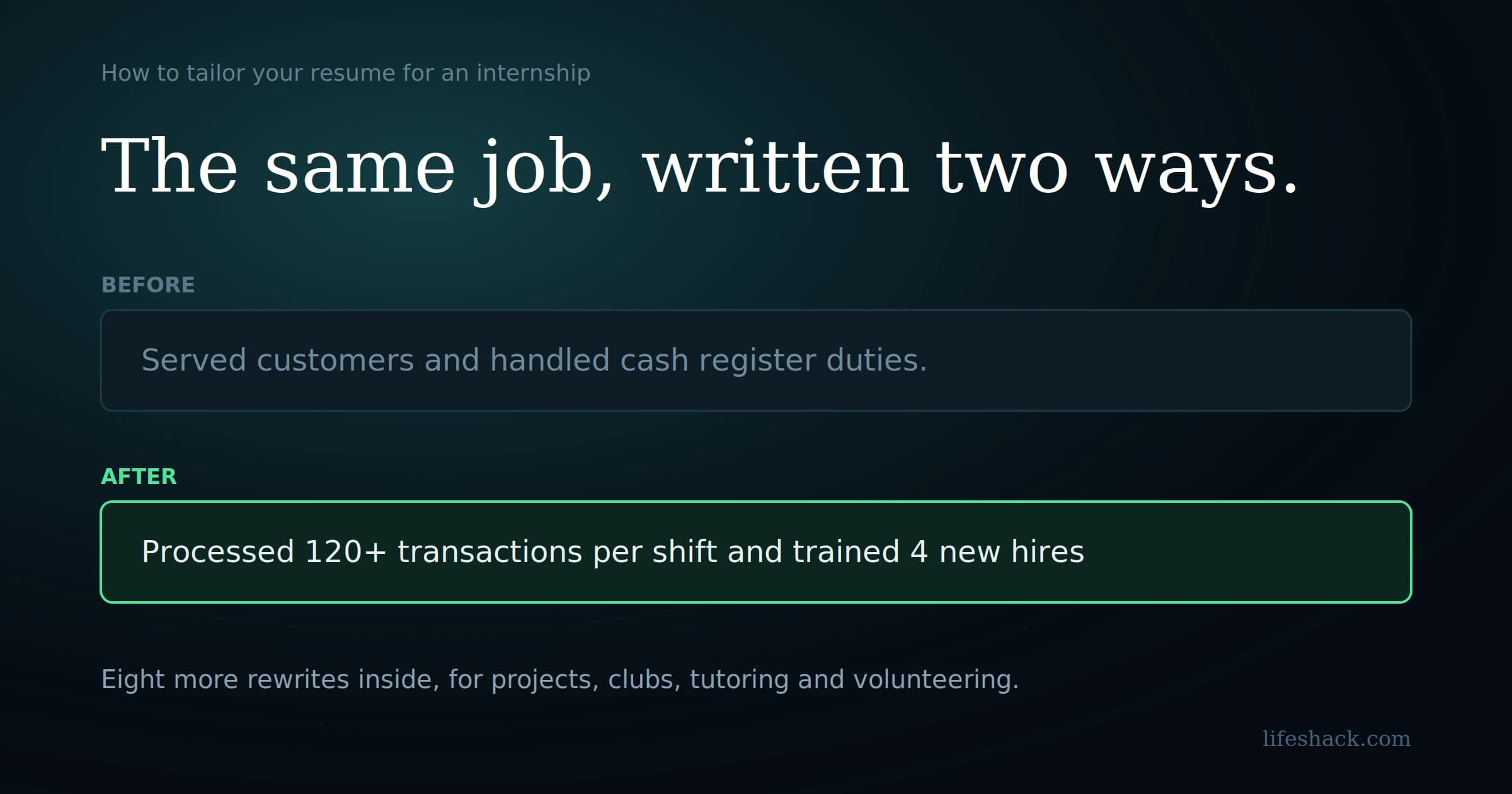
Before: Served customers and handled cash register duties in a fast-paced environment.
After: Processed 120+ transactions per shift in a 6-person team, trained 4 new hires on the POS system, and reconciled a register to within $2 variance across a 14-month run.
Almost every student has a job like this and almost every student wastes it. Operations, training, accuracy, and reliability over time are all things employers screen for, and this job demonstrates all four.
Class project, applying to a technical role.
Before: Completed a group project analyzing a dataset using Python for my data science course.
After: Built a Python pipeline cleaning and analyzing 50,000 rows of city transit data, identified three route inefficiencies, and presented findings to a 30-person class and the course sponsor.
Drop the word "course" from the bullet. Keep the course in Education. The project is the evidence.
Club officer, applying to marketing.
Before: Served as Social Media Chair for the Marketing Club.
After: Ran social for a 200-member student organization, growing Instagram from 340 to 1,100 followers in two semesters and driving 85 signups to the spring career panel.
A title is not a bullet. A title plus what happened because you held it is a bullet.
Research assistant, applying to anything analytical.
Before: Assisted a professor with research in the biology department.
After: Ran 60+ assays for a faculty study on cellular response, maintained the sample database in Excel, and co-authored the methods section of a poster presented at a regional conference.
Volunteer work, applying to nonprofit or program roles.
Before: Volunteered weekly at a local food bank.
After: Coordinated Saturday distribution for a food bank serving 250 families weekly, scheduled 12 volunteers per shift, and cut checkout wait time by restructuring the intake line.
Personal project, applying to product or design.
Before: Built a personal website and a few small apps.
After: Designed and shipped a habit-tracking web app used by 60 people across two semesters, iterating the onboarding flow after 12 user interviews cut first-session drop-off.
Tutoring or TA work, applying to anything client-facing.
Before: Tutored students in introductory statistics.
After: Tutored 15 students through introductory statistics across two semesters, built a problem-set walkthrough series now used by the department, and raised the average quiz score in my section.
Sports, band, theater, or any serious time commitment, applying anywhere.
Before: Member of the varsity rowing team.
After: Committed 20 hours weekly to varsity rowing across three seasons while carrying 15 credits, and coordinated travel logistics for a 24-person squad.
Recruiters read this as evidence you can hold a schedule, which matters more for an internship than for almost any other role, and it is the honest reason to include it.
The coursework section
Relevant coursework earns space only when it does something the rest of the page cannot.
Include it when the posting names specific technical coursework, when you are a freshman or sophomore with thin experience, or when your major does not obviously connect to the role and coursework is the bridge.
Cut it when you have two or more relevant projects or roles, since those are stronger evidence of the same thing.
When you do include it, list courses by name rather than by number, since a course code means nothing outside your school. Five courses maximum, chosen against the posting.
The better version, where you have room, is turning the strongest course into a project entry with a bullet under it. A course title says you enrolled. A project bullet says what you produced.
The GPA decision
Include it at 3.5 and above. Leave it off below 3.0. In between, judge by field: finance and consulting screen on it more than startups and creative roles.
If your major GPA is meaningfully higher than your overall, list the major GPA and label it as such. If a posting states a minimum and you clear it, include yours, since leaving it out reads as not clearing it.
What to cut for one page
An internship resume is one page. That is not a style preference, it is what recruiters expect at this stage, and a two-page student resume reads as padding.
Cut these first, in this order.
The objective statement. It consumes the most valuable real estate on the page to say you are seeking an internship, which the recruiter knows.
High school anything, unless you are a freshman. By sophomore year it is taking space from college material.
Unrelated jobs beyond the most recent one, unless the bullet demonstrates something the posting asks for.
Skills you cannot discuss for two minutes. Listing a language you touched once is a trap waiting for an interviewer.
Interests, unless one connects directly to the employer or the role.
Before you submit
Does the top third of the page match the posting? That is the whole test for section order.
Can you source every number? Approximate is acceptable and invented is not.
Does the resume use the posting's exact terms for tools you have used? The precise wording where the experience is there, rather than the terms stuffed in everywhere.
Did you clear the hard eligibility fields? Class year, graduation date, and work authorization are structured screening questions that filter before anyone reads the document.
Is it one page, and is it a PDF unless the posting says otherwise?
Doing this forty times
One tailored resume takes about fifteen minutes once you have a base version: read the posting, reorder the sections, swap two bullets, adjust the skills line.
Fifteen minutes is fine. Fifteen minutes multiplied by a target list is where it stops being fine.
Internship recruiting runs in two compressed windows, August through October and January through March, and rolling review means a posting applied to in week one competes against a fraction of the pool it will have by week eight. So the plan is forty to eighty applications inside about ten weeks, each with its own tailoring pass, on top of the twenty to forty minutes every applicant tracking system takes to fill in.
That arithmetic is why most tailoring advice fails in practice. The method is sound and the volume is what breaks it. Students either tailor properly for twelve roles, which is thin against an average of 109 applicants per internship posting, or apply to sixty with the same base resume, which is the version recruiters have learned to filter out.
LifeShack handles that part end to end. It searches for roles matching your background, tailors the resume and cover letter to each posting, submits across the eleven-plus applicant tracking systems internship programs run on, including Workday, Greenhouse, Lever, iCIMS, and Ashby, and keeps every application in one place. There is no queue of drafts waiting on your approval and no point where the form comes back to you.
Three questions separate the tools in this category, if you are comparing: does it find the roles or do you paste in links, does it tailor per posting or attach the same file every time, and does it submit or does it prepare and stop. Most stop before submission, which leaves the largest time cost exactly where it was.
What stays with you is the base resume, the numbers only you can verify, and the judgment about which roles are worth wanting. Those are the inputs, and they are worth an afternoon of real attention before the season opens.
Frequently asked questions
How do you tailor a resume for an internship with no experience? Start with section order rather than bullets. Put projects, coursework, and club roles above unrelated jobs when the posting is technical or field-specific. Then rewrite the experiences you do have using scale and outcomes, since a restaurant job demonstrates operations, training, and reliability when written that way.
How long should an internship resume be? One page. A second page at this stage reads as padding, and the material that would fill it is usually the material worth cutting.
Should you include GPA on an internship resume? Include it at 3.5 or above and leave it off below 3.0. Between those, judge by field. If a posting states a minimum you clear, include it, since omitting it suggests you do not.
Should you include relevant coursework? Only when it does work nothing else on the page does, which usually means you are a freshman or sophomore, or the posting names specific coursework. Once you have two or more relevant projects, cut it.
How do you put a class project on a resume? As a project entry with its own bullets, not as a mention inside a course listing. Describe what you built, the tools you used, the scale of the data or the team, and what you found or shipped. Leave the word "course" out of the bullet.
What if you have no numbers for your bullets? You probably have several. Look for headcount, attendance, money, volume, time, rates, and counts of things you produced. If none exist, use scope instead, as in "for a 40-person organization." Do not invent figures, because interviewers follow up on them.
How much should you change per application? Section order, the two or three bullets closest to the posting, and the skills line. A full rewrite for every application is not sustainable across a forty-application season and is not what moves the outcome.
Should an internship resume be a PDF or Word document? PDF unless the posting or the application form asks for Word. Our ATS guide covers the formatting rules that determine whether the file parses correctly.