Why Is It So Hard to Get a Job in 2026? What Changed Since 2022
by Patrick Da Costa Guimarais • Last Updated 10/1/2026
By Patrick Da Costa Guimarais, founder of LifeShack. Updated October 2026.
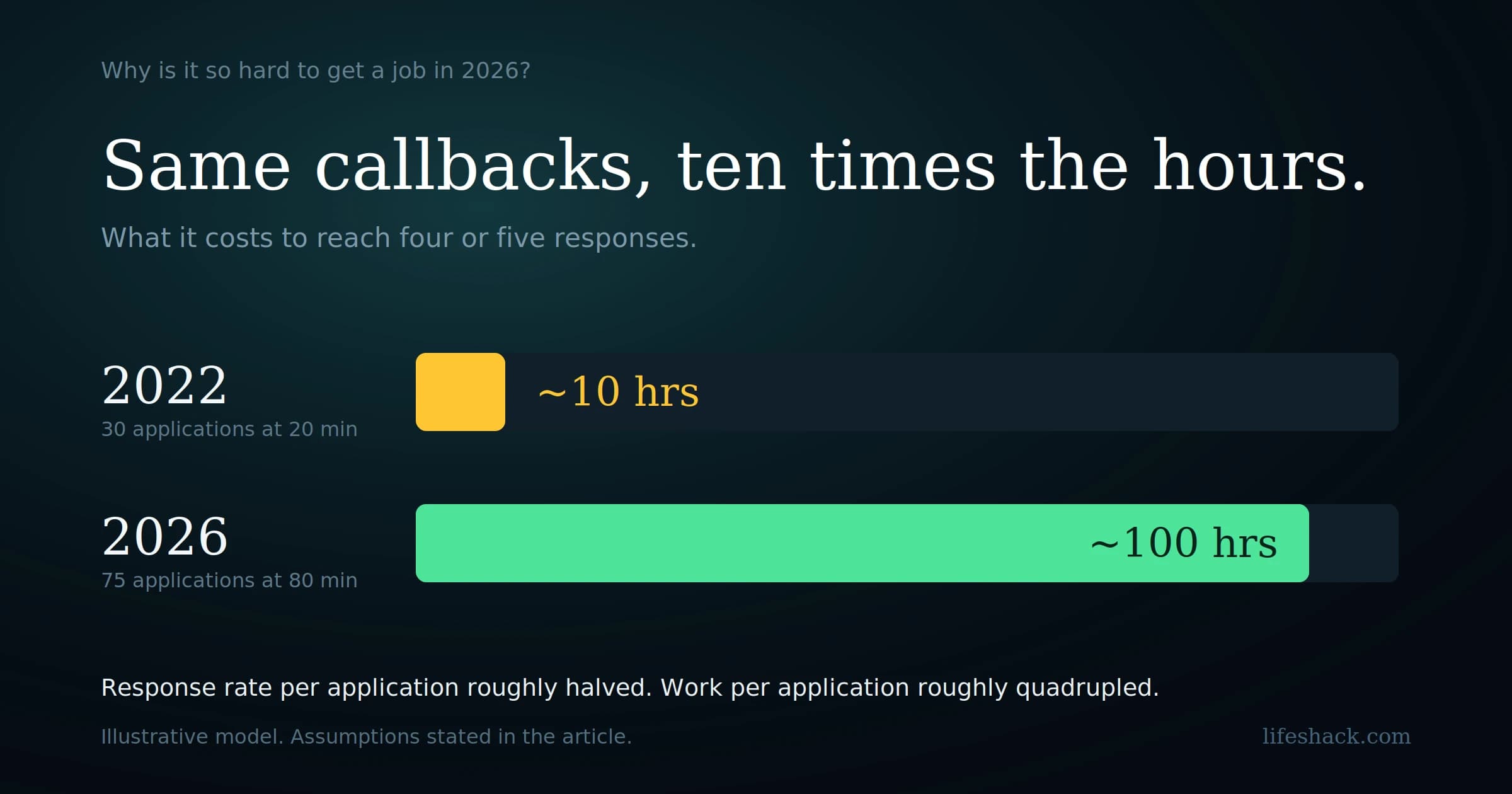
The same job search that took about ten hours in 2022 takes something closer to a hundred in 2026, and produces the same number of callbacks.
The arithmetic behind that is what explains why an approach that worked three years ago now feels like it is failing for no reason.
A mid-level candidate in 2022 could send thirty applications with a lightly adjusted resume, spend around twenty minutes on each, and expect four or five responses. In 2026 the response rate per application has fallen while the work each application requires has risen, so reaching those same four or five responses takes roughly two to three times the applications at roughly four times the effort each.
Nothing about the candidate changed, while six things on the employer side did.
How many people apply to each job now
In 2022, a posting at a mid-size company drew somewhere between fifty and a hundred applicants, and a recruiter could read most of them.
Now, Greenhouse reports that applications per recruiter rose from 146 a year in 2022 to 746 a year in 2025, an increase of more than 400% against recruiting headcount that did not grow with it. Ashby, drawing on more than 54 million applications, found applications per hire have roughly tripled since 2021. WIRED reported in August 2026 that candidate pools at some software and enterprise employers moved from around a hundred per role to more than a thousand in under eighteen months.
One-click apply made sending an application nearly free, generative AI made producing a polished-looking resume nearly free alongside it, and the volume followed from both.
What it does to you. Your application is filtered before it is read. A resume that was competitive in 2022 can be perfectly good now and never reach a person.
How employers screen applications now
In 2022, applicant tracking systems parsed your resume into fields and matched keywords. The screening was crude and mechanical, and a recruiter still worked through a long list.
Now, there is a layer above that. ZipRecruiter's 2026 survey of more than a thousand talent acquisition professionals found 92% report some level of AI in their hiring process and 48% say it has increased the volume they receive per role. Many systems summarize and rank candidates before a recruiter opens the shortlist.
Employers also trust documents less than they did. A 2026 Robert Half survey found 67% of hiring managers saying AI-generated applications slowed their process, and 65% saying skills have become harder to verify in AI-optimized resumes.
What it does to you. Keywords get you through the parsing layer and evidence gets you through the one above it. A skills section with eight entries and nothing demonstrating any of them scores badly at both.
Why applying early matters more than it used to
In 2022, applying in week two or three was fine. Many employers waited for a deadline and reviewed in a batch.
Now, rolling review is close to universal and the arithmetic underneath it changed. SmartRecruiters' benchmark data, built on 89 million applications across 95 countries, puts median time to first review in the US at around six days, with a typical role drawing roughly 73 applicants, interviewing three, and hiring one. When several hundred applications land in week one, the shortlist exists before week two begins.
What it does to you. Timing now outweighs most of what you can do to the document. The same resume on day one and day twenty is two different applications.
Why tailoring stopped being optional
In 2022, tailoring was advice. A strong general resume sent to twenty roles worked on several of them.
Now, it is the floor, because the tools made it cheap and everyone is doing it. The flip side is that generic AI output is easy to recognize. Resume Now's survey of HR workers found 62% are more likely to reject an unpersonalized AI-generated resume.
What it does to you. Per-role tailoring is required and has to be specific rather than merely generated. The short-answer fields and the cover letter are where a human can tell the difference.
Ghost jobs and the new interview formats
In 2022, most postings corresponded to a role someone intended to fill, and most interviews involved a person.
Now, a meaningful share do not. Greenhouse has estimated that 18% to 22% of postings in a given quarter qualify as ghost jobs, with no active intention to hire behind them. The Congressional Research Service noted in April 2025 that no official statistics on the scale exist, so treat any single figure with caution and the general pattern as settled. Asynchronous video interviews have become common at the screening stage, and some employers now run AI-conducted first rounds.
What it does to you. Verify a posting on the employer's own careers page before spending an hour on it, since aggregators keep filled roles visible. Prepare for the recorded format specifically, because it rewards structure and gives you no interviewer reaction to adjust against.
The market underneath all of it
In 2022, the labor market was historically tight. Bureau of Labor Statistics data shows job openings at record levels and the quits rate near its peak, which gave candidates leverage and made employers move quickly.
Now, openings have come down substantially and quits have fallen with them. Fewer voluntary departures means fewer backfills, and employers not competing for scarce candidates feel no urgency. Indeed's Hiring Lab has found time-to-hire moves inversely with the quits rate, so the same process takes longer in a softer market. Greenhouse puts time to fill at about 60 days in 2026 against roughly 44 in 2022.
What it does to you. The timeline stretched for structural reasons. A search that feels stalled at week six is frequently on schedule.
The arithmetic, stated plainly
Treat the following as a model with visible assumptions rather than measured data, and substitute your own numbers once you have twenty applications to measure.
In 2022. Thirty applications. A general resume adjusted lightly, twenty minutes each. Around ten hours total, producing four or five responses.
In 2026. Finding and verifying a role takes about ten minutes. Tailoring the resume against the posting takes twenty. The cover letter and short-answer fields take fifteen. Submitting through an applicant tracking system takes twenty to forty, because each employer runs its own instance and each wants an account created and a work history retyped into fields your attached resume already contains. Logging it takes two. Call it eighty minutes.
If the per-application response rate has roughly halved, reaching the same four or five responses needs somewhere between sixty and ninety applications. At eighty minutes each, that is eighty to a hundred and twenty hours.
So the same outcome costs roughly ten times the hours. Compressed into the eight to twelve weeks a search runs, it is fifteen to thirty hours a week of unpaid work, most of it typing identical information into different forms.
That gap is why the 2022 approach stops producing results without anything about you having changed.
What a good 2026 application looks like
Find the role in its first few days. Set alerts on the sources that post first, check target employers' careers pages on a weekly rotation, and submit within two or three days of a posting going live.
Confirm it is live and that you clear the hard requirements. Check work authorization, licensing, location, and anything appearing as a yes-or-no field in the application form, since those are screened mechanically before a resume is opened.
Tailor the resume to the posting. Pull the tools, platforms and skills the description names and mirror that language where you have the underlying experience. Attach a number to the bullets covering the role's core function. Leave out terms you cannot defend in an interview.
Write the cover letter and short-answer fields yourself. Two or three sentences that could only have been written about this employer outperform a page of polished generality.
Submit on the employer's own system rather than through an aggregator's quick-apply button wherever the option exists.
Track four columns. Company and role, date applied, where you applied, and outcome. Without it you cannot tell whether your materials or your volume is the constraint.
Every step there works when you do it properly on one application, and the difficulty is doing it eighty times inside two months.
Where the hours should go
Some of that eighty minutes rewards your attention and some of it does not. Deciding what to apply to, preparing for interviews, and writing the parts a person reads all get better the more thought you give them. Account creation and work-history retyping get no better at all, and together they are the largest block of time in the whole search.
LifeShack handles that second group end to end. It searches for roles matching your background and constraints, tailors the resume and cover letter to each posting, submits across the eleven-plus applicant tracking systems employers run on, including Workday, Greenhouse, Lever, iCIMS and Ashby, and keeps every application in one place. There is no queue of drafts waiting on your approval and no point where a form comes back to you.
What changes is the tradeoff in the arithmetic above. The right process stops competing with the volume the market requires, applications land in the first days of a posting rather than the third week, and the hours you have go to the parts of a search only you can do.
Frequently asked questions
Why is it so hard to get a job in 2026? Six things changed together. Applications per role rose several times over, employer-side AI screening now ranks candidates before a recruiter reads them, rolling review means shortlists form within days, tailoring became the baseline rather than an edge, ghost postings absorb part of your effort, and the market softened from the 2021-22 peak so employers feel no urgency. The combined effect is a lower response rate per application and more work required per application.
How many applications does a job search take now? More than it did. A candidate who needed around thirty applications in 2022 typically needs sixty to ninety now to reach a similar number of responses, and the figure runs higher in competitive fields.
Has the job market gotten worse or have I gotten worse? The mechanics changed. Greenhouse reports applications per recruiter rose from 146 a year in 2022 to 746 in 2025, and time to fill went from roughly 44 days to about 60. The same resume faces a different process.
Does applying early really matter? Yes, more than it used to. Median time to first review in the US is around six days, and with several hundred applications arriving in the first week, a shortlist frequently exists before the second week begins.
Do I need to tailor my resume for every application? Yes. Tailoring moved from advice to baseline because the tools made it cheap, and 62% of HR workers report being more likely to reject an unpersonalized AI-generated resume.
What are ghost jobs and how common are they? Postings with no active intention to hire behind them. Greenhouse has estimated 18% to 22% of postings in a given quarter, and the Congressional Research Service noted in 2025 that no official statistics exist. Verify a posting on the employer's own careers page before applying.
How long should a job search take in 2026? Longer than in 2022. Time to fill is around 60 days, up from roughly 44, and that measures only the requisition rather than your whole search. A search running eight to twelve weeks is normal rather than stalled.
Is it worth applying if hundreds of people already have? Yes, when you clear the hard requirements and apply early. The alternative is a smaller number of applications at the same conversion rate, which produces fewer outcomes rather than better ones.
Sources
Greenhouse recruiting benchmarks and the 2026 Hire Standard. Ashby 2026 Talent Trends, covering more than 54 million applications. SmartRecruiters 2025 Recruiting Benchmarks, covering 89 million applications across 95 countries. ZipRecruiter 2026 survey of talent acquisition professionals. Robert Half 2026 hiring managers survey. Resume Now HR workers survey. WIRED, August 2026. Congressional Research Service, April 2025. Bureau of Labor Statistics JOLTS data and Indeed Hiring Lab research on labor market effects.