Consulting Internships: Recruiting Timeline and Application Guide
by Patrick Da Costa Guimarais • Last Updated 9/24/2026
By Patrick Da Costa Guimarais, founder of LifeShack. Updated September 2026.
Consulting runs the earliest and most compressed recruiting calendar of any internship track, and it moved earlier again in the last two cycles. The model most people still work from, where you apply in the fall of junior year and interview over the winter, no longer describes how the top firms hire.
For the Summer 2027 cycle, the major windows opened and closed well before the fall semester began. McKinsey opened undergraduate intern applications in the first half of 2026. BCG's US Summer Associate window for that cycle has closed with no fall round. Bain ran a first deadline in the spring and a later window that ran into late summer at some schools.
If you are a junior reading this in September 2026 and you have not applied, the MBB main round for Summer 2027 is behind you. That is a calendar outcome rather than a verdict, and the rest of this page covers what remains open, what the tier below MBB is doing right now, and how to be early for the next cycle instead of late for this one.
One instruction before any of it. Every firm publishes its own deadlines page, and those dates have moved repeatedly in recent cycles. Treat every window described here as a pattern to plan against and verify the specific date on the firm's site before you act on it.
Why the timeline collapsed
Consulting firms compete with each other and with investment banks for the same few thousand students, and the way to win that competition is to make an offer before anyone else does. Each firm moving earlier forces the others to follow, and the cycle has compressed by roughly a full semester over two years.
The practical consequence is that the decisive work happens during sophomore year. By the time a junior sits down in September to start thinking about consulting, the resume that will be screened is already written and the case skills that will be tested are already whatever they are.
That is uncomfortable and it is also the most useful thing to know early, because it means a sophomore reading this has more leverage than a junior does.
The tiers, and when each one moves
MBB, meaning McKinsey, Bain, and BCG. The earliest and most structured. Recent cycles have seen portals opening in the first half of the year preceding the internship, with first deadlines in spring and, at some firms, a second window later in the summer. Several programs have moved to a single window with no fall round, so assuming a second chance is risky.
Tier two strategy and Big Four advisory. Oliver Wyman, Kearney, LEK, Strategy&, Accenture Strategy, and the advisory and transaction arms of Deloitte, EY, PwC, and KPMG. These run behind MBB, typically opening midsummer and closing through the early fall. This is the tier with live windows in August, September, and October, which makes it the answer for anyone who missed the earlier round.
Boutique, specialist, and adjacent consulting. Economic consulting, healthcare and life sciences consulting, HR and organizational consulting, technology consulting, public sector consulting, and regional strategy shops. These open September through November and run latest of all. They are also the largest part of the market by number of firms and the part least likely to be looked at.
Sophomore and early-identification programs. These run on their own calendar, usually opening in the fall of sophomore year and closing over the winter, and they matter more than their size suggests. They function as a feeder into junior-year internship interviews and in many cases produce a fast track. Program lineups change from year to year, including cancellations, so check each firm's page rather than working from a list published earlier in the year.
The portfolio math
Run the numbers before you build the plan, because the plan most candidates build fails on arithmetic rather than on effort.
Assume, as an illustrative model rather than measured data, that a well-prepared candidate converts at roughly 1% per MBB application, 6% per tier two or Big Four advisory application, and 8% per boutique or specialist application. Those figures are consistent with published acceptance rates at the top and with the much wider funnels below it, and you should replace them with your own once you have data.
Probability of at least one offer is one minus the product of the misses.
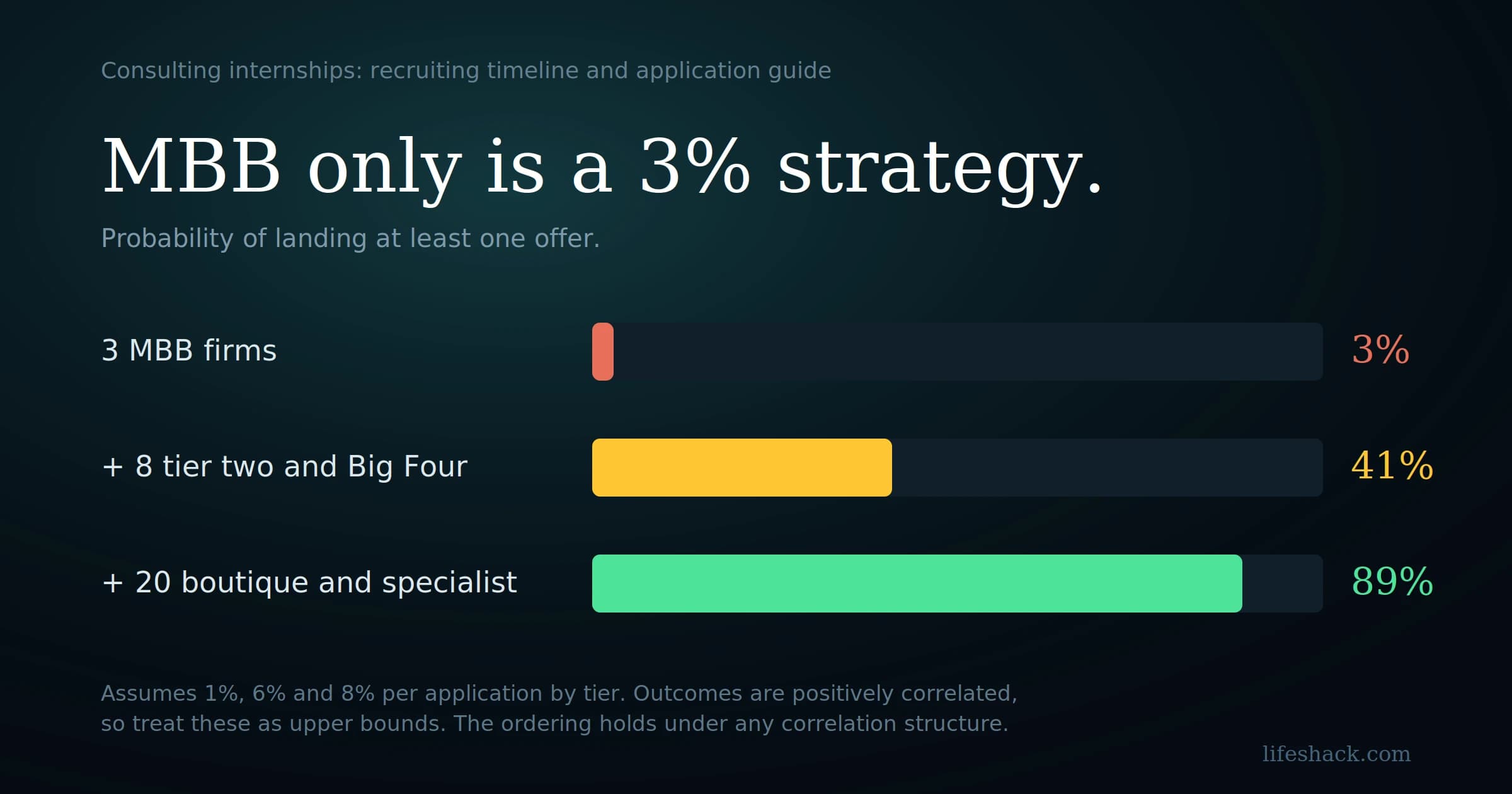
Three MBB applications only. 1 minus 0.99 cubed. You end the cycle with roughly a 3% chance of an offer.
Three MBB plus eight tier two and Big Four. 1 minus 0.99 cubed times 0.94 to the eighth. That moves you to roughly 41%.
Add twenty boutique and specialist firms. 1 minus 0.99 cubed times 0.94 to the eighth times 0.92 to the twentieth. Roughly 89%.
The strategy that most candidates run produces a 3% outcome. The strategy that adds firms they have not heard of produces something close to 89%. Nothing in that difference is preparation. It is coverage.
The caveat a consultant will reach for. These outcomes are not independent. Your resume, your case skill, and your interviewing under pressure are shared inputs across every application, so a rejection at one firm raises the probability of rejection at the next. The correlation is positive and meaningful, which makes 89% an upper bound rather than a forecast.
Correlation does not change the ordering, though, and that is the part that matters. Under any correlation structure short of perfect, a broader portfolio strictly dominates a narrow one, and the gap between three applications and thirty-one is large enough that no reasonable correlation assumption closes it.
It also tells you where correlation is worth attacking. Improving the shared inputs, meaning case skill and resume quality, raises every term in the product at once. That is why preparation and coverage are complements rather than competing uses of your semester.
The funnel, stage by stage
Decompose the 1% and the allocation question answers itself.
An MBB funnel consistent with a 1% overall rate runs approximately 15% through the resume screen, 50% through the online assessment, 35% through first round, and 40% through final round. Multiply those and you land near 1.05%.
A tier two or Big Four funnel consistent with a 6% rate runs roughly 40% through screen, 65% through assessment, 45% through first round, and 50% through final.
Three things fall out of that decomposition.
The resume screen is the largest single filter at MBB and it is the one you can finish work on before the cycle opens. It is also the stage where 85% of applicants are eliminated without any case skill being observed at all.
The online assessment is a cheap stage to win. At roughly 50% pass, it removes half your remaining probability, and it is practiceable in a handful of hours. Walking into it cold is the worst expected-value decision available in the whole process.
Case rounds compound. First round at 35% and final at 40% means case skill is applied twice multiplicatively. Moving case performance from the 50th to the 75th percentile might take those to 45% and 50%, which raises the product from 14% to 22.5%, a 60% relative improvement in the back half of the funnel from one skill.
Where the marginal hour goes
Rank your activities by expected offers per hour and the semester plans itself. This ordering holds for anyone who has not yet done the item above it.
One: fixing a resume that fails screens. A few hours of work operating on the 15% stage, applied across every application you will send. Highest return available and it is finite work.
Two: the first ten practice cases. The steepest part of the learning curve by a wide margin, taking you from unable to structure a problem to functional. Roughly fifteen hours.
Three: online assessment practice. Three to five hours against a stage that eliminates half of survivors.
Four: application coverage beyond MBB. Each additional well-matched tier two or boutique application adds roughly 6 to 8 percentage points of independent probability at about an hour of cost. This is the highest-return activity for most candidates and the one most likely to be skipped.
Five: cases eleven through thirty. Steady, meaningful improvement. Thirty hours or so.
Six: the eight behavioral stories. Ten hours against a stage that eliminates candidates who cased well, which makes it cheap insurance.
Seven: networking conversations. See the break-even below.
Eight: cases thirty-one through sixty. Real but diminishing, and worth doing once everything above is done.
The ordering is the point. Most candidates start at item eight and work upward, spending sixty hours on cases while leaving twenty firms unapplied to.
Diminishing returns on case practice
The 40-to-60-case figure is real and it is an aggregate that hides a curve.
Cases one through ten take you from no structure to basic competence. Largest marginal gain in the sequence.
Cases eleven through thirty build speed, math fluency, and the ability to recover when a case goes sideways. Steady gains.
Cases thirty-one through fifty are about consistency under pressure and edge cases. Smaller gains per case, and they matter because final rounds sample from a narrow distribution where consistency is what is being measured.
Beyond sixty, additional volume returns close to nothing unless partner quality improves.
The variable that dominates after case thirty is not count, it is who is giving them. Case 25 with a former consultant is worth several cases with a peer at your own level. The implication for a semester plan is that you should be raising partner quality after case thirty rather than raising volume, which is why consulting clubs with alumni networks outperform solo preparation by a wide margin.
The networking break-even
Fifteen conversations at roughly an hour each including preparation and follow-up is fifteen hours.
For that to beat the alternative use of those hours, which is fifteen additional applications at roughly 6% each, networking needs to add about 1.2 percentage points of conversion across your whole portfolio. Fifteen applications at 6% adds roughly 60 percentage points of raw probability before correlation, so on a pure numbers basis, applications win.
The reason networking still earns its place is that it operates on the stage applications cannot reach. A referral moves the resume screen, which is the 15% gate, and it moves it for the specific firms where you have the relationship. Fifteen conversations concentrated at your five highest-priority firms is a defensible allocation. Fifteen conversations spread across fifteen firms is not, because the effect does not accumulate that way.
Allocate networking to your top five targets and coverage to everything else.
The sophomore arbitrage
Applying a year early is the largest structural edge available in consulting recruiting and it is underused because it requires acting before the pressure arrives.
Early-identification and sophomore programs run smaller applicant pools than junior internship rounds, and they frequently produce a fast track into the following year's process. The arbitrage is that you are competing against the subset of sophomores who knew the program existed, which is a fraction of the eventual junior pool.
There is a second, compounding effect. A sophomore who runs a full cycle, even unsuccessfully, arrives at junior recruiting with thirty practice cases behind them and a resume already tested against real screens. Their conversion rate the following year is materially higher than a first-time junior's, and the cost of acquiring that was a cycle they were not expected to win.
The expected value of a sophomore application is therefore not the probability of the offer. It is the probability of the offer plus the option value of being prepared twelve months early.
The semester time budget
A student carrying a full course load has roughly 150 usable recruiting hours across a semester. Here is where they go under the ordering above.
Fifty cases at an hour and a half is 75 hours. Fifteen networking conversations is 15. Resume and eight behavioral stories is 15.
That leaves about 45 hours for applications, which at roughly an hour each covers about 45 firms. An hour per application is the honest figure once you count finding the role, tailoring, researching the firm for the short-answer field, and the twenty to forty minutes every applicant tracking system takes to create an account and retype a history your attached resume already contains.
So the binding constraint on the highest-return activity in the whole process, which is coverage, is data entry. Roughly 30% of a recruiting semester goes into filling in forms, and none of it is observed by anyone evaluating you.
That is the arbitrage LifeShack exists to capture.
What the process evaluates
The resume screen. Brutal and fast at the top firms given the volume. GPA matters more here than in most other industries, leadership positions with outcomes matter, and a quantitative signal of some kind helps. Our guide to tailoring a student resume covers the mechanics, with the caveat that consulting screens harder on academic and leadership signals than most tracks.
The online assessment. McKinsey uses a problem-solving game, BCG uses a candidate assessment, and Bain and others run their own tests. These are pass or fail gates rather than scored rankings in most cases, and they are practiceable. Do not walk into one cold.
The case interview. The core of the process, two to four rounds, testing structured problem solving out loud under mild pressure. This is a learnable skill and it is the single largest determinant of outcome for candidates who clear the screen.
The behavioral interview. At McKinsey this is the Personal Experience Interview and it is weighted heavily, structured around dimensions like leadership, drive, and personal impact. Other firms run something similar under a different name. Candidates routinely over-prepare cases and under-prepare this, and it eliminates people every cycle.
A realistic case preparation plan
Serious candidates do 40 to 60 practice cases before final rounds. That number sounds absurd until you break it down, and it is the consensus figure across coaches and successful candidates for a reason.
Weeks one and two: frameworks and mechanics. Learn the standard case types, get comfortable with structure, and do your first five cases badly. Everyone's first five are bad.
Weeks three through six: volume with partners. Two to four cases a week with another candidate, alternating giving and receiving. Giving cases teaches you more than receiving them, which is why consulting clubs work.
Weeks seven through ten: pressure and polish. Cases with people better than you, ideally former consultants or club seniors. Add math drills, since mental arithmetic under observation is where otherwise strong candidates fall apart.
Throughout: the behavioral stories. Eight stories, structured, with specifics. Write them out. Rehearse them aloud. They should cover leading something, failing at something, persuading someone, and doing something difficult over a sustained period.
If your campus has a consulting club, it is the highest-return thing available to you, because case practice requires partners and the club is where the partners are. If it does not, case practice partners are findable online and the format works the same.
Coffee chats, and why consulting is different here
Consulting recruiting runs on relationships more than almost any other track, and firms explicitly count networking touchpoints at some schools.
The mechanics are simple and they are commonly executed badly. Reach out to alumni from your school at the firm, ask for fifteen minutes, come with two or three specific questions that are not answerable from the website, and follow up with a short thank-you that references something they said. Do this in the months before the window opens rather than the week you apply.
What makes a chat work is specificity. A question about how a particular case study on their site played out, or how the firm's healthcare practice differs from a competitor's, lands differently than asking what a typical day looks like.
Fifteen conversations over a semester is a reasonable target and puts you ahead of most of the pool.
If you are at a non-target school
Target school status measurably affects interview rates in consulting more than in most industries, because firms concentrate campus recruiting resources at a limited set of schools.
It is a real disadvantage and it is not a wall. What changes is the route.
Apply through the general portal rather than waiting for a campus process that does not exist at your school.
Lean harder on networking, since alumni referrals substitute for the campus pipeline you do not have.
Target the tier below MBB more heavily, where school filtering is looser and the firms are hiring more people.
Consider regional and specialist firms in your area, which frequently recruit locally and compete for fewer candidates.
Build a quantitative signal that does not depend on your school's brand, such as a competition placement, a research project with output, or a technical skill demonstrated in work.
If you missed the window
The tier below MBB is open right now. Big Four advisory, tier two strategy, and specialist consulting run windows through the fall. This is the most direct answer.
Boutique and regional firms open latest, through November and into the winter, and many never appear on campus.
Off-cycle and spring internships exist at smaller consulting firms, which staff against project need rather than a cohort calendar.
Adjacent roles build the same case. Corporate strategy, internal consulting groups at large companies, economic consulting, and data or analytics roles all produce experience that reads well in the next consulting cycle.
Sophomores should treat the next window as the real one and start now, because the preparation is what determines the outcome and there is a full semester available before the portals open.
Where the volume sits
MBB is not a volume problem. Three firms, three applications, and the work is preparation.
Everything else is the opposite. Several hundred firms hire undergraduates across strategy, economic, healthcare, technology, HR, and public sector consulting, and almost none of them come to campus. Each additional well-matched application there buys roughly 6 to 8 points of probability for about an hour, which is the best rate available anywhere in your semester, and it is the activity that gets cut first when the calendar tightens.
LifeShack removes the cost side of that trade. It searches for roles matching your background and constraints, tailors the resume and cover letter to each posting, submits across the eleven-plus applicant tracking systems these firms run on, including Workday, Greenhouse, Lever, iCIMS, and Ashby, and keeps every application in one place. There is no queue of drafts waiting on your approval and no point where the form comes back to you.
Run the budget again with that 45 hours freed. Fifty cases becomes seventy with better partners, fifteen conversations becomes twenty-five concentrated on your top five firms, and coverage goes from 45 firms to whatever your target list holds. Every one of those moves operates on a different term in the product, which is why they compound rather than trade off.
What stays with you is everything a firm evaluates. No tool does seventy practice cases for you, writes your eight behavioral stories, or has the alumni conversation.
Frequently asked questions
When do consulting internship applications open? MBB opens earliest, with recent cycles seeing portals open in the first half of the year preceding the internship and first deadlines in spring. Tier two and Big Four advisory follow from midsummer into early fall. Boutique, economic, and specialist consulting open September through November. Verify specific dates on each firm's own deadlines page, since these have moved repeatedly.
Is it too late to apply for a Summer 2027 consulting internship? For MBB, the main undergraduate round has closed. Big Four advisory, tier two strategy, boutique, economic, and specialist consulting firms have live or upcoming windows through the fall and winter.
When should you start preparing for consulting recruiting? Sophomore year, because the compressed calendar means the first major deadlines land before junior year begins. The resume and case skills that get evaluated are built in the preceding twelve months.
How many cases should you practice? Forty to sixty before final rounds is the consensus range among coaches and successful candidates. The first five will be bad regardless of preparation, which is why starting early matters more than starting well.
How hard is it to get an MBB internship? McKinsey and BCG accept roughly one percent of applicants. Big Four advisory and tier two firms accept at substantially higher rates and hire more undergraduates in total, which is why a search structured only around MBB leaves most of the market unaddressed.
Do you need to be at a target school? No, and it is a genuine disadvantage that changes the route rather than closing it. Applying through general portals, building alumni relationships, and weighting toward tier two, boutique, and regional firms are the adjustments that matter.
What are sophomore consulting programs? Early-identification programs that run in sophomore year and function as a feeder into junior-year internship interviews, often with a fast track attached. They open in the fall of sophomore year at most firms. Lineups change annually, including cancellations, so check each firm's page directly.
What GPA do consulting firms require? Most do not publish a hard floor and the screen is competitive in practice, with successful candidates clustering well above a 3.5 at top firms. GPA carries more weight in consulting than in most other internship tracks.
Can you get a consulting internship with no consulting experience? Yes, and that is the normal case, since these are internships. What firms screen for is academic signal, leadership with outcomes, quantitative capability, and case performance. Building that evidence takes about four weeks of part-time work in a semester.
What if you get no interviews after applying widely? Diagnose rather than add volume. Check eligibility criteria, how late in each window you applied, whether the roles matched your background, and whether your resume mirrors the posting's language, in that order.
A note on dates
Consulting recruiting dates have moved in every recent cycle, in some cases by several months, and firms have added, changed, and cancelled programs mid-year. Nothing on this page should be treated as a deadline. Each firm publishes its own application deadlines page, and that page is the only reliable source for the cycle you are in. This guide is reviewed through the recruiting season.