No Response to Job Applications? A 4-Step Plan
by Patrick Da Costa Guimarais • Last Updated 9/25/2026
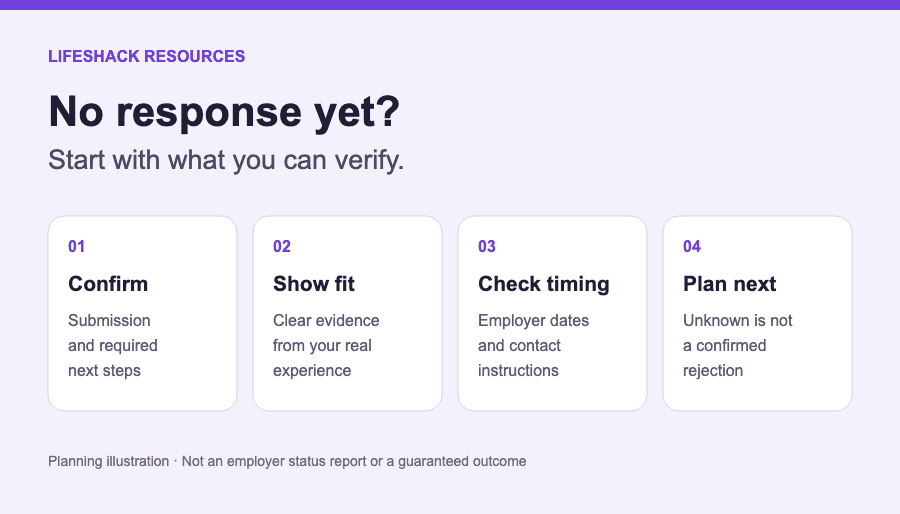
If you never hear back from job applications, first verify that each application was submitted, check the employer's review schedule, and review how clearly your experience meets the role's requirements. Follow up through an appropriate contact when the employer's instructions allow it. Keep looking elsewhere while the outcome remains unknown.
Silence is frustrating, but it does not tell you whether a recruiter read your resume, a system screened an answer, the job was filled, or the team has not made a decision. You do not need to diagnose the employer's motives to decide what to do next.
This guide is for applications that have not reached an interview. If you have already spoken with the employer, use the separate post-interview follow-up plan. A thank-you note, an application-status inquiry and an interview follow-up serve different purposes.
Before changing your resume, identify the situation
| What you can verify | What it does—and does not—tell you | Useful next step |
|---|---|---|
| A submission confirmation or completed application appears in the employer's portal | You have evidence of submission, not evidence of human review | Save the confirmation and check the stated process |
| An upload failed or a required task is still incomplete | There may be a delivery or completion problem | Use the employer's support instructions; do not assume another application is needed |
| A closing date or first-review date has not passed | Review may follow that schedule | Check the actual posting instead of counting only days since you applied |
| The portal displays a status you do not understand | A label alone may not explain what happened | Read the employer's definition; consult our status guide for questions to ask |
| There is an explicit rejection | This application has a communicated outcome | Record that outcome and review the next suitable opportunity |
| There is no update and no stated timetable | The outcome is unknown | Consider one appropriate inquiry, then continue your search |
An absent confirmation is a reason to check—not proof that submission failed. Search spam folders, confirm which email address you used, and inspect the application record if the employer provides one. Do not create duplicate accounts or repeatedly submit to the same requisition just to get attention.
Step 1: Check the role and the application you actually sent
Use the saved posting and your submitted materials, rather than the version of your resume you have since improved.
- Eligibility and requirements: Did the role require a license, location, work arrangement or qualification you do not have? Answer application questions accurately; do not change a truthful answer to try to bypass screening.
- Application completeness: Was an assessment, portfolio, cover letter or other separate task required? Follow its deadline and submission instructions.
- Evidence of fit: Can a reader find relevant experience for the role's main responsibilities without guessing? Check that your contact details and links work.
- Employer timing: Is review rolling, after a closing date, or in batches? A long-open posting does not tell you when your particular application will be considered.
For one documented example, the University of Washington's staff-hiring process distinguishes resumes generally reaching hiring managers after a fixed closing date from open-until-filled roles, where resumes may become available as they are moved forward. That is one employer's process, not a rule for every company. For more on posting age versus actual deadlines, see how soon after a job is posted to apply.
Is the ATS automatically rejecting my resume?
You cannot determine that from silence. Automated screening is possible, but its rules vary. Greenhouse's Auto-reject documentation, for example, describes employer-configured rules based on answers to application questions. This does not prove that a missing keyword, a particular font or an automated resume score caused your outcome.
Follow the employer's accepted file types, inspect the uploaded document, and correct any inaccurate autofilled fields before submitting. Readable formatting helps communicate your evidence; no format or keyword list guarantees a review or interview.
Step 2: Make the next application easier to evaluate
Tailoring should make your real experience clearer, not imitate every phrase in the posting. Pick a few important requirements and connect each to evidence you can defend.
Illustrative example: if a job requires reporting and stakeholder communication, “Prepared a weekly renewal report and explained account risks to the sales team” is more informative than “Responsible for reports”—but use it only if it describes work you actually did. Add a result or scale only when you can substantiate it. Do not borrow invented percentages from a template.
Before submitting your next application:
- Put the most relevant experience where a reader can find it quickly.
- Use the employer's terminology when it accurately describes your work.
- Check dates, role titles, contact information and any generated text.
- Open the final file and follow the requested submission format.
Ask a trusted reviewer to compare one specific posting with your application. “Which required capability is hardest to find evidence for?” is a more useful question than asking whether a resume will “beat the ATS.” A better document can improve clarity; it cannot resolve an employer's budget, hiring priorities or applicant pool.
Step 3: Follow up based on the employer's process
Start with the posting, confirmation message and any recruiter instructions. If they say not to contact the team or that only shortlisted applicants will hear back, respect that. If a review window is still open, let it pass. Use a contact provided for recruitment; do not message unrelated employees or guess private addresses.
There is no universal seven-day rule. The University of Melbourne's career guidance recommends following an announced timetable and suggests roughly two to three weeks when none is communicated. Treat that as one career service's guideline, not a promised employer response time or a reason to override a later review date.
If there is a suitable contact and enough time has passed, send a short inquiry with the role and application date. You do not need another full cover letter.
Application-status inquiry you can adapt
Subject: Application status — [role / requisition ID]

Hello [name],

I submitted my application for [role / ID] on [date]. Is there
an expected review timetable or a next step I should complete?

I remain interested in the work on [specific, relevant area].
Please let me know if any required information is missing.

Thank you,
[your name]
This is an original example, not a tested response-rate technique. Replace the placeholders and keep only statements that are true. If you receive an automated reply with different instructions, follow those instructions. An inquiry does not move your application to the front of a queue or guarantee an answer.
Step 4: Separate an unknown outcome from your next action
Keep a record of the employer, requisition, submission date, materials, stated review date, last contact and next action. Store only what you need and avoid including other people's private information in shared spreadsheets.
Use two separate ideas in your notes:
- Employer outcome: no update, interview invitation, rejection, offer, or another status actually communicated.
- Your action: wait until a date, check a missing document, send one inquiry, or stop active follow-up.
Stopping follow-up is not the same as being rejected or withdrawing. Unless you intend to withdraw, do not click a withdrawal control to tidy your tracker. You can write “No update; no further outreach planned” while leaving the application open.
The free job-application tracker offers a standalone spreadsheet starting point. Read its instructions and keep your own next-action notes distinct from the employer's status. It is not a live connection to every employer or a record of decisions the employer has not communicated.
Review patterns without inventing a success threshold
Group similar roles and keep recent applications separate from those whose announced review windows have passed. Count actual interview invitations separately from automatic acknowledgments, and retain unanswered applications as unknown rather than confirmed rejections.
For example, six applications submitted yesterday and six whose review dates passed last month are not twelve equivalent “failures.” This is a fictional bookkeeping example, not a recommended application target. Small samples, different employers and different review schedules limit what a response rate can tell you. There is no reliable personal diagnosis in a universal percentage cutoff.
If you repeatedly receive no invitations for otherwise suitable roles, review targeting, evidence and submission completeness with someone who understands your field. If invitations arrive but progress stops after interviews, use an interview debrief instead of assuming your resume is the only problem.
Where LifeShack fits
LifeShack is an AI auto-apply agent that finds matching roles, prepares tailored application documents and completes supported applications using your information. It does not make employers reply or reverse a rejection. The follow-up message above is yours to review and send through the employer's appropriate channel.
Read how Auto Apply works before choosing it. You can set preferences, block companies and pause Auto Apply, but applications are sent without individual pre-submit review. If approving every application matters to you, apply directly instead. A standalone spreadsheet can remain useful alongside either approach.
You can start with 5 free application credits, with no credit card required. Completing checkout activates Auto Apply, so review your information and preferences first.
Common questions
Does no response mean I was rejected?
No. It means you do not have a communicated outcome. Keep pursuing other opportunities without recording an unconfirmed rejection as a fact.
Should I apply again to the same job?
Not simply because the employer is silent. Check whether it is the same requisition and whether the employer permits updates or reapplications. If the role was reposted, use the reposted-job checklist before deciding.
Should I keep emailing until someone answers?
No. Respect the employer's contact policy. One appropriately timed inquiry may be enough; a further message should have a real purpose, such as requested information, rather than a daily reminder. Keep the rest of your search moving.
Sources checked September 18, 2026. The checklists and message example are editorial guidance, not evidence of an employer's internal decision or a guaranteed outcome.