2027 New-Grad Job-Search Timeline: Get Hired Before Graduation
by Patrick Da Costa Guimarais • Last Updated 9/28/2026
By Patrick Da Costa Guimarais, founder of LifeShack. Updated September 2026.
If you are graduating in 2027, the most useful thing to know is that the fall deadline you are worried about mostly does not exist anymore.
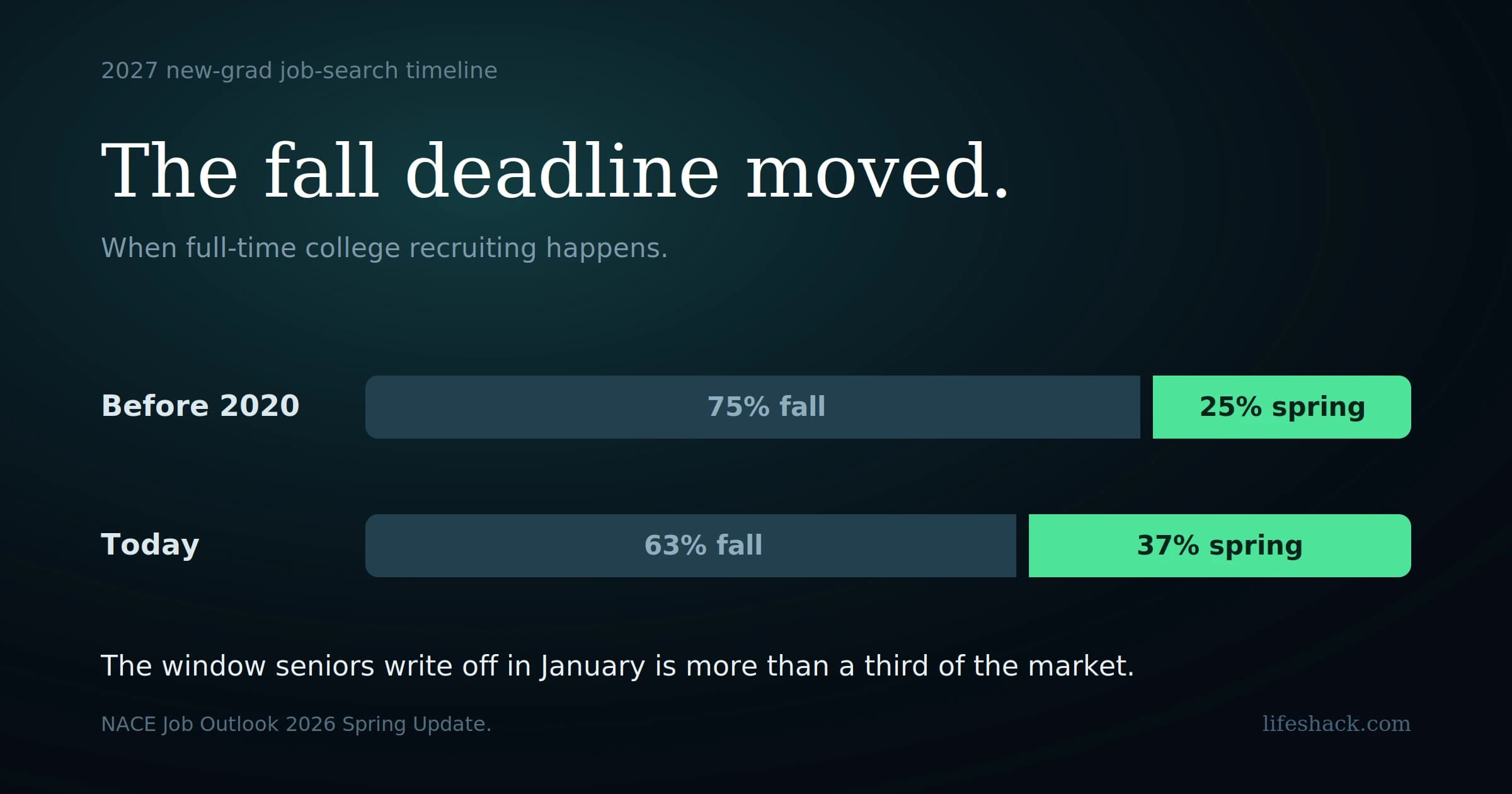
Before the pandemic, roughly three-quarters of full-time college recruiting happened in the fall. In NACE's most recent data, the share taking place in spring has risen to 37% for full-time hires. More than a third of new-graduate hiring now happens in the second half of the academic year, and that share has been climbing.
That single shift changes how a senior year should be structured. The fall is where structured programs and return offers resolve. The spring is where the larger and more fragmented part of the market hires, and it is the part written off in January by people who believe the window closed.
This covers where the cycle sits, what each sector does when, and a month-by-month plan from now through graduation.
The market you are graduating into
For the Class of 2026, employers initially projected a 1.6% hiring increase in the fall survey, then revised that to 5.6% in the spring update. A plurality of 45% had called the market fair, NACE's lowest rating and the weakest employer confidence reading since 2021, while 85.6% said they would increase or maintain new-graduate hiring.
Two things are worth taking from that. Fall projections have recently understated the year, so an early pessimistic number is not the final number. And employer sentiment and actual hiring volume move separately, so a market described as fair still hired.
The Class of 2027 projection is not published yet. NACE collects that survey in late summer and reports in the fall, with a spring update following, so the first figure you see will be an early read subject to revision.
The number that has been stable across every recent cycle is the experience gap. Graduates who completed an internship or co-op were hired at 81.6% within three months of graduating, against 40.7% for those with no work experience. Nothing else in the data comes close to that spread.
Where the cycle sits today
If you interned last summer, your return offer is the main event this fall. NACE found 63.1% of eligible interns accepted a full-time offer for 2024-25, a five-year high. Return offers typically resolve between September and December, and they are the single highest-probability path available to anyone who has one in play. Treat everything else this fall as a hedge rather than a plan.
If you are targeting banking, consulting, or a similar on-cycle track, those processes recruited you during junior year through the summer internship. If you do not have an offer from that path, the on-cycle route for 2027 is behind you and the realistic options are boutiques, regional firms, off-cycle roles, and the tier below the household names.
If you are in almost any other field, you are on time. The fall covers rotational and leadership development programs, large technology employers, and structured graduate schemes. The spring covers most of the rest of the economy.
The timeline by sector
August through November 2026. Rotational and leadership development programs at large corporations, big technology new-grad roles, aerospace and defense, and government agencies with long lead times. Return offers resolve here. Campus career fairs concentrate in September and October and are worth more for seniors than students assume, because employers attending are hiring now rather than building a pipeline.
December 2026 through February 2027. The quiet stretch, and the most underrated one. Fewer students are applying, many employers get new headcount approved in January, and roles posted in this window compete against a thinner field. Federal and state government hiring runs on its own calendar through this period with firm deadlines.
February through May 2027. The largest volume window. Mid-size and regional employers, nonprofits, healthcare systems, education, startups, and anyone who staffs against need rather than a cohort calendar. This is the 37% that used to be a much smaller share.
May 2027 onward. Hiring does not stop at graduation. Employers who lost candidates to competing offers reopen requisitions in June and July, and summer is a genuine hiring season rather than a dead zone.
Month by month from here
September and October 2026. Resume finalized against two target tracks rather than five. Attend the career fairs, since seniors get disproportionate value from them. Apply to rotational programs and large technology roles, which are open now. If a return offer is in play, get clarity on its deadline, because it will constrain everything else.
November 2026. Peak application volume for fall-cycle roles. Also the month to line up references, which takes longer than anyone plans for.
December 2026. Application volume drops off sharply, which is the arbitrage. Employers posting into an empty field in late December and early January get a fraction of the usual applicant pool.
January 2027. New headcount lands. Set alerts and check target employers directly, since much of this posts without fanfare.
February through April 2027. The largest window. Widen the target list rather than narrowing it, and weight toward employers who hire continuously rather than in cohorts.
May 2027. Keep applying through graduation and past it. If you have an offer you are unsure about, the decision deadline is a negotiation, and asking for two more weeks is normal.
What employers are screening for in this cycle
Skills-based hiring is now the majority approach. NACE's Job Outlook 2026 found 70% of employers using it, up from 65% the prior year, with 71% of those applying it at least half the time. The practical translation is that a claimed skill needs a situation attached to it. Employers said they want candidates to describe specific problems they solved rather than list competencies.
Teamwork, problem-solving, and communication are the evidence employers said they look for on entry-level resumes, and the word doing the work there is evidence rather than mention.
AI familiarity has become an expectation for early-career talent rather than a differentiator. Naming the tools you use and being able to explain what you verified is now closer to baseline than to an edge.
If you graduate without a job
This happens to a large share of every graduating class and it is not the outcome the panic makes it out to be.
The 81.6% figure for graduates with internship experience is measured within three months of graduation, not at graduation. The measurement window is the point. A substantial part of every class signs in June, July, and August.
Three things make that period productive rather than dead. Employers reopen roles in early summer when accepted candidates fall through. You have full days to apply rather than the hours left over after class. And the applicant pool thins out as the people who signed in spring leave it.
What does not help is waiting until August to start, or treating the summer as a break before the search resumes in the fall.
The math on a senior-year search
A full-time search targeting the spring window is a wider search than the fall one, because the spring market is fragmented across thousands of employers who do not run cohort programs and do not come to campus.
That means more applications rather than fewer, at the point in the year when a final semester, a thesis, and a job search compete for the same hours.
Each application runs roughly forty minutes to an hour once you count finding the role, tailoring the resume against it, and the twenty to forty minutes every applicant tracking system takes, since each one wants an account created and a work history retyped into fields your attached resume already contains. A hundred applications across a spring semester is sixty to a hundred hours, most of it duplicated data entry that no recruiter ever sees.
That is the layer LifeShack removes. It searches for roles matching your background and constraints, tailors the resume and cover letter to each posting, submits across the eleven-plus applicant tracking systems employers run on, including Workday, Greenhouse, Lever, iCIMS, and Ashby, and keeps every application in one place. There is no queue of drafts waiting on your approval and no point where the form comes back to you.
Three questions separate the tools in this category: does it find the roles or do you paste in links, does it tailor per posting or attach one file, and does it submit or does it prepare and stop. Most stop before submission, which leaves the largest cost exactly where it was.
What stays with you is choosing what you want, preparing for the interviews that come back, and deciding between offers.
Frequently asked questions
When should you start applying for jobs before graduation? Early in your final fall, around August through October, for rotational programs, large technology employers, and government roles. Most other hiring happens between February and May, and 37% of full-time college recruiting now takes place in the spring.
Is it too late to find a job if you are graduating in six months? No. More than a third of new-graduate hiring happens in the spring semester, up substantially from pre-pandemic levels when roughly three-quarters of full-time recruiting was completed in the fall.
How long does a new-grad job search take? Most graduates who find work do so within three months of graduating. NACE found 81.6% of graduates with internship or co-op experience were hired within that window, against 40.7% for those without work experience.
What is the job market like for the Class of 2027? The projection is not published yet, since NACE surveys in late summer and reports in the fall. For the Class of 2026, employers projected a 1.6% increase in the fall and revised it to 5.6% in the spring, which is worth knowing before reacting to an early number.
Do most people have a job at graduation? No, though the assumption is widespread. A substantial share of every class signs during the summer after graduating, partly because employers reopen roles in June and July when accepted candidates fall through.
How many applications does a new-grad job search take? More than the typical plan accounts for, particularly if you are targeting the spring market, which is fragmented across employers who do not run cohort programs. Plan for a wider target list rather than a narrower one.
What are employers looking for in new-grad resumes? Evidence rather than claims. NACE found 70% of employers using skills-based hiring, and employers said they want specific examples of problems solved using teamwork, problem-solving, and communication rather than a list of competencies.
Should you apply to jobs before you graduate or after? Before, and keep going after. Starting in the fall of senior year captures the structured programs, and continuing through spring and into the summer captures the larger share of the market that hires on rolling need.
Sources
NACE Job Outlook 2026 and Job Outlook 2026 Spring Update. NACE 2026 Internship & Co-op Report. NACE data on fall and spring recruiting distribution and first-destination outcomes.