How Long Does It Take to Hear Back After Applying for a Job?
by Patrick Da Costa Guimarais • Last Updated 9/28/2026
By Patrick Da Costa Guimarais, founder of LifeShack. Updated September 2026.
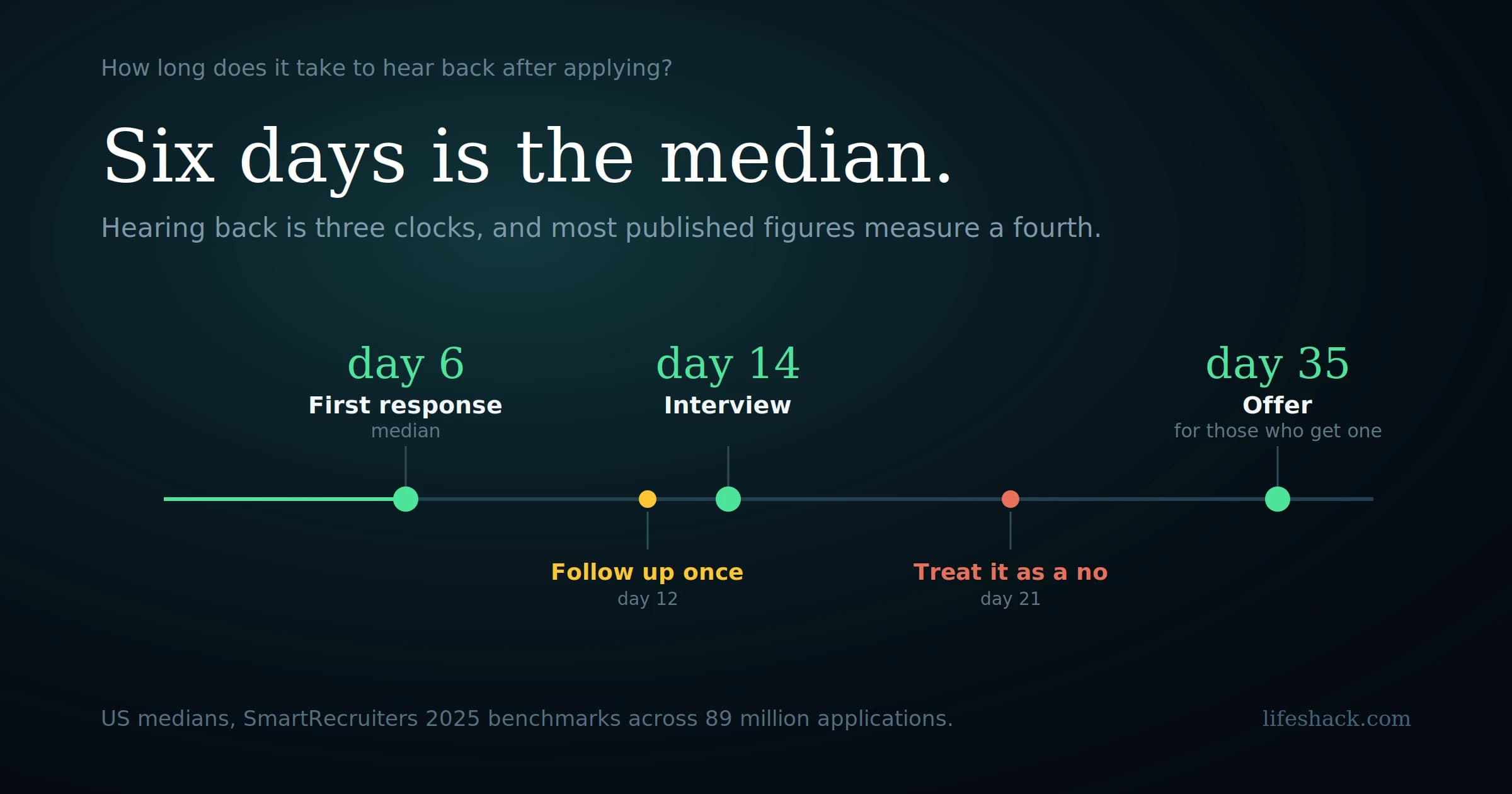
The median first response in the US arrives about six days after you apply. Roughly 37% of applicants who hear anything hear within a week, and 44% within two.
If an employer is going to move on your application, it usually happens in the first eight or nine days. After that you are in the slow tail, and the probability of a response drops steeply rather than gradually.
Those are the numbers most people are looking for. The rest of this page covers why the wait varies so much, why most published figures answer a different question, and the point at which waiting stops being worth it.
Hearing back is three separate clocks
Treating this as one number is where the confusion starts. SmartRecruiters' benchmark data, built on 89 million applications across 95 countries, separates the US process into distinct stages.
About 6 days to review. The gap between applying and any human or system decision on your application.
About 14 days to an interview. From application to a scheduled first conversation, for the applications that convert.
About 35 days to the end. Application through to offer, for the people who get one.
Ashby's 2026 data, drawn from more than 54 million applications, puts median time-to-hire at 30 days for business roles and 40 for technical ones, which is consistent.
So a candidate who hears nothing for three weeks and concludes it is over is reading the wrong clock. A candidate who has heard nothing for three weeks and has not been contacted at all is reading the right one.
Most quoted numbers answer a different question
This is the part worth understanding, because it explains why the figures you find contradict each other.
Greenhouse's 2026 data puts time-to-fill at 59.67 days, up 37% from 43.64 days in 2022. SHRM's 2026 benchmarking puts median time to fill for non-executive roles at 39 calendar days.
Neither of those tells you when you will hear back. Time-to-fill measures a requisition from the day it opens to the day someone starts, which includes sourcing, the whole interview loop, offer negotiation, and the hired person's notice period. It is a hiring-side operations metric describing the journey of the one person who got the job.
The candidate-side question is different. You are asking when a decision touches your application, and that is the six-day clock rather than the sixty-day one.
One more caution on sources. The most widely cited role-level timing dataset, Glassdoor's interview duration research, was published in 2017 and is still quoted in articles written this year. Treat any by-role breakdown with a date check.
What changes your wait
Volume on the role. SmartRecruiters' funnel data puts a typical role at roughly 73 applicants, 3 interviewed, and 1 offer. Ashby's 2026 figures show applications per hire have tripled since 2021, with roles now averaging more than 300. A posting with 400 applicants moves slower than one with 40, and you cannot see which you are in.
Seniority. Entry-level and high-volume roles move fastest because the pool is large and the criteria are clear. Senior and specialized roles run considerably longer, and a meaningful share of senior searches exceed 90 days.
Industry. Retail and hospitality hire quickly because they need people in seats. Technology, engineering, finance, and healthcare run longer, and government agencies are slower than almost anything in the private sector.
Whether a human has seen it yet. Many teams review in batches on a schedule rather than continuously, so a role posted Monday may not be looked at until the following week regardless of when you applied.
The labor market itself. Indeed Hiring Lab found that a one-point rise in the quits rate cuts time-to-hire by roughly 2.7 days across the market, so the same application takes longer in a soft market than a tight one.
Why it got slower
The cause is measurable and it is not that recruiters became less responsive.
Greenhouse's data shows applications per recruiter per year went from 146 in 2022 to 746 in 2025, a 411% increase. That is more than sixty applications landing in a single recruiter's queue every month, against a headcount that did not grow with it.
SmartRecruiters states the consequence plainly: recruiters either rely on automation or they cannot examine and respond to most candidates. Silence is a capacity outcome rather than a judgment, which does not make it less frustrating and does change what you should read into it.
The decision rule
Waiting is expensive because it feels like doing something. Here is when each action is worth taking.
Days 1 to 5. Do nothing. You are inside the median. Keep applying elsewhere.
Days 6 to 9. The median has passed and most responses that will come have come. Still too early to act.
Day 10 to 14. Follow up once, briefly, to the recruiter or hiring manager if you can identify them. One message, three sentences, no apology for following up.
Day 21. If there has been no signal at all and you have followed up once, treat it as a no and reallocate the time. The role may still come back, and planning around that is a bad use of your attention.
Any point. Keep applying throughout. The single biggest error in this whole process is pausing your search while waiting on an outcome you do not control.
The portal status is not a signal. An application can read "in progress" long after a role is filled or paused, because updating it is manual and low priority. Follow-up timing should come from the six-to-eight day benchmark rather than from what the system says.
What the silence usually means
Most applications produce no response at all, and the reasons are structural rather than personal.
It has not been reviewed yet. Batch review, a busy week, a recruiter covering four searches.
The role was paused or cancelled. Reqs get frozen mid-process and the posting frequently stays live.
You are the second choice. Teams hold a backup candidate without telling them, and you hear nothing until the first choice accepts or falls through.
A structured field ruled you out. Location, work authorization, salary expectation, or a required certification. Mechanical and instant, with no human involved.
The listing was not a live role. A share of postings have no active intention to hire behind them, with estimates varying widely by methodology.
None of these is something you can fix by waiting longer.
The part that changes the math
Every timeline on this page describes one application. The useful conclusion is about all of them at once.
If the median response is six days and most roles produce nothing, then the variable you control is how many applications are in flight when that six-day window opens. Ten applications sent over a month produce a thin, anxious search where each silence feels significant. Forty sent in the same month produce a steady flow of outcomes, and no single silence means anything.
That is why the answer to "how long should I wait" is usually "you should not be waiting."
The obstacle is that each application costs forty minutes to an hour once you count finding the role, tailoring, and the twenty to forty minutes every applicant tracking system takes, since each one wants an account created and a work history retyped into fields your attached resume already contains.
LifeShack removes that layer. It searches for roles matching your background and constraints, tailors the resume and cover letter to each posting, submits across the eleven-plus applicant tracking systems employers run on, including Workday, Greenhouse, Lever, iCIMS, and Ashby, and keeps every application in one place, so you can see the whole portfolio rather than refreshing one inbox.
What stays with you is deciding what to apply to and showing up to the conversations that come back.
Frequently asked questions
How long does it take to hear back after applying for a job? The median first response in the US arrives around six days after applying. About 37% of those who hear anything hear within a week and 44% within two. Most responses that will arrive do so within the first eight or nine days.
Is no response after two weeks a rejection? Usually, though not always. Roles get paused, reviewed in batches, or held open while a first-choice candidate decides. Follow up once around day 10 to 14, then treat day 21 with no signal as a no.
How long until you hear back about an interview? About 14 days from application to a scheduled first interview in the US, for applications that convert. The full process to an offer runs roughly 30 to 40 days depending on whether the role is a business or technical one.
Why do employers take so long to respond? Volume. Applications per recruiter went from 146 a year in 2022 to 746 in 2025, a 411% increase, with no matching growth in recruiting headcount. Most teams either automate the response or cannot respond to the majority of applicants at all.
When should you follow up after applying? Around day 10 to 14, once, briefly. Earlier than that you are inside the window where a response was always likely to arrive. Later than day 21, a follow-up rarely changes the outcome.
Does the application status in the portal mean anything? Rarely. A status can stay unchanged long after a role is filled or cancelled, because updating it is manual and low priority. Use the response-time benchmark to time your follow-up instead.
Do some industries respond faster than others? Yes. Retail and hospitality move fastest, technology, engineering, finance and healthcare run longer, and government hiring is the slowest of the common categories. Entry-level roles move faster than senior ones within any industry.
What percentage of applications get a response? A minority. SmartRecruiters' funnel data puts a typical role at roughly 73 applicants, 3 interviewed, and 1 offer, and most candidates who are not advanced receive no communication.
Sources
SmartRecruiters 2025 Recruiting Benchmarks, covering 89 million applications across 95 countries. Ashby 2026 Talent Trends Report, covering more than 54 million applications. Greenhouse 2026 Hire Standard and recruiting benchmarks. SHRM 2026 benchmarking data. Indeed Career Advice response-time data and Indeed Hiring Lab research on labor market effects.