How Many Internships Should You Apply To? A Practical Weekly Plan
by Patrick Da Costa Guimarais • Last Updated 9/25/2026
By Patrick Da Costa Guimarais, founder of LifeShack. LifeShack publishes this guide and offers application automation; the planning examples below are not measured customer outcomes.
There is no verified number of internship applications that guarantees interviews or offers. Start with a weekly target you can complete accurately, then adjust it to the suitable roles available, their deadlines and your interview workload.
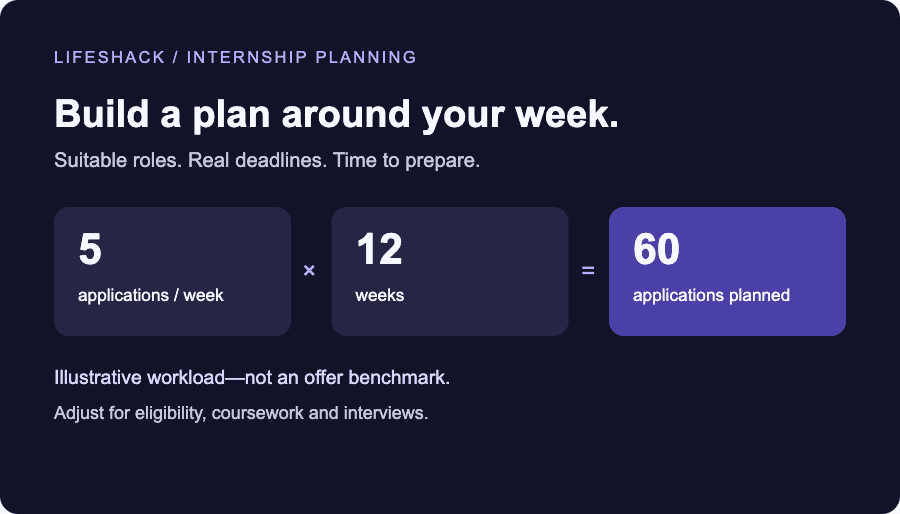
For a concrete starting plan, try five suitable applications a week for twelve weeks: 60 applications if you sustain that pace. That is an illustrative workload, not a finding that students need 60 applications. A smaller target may make more sense during exams or when applications require portfolios, assessments or detailed essays.
This guide helps you choose and revise that target. For the broader full-time search, see how many applications it takes to find a job. For deadlines rather than volume, use the internship application timeline.
Start with capacity and eligible roles
Before choosing a seasonal total, write down:
- Your available hours each week, including sourcing, applications, assessments and interview preparation.
- The programs for which you meet the stated class-year, graduation-date, location and work-authorization requirements.
- Each employer's actual deadline, any rolling-review instructions and any required assessment deadline.
- The work each application needs: a resume update, portfolio selection, referral conversation or employer-specific answer.
Treat required eligibility differently from a preferred skill. Do not misstate a graduation date or authorization answer to reach a weekly quota. If a requirement is unclear, ask the employer or your careers adviser.
Apply to a suitable open role when your materials are ready. Do not hold it until your usual application day if an earlier deadline matters. Nor should you assume that every employer reviews applications in arrival order: employer instructions take precedence over a generic calendar.
What published benchmarks can—and cannot—tell you
Three different denominators often get mixed together:
| Source | What it measures | What it does not establish |
|---|---|---|
| Handshake's 2025 Internships Index, Appendix A | Its platform data shows 109 applications per internship posting in 2024–25, versus 62 in 2023–24 and 43 in 2022–23. Technology averaged 273 and financial services 192 in 2024–25. | Applications per posting are not applications per student, the number you need to send, or your chance of an offer. |
| CareerPlug's 2025 Recruiting Metrics Report | The report covers 2024 activity at more than 60,000 small businesses and over 10 million applications. Employers invited about 3% of applicants to interview. | This is not an internship-only or individual-student benchmark. Industries and hiring processes differ. |
| NACE's 2026 internship survey summary | It reports an average intern-to-full-time conversion rate of 63.1% for 2024–25 interns at participating organizations. | This describes a later stage, after someone has secured an internship. It is not an internship application's offer probability. |
These sources explain different parts of the market. Combining their percentages does not produce a reliable personal application target. We have not verified a representative study that establishes a universal 40–80 application requirement or a pass/fail interview-rate threshold for students.
Track results without treating pending applications as failures
Keep one row per application, not one row per interview round. Record company, role, employer posting link or ID, date applied, source, current status and the next action. Save the version of your materials you submitted.
The free job-application tracker is an optional starting point; a simple personal sheet works too. Adapt its columns to your process. It is separate from LifeShack's application dashboard.
Review comparable groups, such as applications sent in the same month to similar roles. Record both the number submitted and how many are still pending, and date each review. Employer response times vary, so a fresh application is not equivalent to a closed rejection.
For example, if two of twenty applications have produced an interview so far, the observed rate is 10%. If twelve are still pending, the cohort is unfinished. One additional interview would move that same small cohort to 15%. Neither reading proves that your materials are strong, weak or responsible for the result.
Use the observations to choose a next check:
- Few suitable roles found: widen your employer list or sourcing channels before increasing your application quota. The internship website guide can help you choose sources.
- Repeated eligibility mismatches: revise the target list and verify the screening requirements.
- Older applications with little response: inspect fit, resume evidence, portfolio quality and application completeness with your careers adviser. Silence alone does not identify the cause.
- Interviews arriving: reserve time to prepare and decide whether to reduce applications temporarily.
- Interviews without offers: seek specific feedback where available and practise relevant interviews. More applications and better preparation can both matter; a fixed number of STAR stories is not a guaranteed fix.
A weekly plan you can change
This example uses a five-application target. It is a scheduling aid, not an optimum proven by hiring research.
Monday: source and prioritize. Review alerts and employer career pages. Keep the roles you would genuinely accept, verify eligibility and record deadlines. Prioritize work by fit and urgency, not just posting age.
Midweek: prepare and submit three applications. Adapt your truthful experience to each role, check the required fields and save confirmation. If three will not fit in your available time, reduce the number rather than skip verification.
Weekend: finish two more and review the pipeline. Update statuses, handle assessments and leave time for interviews. Add promising employers you missed. Rebalance the coming week around actual deadlines and coursework.
Each month: review a dated cohort. Compare like-for-like roles and keep pending outcomes visible. Change one aspect you can explain—such as targeting, evidence in your resume or a sourcing channel—and record when you changed it. Small samples may remain inconclusive.
Five applications over twelve weeks totals 60. Four over twelve weeks totals 48. Neither total promises an outcome. If you choose a front-loaded schedule of eight, five and three per week for four weeks each, the total is 64, not 60.
Recruiting calendars differ by employer and program. Handshake's 2026 report summary describes earlier fall activity on its platform, but does not give every internship a universal two-window calendar. For a spring placement, check the spring 2027 guide and the employer's current page well before the placement begins.
Budget time from your own applications
Time the work on a few applications: finding the role, checking eligibility, tailoring documents, completing forms and assessments, and logging the result. Reuse truthful information where possible, but do not assume every employer asks the same questions.
As illustrative arithmetic, 60 applications averaging 30 minutes each would take 30 hours; at 60 minutes each, they would take 60 hours. Those are assumptions, not measured student averages or promised savings. Interviews, travel and separate assessments may add time.
A useful target leaves room for those later stages. It should not require you to sacrifice accurate answers just to keep a counter moving.
Where automation fits—and where it does not
Before using a tool, ask whether it helps you discover roles, prepare documents, fill forms or actually submit applications. Also check whether you can review every application before it is sent and whether your particular workflow is supported. Different tools make different tradeoffs; a document or tracking tool can be the right choice if you want hands-on control.
LifeShack's AI Auto Apply finds matching roles, prepares tailored resumes and cover letters, and completes supported applications using your saved information. Auto Apply submits without individual pre-submit review. You can pause it and add company blocklists, but these controls do not recall an application already sent or guarantee perfect matching.
Not every employer workflow is supported. Employer-specific questions or portal changes may need additional input. An ATS guide or platform name does not prove coverage of every internship program, school portal, assessment or deadline. We do not promise first-week submission, interviews or offers.
Use a manual workflow when you need to choose and approve each specific application, follow an employer's restrictions, submit a bespoke portfolio or control deadline-critical delivery. Keep your information accurate whichever route you choose.
If supported, delegated applications fit your needs, start with 5 free application credits. No credit card is required for the introductory offer. Review the activation disclosure before starting; this is an optional product path, not a prerequisite for using this guide.
When to reduce or stop applications
Rebalance when interviews or assessments need attention, when your coursework or health requires a smaller workload, or when the suitable openings are exhausted. After accepting an offer, follow your employer and school commitments and withdraw from other processes appropriately.
Low response can justify reviewing your approach, but a universal 5% threshold should not decide whether you stop. Look at eligibility, pending outcomes, elapsed time and actual feedback together.
Frequently asked questions
How many internships should I apply to? Choose a sustainable target from suitable open roles and your available time. Five a week for twelve weeks is an illustrative 60-application plan, not an evidence-backed requirement or guarantee.
How many internship applications lead to an offer? There is no verified universal number. Applications per posting, employer interview rates and intern-to-full-time conversion rates measure different stages and cannot be substituted for your personal odds.
Should I tailor each application or apply to more roles? Meet hard requirements and submit accurate, relevant materials first. Increase the target only if the available roles and your time support that quality. Reuse truthful material without inventing qualifications.
What is a good internship interview rate? No universal student threshold is established here. Track comparable dated cohorts, show pending applications, count each application once and seek feedback before attributing a change to your resume.
When should I start? When relevant programs open and your application is ready. Verify dates and review rules on each employer's page; do not assume all industries share the same seasonal windows.
Can I automate internship applications? Some tools support some workflows. LifeShack's Auto Apply does not provide individual pre-submit approval or cover every application. Keep review-required, restricted and deadline-critical applications manual.