Spring 2027 Internships: Opportunities, Deadlines and Application Guide
by Patrick Da Costa Guimarais • Last Updated 9/25/2026
By Patrick Da Costa Guimarais, founder of LifeShack. Source review: September 2026.
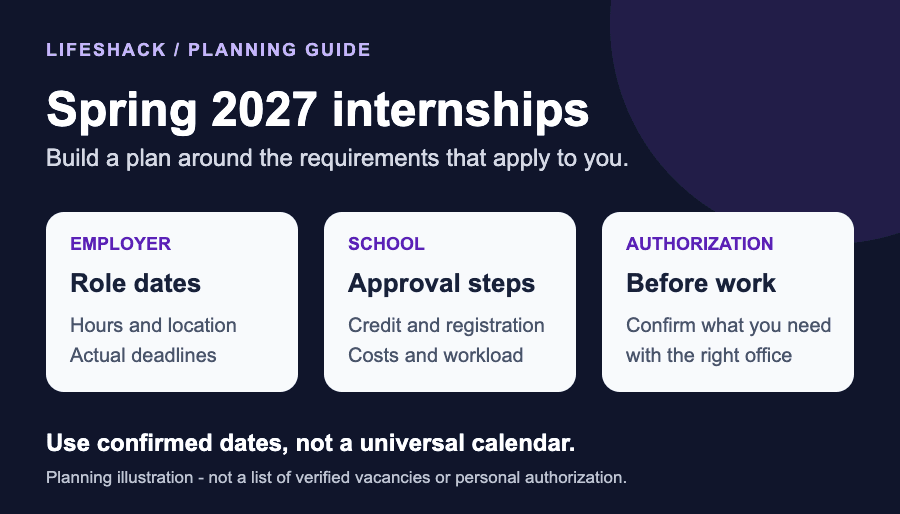
For a spring 2027 internship, start with three checks: the employer's actual start and end dates, a schedule you can sustain, and any school or work-authorization requirements that must be satisfied before you begin. A role labeled "spring" might fit a January-to-May semester, extend into summer, or follow a different academic calendar.
There is no single opening date or application deadline for spring internships. Search during fall 2026, but use each posting's instructions rather than waiting for a supposed peak month. If you find a role later, check whether its dates and remaining approval steps still work. An open application form is not proof you can start in time.
This guide helps you choose a format, build a calendar, ask the right questions and evaluate an offer. The sample schedule is a planning aid, not a list of confirmed employer or university deadlines. Credit, enrollment and immigration requirements need confirmation from the offices responsible for your own situation.
Choose the internship format before building your list
The commitment matters more than the season in the title. Start with these three possibilities, then verify the hours and dates in each posting.
| Format | What to clarify | What could rule it out |
|---|---|---|
| Part-time semester internship | Weekly hours, required meeting times, location, commute, exam-period flexibility and supervision | Required work hours overlap with classes or other commitments |
| Full-time co-op or semester placement | Full date range, school approval, enrollment status, pay, housing and any required training authorization | The role requires an unapproved course-load change or extends beyond your availability |
| Off-cycle internship | Country, eligible graduation years, duration and whether the intake has a fixed or rolling deadline | Location, authorization or duration does not fit, even if the start date is in spring |
Don't assume an unspecified schedule is part-time or full-time. Ask before investing in a long application or changing your course registration.
For a concrete example, Northeastern's 2026-27 co-op policy defines a full-time co-op job as 32-40 hours per week and has separate approval and course-enrollment rules. That is Northeastern's policy, not a threshold every employer or school uses.
Goldman Sachs' EMEA off-cycle program describes placements lasting 3, 6 or 12 months and rolling application review. "Off-cycle" therefore does not automatically mean a three-month January placement. Check the individual role's location, eligibility and dates; this program page is not a promise of a currently open spring 2027 seat.
When to apply for spring 2027 internships
Use employer deadlines first and your planning calendar second. A fixed closing date, rolling review and a school nomination deadline are different constraints. Save the exact date, time zone and source link when they are supplied; mark missing dates as unknown rather than guessing.
Handshake's 2025 Internships Index shows that posting patterns differ by employer size. Its Appendix B describes September and January peaks among larger employers and more distributed recruiting among smaller ones. Those are historical platform posting patterns, not the start dates of the internships or a spring 2027 deadline calendar.
This means you should not abandon the search solely because one company's cycle closed. It also does not justify delaying an application that is already ready. Follow the particular employer's review instructions, and leave time for assessments, references or other required steps.
For broader seasonal planning, use the separate internship application timeline. Keep this page focused on fitting a spring placement around a semester.
A sample fall-to-spring planning calendar
Move these planning checkpoints earlier if an actual deadline requires it. None of the dates below overrides your school or employer.
| Planning period | Useful action | Evidence to have before moving on |
|---|---|---|
| September 2026, or as soon as you begin | Define available dates, hours, locations and budget; ask your school about eligibility and approval steps | Written answers or the current official policy, with unresolved questions listed |
| September-October | Build a list from your campus career service and employer sites; prepare a truthful resume and relevant work samples | Current role URLs, requisition identifiers, eligibility requirements and real deadlines |
| October-November | Submit suitable applications, complete required assessments and discuss any credit or schedule changes | Submission confirmations and separate school approval/registration dates |
| December | Follow up when appropriate; compare offers and check holiday office closures | Written role terms and enough time for all outstanding approvals |
| January 2027 and later | Consider still-open roles only if the start date, term length and approvals are workable | Confirmed start date, schedule and any required authorization before work begins |
A late opportunity can be worth considering. It is not a reason to start work while permission is pending, assume a course can be added late, or accept an arrangement you cannot afford.
Are spring internships easier to get than summer ones?
The sources reviewed here do not establish better spring acceptance odds. Availability, applicant numbers, seats, eligibility and selection methods can all differ. A smaller pool would not, by itself, prove a better applicant-to-seat ratio.
Handshake's Appendix A reports 109 applications per internship in its February 2024-January 2025 platform period, versus 62 in the preceding period. This is an applications-per-posting measure, not the number a student needs to submit, a summer-only statistic or a spring acceptance rate. It cannot support a rule that every student should send at least 30 spring applications.
Choose a target list based on credible fit and the time available to prepare each application. Review your progress without treating pending applications as rejections or assuming one response rate diagnoses every search. Spring experience can be valuable, but the season alone does not guarantee the same work, supervision or return-offer prospects as another program.
Academic credit: get your own program's requirements
An employer's willingness to host an intern does not establish that your school will award credit. Ask your department, internship coordinator or registrar which approval and registration steps apply before committing to a credit-dependent arrangement.
Two examples show why a universal rule would be misleading:
- Arizona's Eller College normally asks students to apply for its internship credit two weeks before the semester begins. Its page rules out retroactive credit for earlier duties and describes its own academic work and tuition requirements. It also directs students to confirm the exact deadline with the coordinator.
- NYU College of Arts and Science makes credit-bearing internships subject to department permission, academic work and regular registration deadlines. Whether the course counts toward a major depends on the department.
Do not infer your deadline from either example. Your school may require several steps with different cutoffs; a placement-approval deadline may be earlier than course add/drop. Ask whether exceptions exist, but don't build a plan that depends on one being granted.
Six questions to resolve before accepting credit
- Is credit required? Separate degree requirements, employer conditions and any applicable training-authorization requirements. Credit can also have educational value when optional; decide with your advisor rather than automatically enrolling or skipping it.
- Does this particular role qualify? Share the duties, supervisor, location, dates and weekly hours. A role being paid, unpaid or called an internship does not answer the school's eligibility question.
- Who approves and supervises it? Find out whether you need a faculty sponsor, coordinator approval, a learning agreement or employer evaluation. Get explicit agreement from the relevant people.
- What are the actual deadlines? Record application, approval, registration and any authorization deadlines separately. Confirm office processing times and closures.
- What work earns credit? Ask about site hours, academic assignments and how credit applies to your degree. Do not substitute a general federal credit-hour calculation for your department's published requirements.
- What will it cost? Ask the bursar or financial-aid office about tuition, fees, aid and enrollment effects. Add transport, housing and other costs before comparing an offer with alternatives.
Illustrative arithmetic: 10 hours per week for 15 working weeks is 150 site hours, before missed weeks or holidays. This calculates hours only; it does not establish how many credits you receive. The institution decides whether the role and academic work qualify.
Work authorization is a separate approval, not just course registration
If you are an international student, contact your designated school official (DSO) or international student office early with the exact opportunity. Do not assume that taking an internship course, having an offer, working remotely or accepting unpaid work is enough to authorize employment.
DHS's training guidance, updated August 24, 2026, directs students to work with their DSO on eligibility and obtain the appropriate authorization before practical training. For CPT, ICE's guidance says a student may begin only after receiving the endorsed Form I-20 and not before its authorized CPT start date.
There is no universal ten-business-day approval guarantee in this guide. Ask your DSO about current rules, your program, required documents and realistic processing time. Check the effect of any proposed change in employer, hours, location, dates or enrollment before acting on it. If timing is tight, discuss a later start with the employer rather than starting while approval is pending.
This is general information, not individual immigration or legal advice. Your DSO and, when needed, a qualified immigration professional can assess your circumstances.
Pay, credit and the cost of taking a role
Ask for the compensation, expected hours and any expenses in writing. A rate quoted for a different employer, city or year is not the rate for your offer. A school credit award is separate from employer pay and may involve costs of its own.
For U.S. for-profit employers, the Department of Labor's Fact Sheet #71 explains a seven-factor primary-beneficiary test for determining whether an intern is an employee under the FLSA. Academic credit is one factor; it does not automatically make an unpaid arrangement lawful. Do not treat "unpaid" as an exemption from employment rules or decide the legal status from this article alone. Seek guidance from your career office, the relevant labor authority or a qualified professional if the arrangement is unclear.
Build a practical budget: expected take-home pay, commuting, housing, food, any course costs and other work you would give up. Ask about reimbursement and payment timing. You do not have to accept an unaffordable arrangement because it might lead to a future offer.
Build a schedule that leaves room for the actual work
Map classes, study time, paid work, care responsibilities, commute and rest before promising availability. Then ask the employer which work must happen at set times and which hours are flexible. Two open weekdays might suit one team; shorter blocks may fit another. Neither is a universal requirement.
Include any internship-course assignments and meetings. Do not reduce enrollment solely on a blog recommendation: discuss academic progress, aid, housing and any immigration implications with the responsible offices. There is no credit-load/hour combination that this guide can certify as safe for every student.
At interview, ask: "What would I own during the term, who would supervise me, and how would my work be evaluated?" A meaningful project or recurring responsibility can be useful. The season and part-time label do not determine which work you will receive.
Find roles and verify the posting
Start with your campus career service, departmental or co-op office and employers' own career pages. Look for the terms employers actually use: spring intern, semester internship, winter internship, co-op and off-cycle. Check dates rather than assuming those labels are interchangeable.
Search by the work you want to learn, not only recognizable company names. Relevant possibilities might include an engineering team, local business, research group, public office, nonprofit or agency. These are places to investigate, not a verified list of organizations hiring for spring 2027. Each opportunity still needs its own eligibility, pay, supervision and timing check.
The internship-websites guide covers discovery channels. An aggregator can help you find a lead, but confirm the role through an official employer or trusted campus channel. A missing copy on one site is not conclusive proof that it closed; ask the employer when the destination or status is unclear.
Keep a simple record of the role URL, requisition, date checked, deadline if known, required steps, submission confirmation and next action. A spreadsheet or your existing tracking system is enough. Do not record an application as submitted just because a tool found the posting or prepared a draft.
Use a sustainable application routine
Reserve time for finding roles, checking eligibility, preparing accurate materials, completing forms and following up. Measure a few of your own applications before setting a weekly target; there is no established one-hour cost or required 30-application minimum for this audience.
As an illustration, a student with two 90-minute search blocks could use the first for role verification and preparation, and the second for the highest-priority ready application and outstanding steps. This is a workload example, not a forecast of how many applications or interviews it will produce.
Before submission, check:
- The application destination and posting are legitimate and current.
- Dates, location, hours and required eligibility match your circumstances.
- Every resume statement, availability answer and authorization answer is accurate.
- You have completed required assessments or other steps by their own deadlines.
- Any use of AI follows the employer's instructions, and you have reviewed the final materials.
If you are getting few responses, examine fit, completeness, elapsed time and whether outcomes are still pending. Ask a career advisor for feedback rather than diagnosing the whole search from a fixed application count. The application-volume planning guide addresses that separate planning question.
Five messages you can adapt
These templates help you ask for facts. They are not proven response-rate tactics. Replace the brackets with accurate details, and use an appropriate official contact channel.
1. Ask about academic credit
Subject: Requirements for a spring 2027 internship

Hi [name],

I'm considering a spring internship in [field]. Could you confirm:
1. Whether I am eligible for internship credit in my program.
2. The separate approval and registration deadlines.
3. Required duties, site hours, academic work and supervision.
4. Whether the credit counts toward my degree and where to confirm costs.

If an offer arrives after a deadline, is there an exception process?
I understand that an exception is not guaranteed.

Thank you,
[Name], [program/year]
2. Ask a faculty member to supervise, if required
Subject: Possible supervision for [internship course]

Hi Professor [Name],

My program requires [specific supervision/academic work] for internship
credit. I'm considering [role and duties], connected to [relevant topic].
The approval deadline is [confirmed date]. Would you be available to
discuss whether you can supervise the required work? I can bring the
current course requirements and proposed learning plan.

Thank you,
[Name]
3. Clarify hours before committing
I'm planning my spring schedule and want to confirm the role's needs.
What are the expected weekly hours and required meeting times?
My confirmed availability is [days/times]. Is there flexibility around
[specific class or exam constraint], and who would approve any change?
4. Discuss a real offer deadline
Subject: Timing for the [role] process

Hi [name],

I have another offer with a decision deadline of [date/time zone].
I'm still interested in [Company/role]. Can you share the expected
timeline and whether the remaining steps could be completed before then?

I understand that you may not be able to change your schedule.
Thank you,
[Name]
Only describe a competing offer if it exists. You can also request a reasonable extension from the employer that made the offer; neither response is guaranteed.
5. Withdraw after deciding
Subject: Withdrawing from the [role] process

Hi [name],

I've accepted another opportunity and would like to withdraw from
consideration for [role]. Thank you for your time and consideration.

Best,
[Name]
Evaluate the offer without assuming a summer or full-time conversion
Compare the written duties, supervisor, learning opportunities, pay, costs, hours, location and dates. If a return internship or full-time role matters, ask how that process works and whether your graduation timing would qualify. Prior intern conversion statistics from another employer or season do not forecast your own outcome.
When an offer deadline arrives before another process ends, use the timing message above and decide based on the actual terms and your priorities. There is no universally correct rule to accept the first offer or choose the employer with the biggest summer program.
Resolve these hard cases before accepting or starting:
- Hours exceed your approved availability: ask whether the role can change, then confirm the revised arrangement with all relevant parties. Do not assume the employer or school can waive a limit.
- Credit approval is late or refused: ask the responsible office what options exist. Do not automatically work without credit if credit, enrollment or authorization is a condition of the placement.
- A February start is offered: check the full term, supervision, school deadlines and any authorization. It may work, but "late" does not make it automatically suitable or unsuitable.
- No responses yet: separate recent/pending applications from resolved outcomes, verify required steps and ask for feedback. Keep alternatives open without indiscriminate volume.
Where LifeShack fits, and where to apply directly
LifeShack publishes this guide and sells an AI auto-apply service. Its current product focuses on full-time job searches. Do not assume that a spring internship, part-time schedule, campus-only application, co-op approval or school-credit requirement is supported because this article discusses it.
For a suitable supported job search, Auto Apply can match roles, prepare application materials and submit supported applications without individual pre-submit review. Extra input or employer steps can still be required. Check supported workflows and your actual preferences; a matching filter is not a guarantee that a role satisfies every school or authorization condition.
Use a manual employer application when you need to review every submission, meet a specific internship deadline, use a campus portal or handle school-specific information. Keep credit and authorization decisions with the responsible offices. Company blocking and pause controls have limits; pausing does not cancel billing or withdraw submitted applications.
If the supported workflow fits a separate search, you can start with 5 free application credits. No credit card is required for the introductory allowance. Completing checkout activates Auto Apply. This is an optional next step, not a promise that LifeShack will find or submit a spring internship for you.
Frequently asked questions
When do spring 2027 internship applications open?
There is no common opening date. Search during fall 2026 and follow each employer's posting, review instructions and deadline. Keep checking later opportunities when their dates and approval requirements are still workable. The sample calendar above is not an employer deadline list.
Are spring internships easier to get?
The reviewed evidence does not establish better spring acceptance odds. General applications-per-posting data cannot answer that question without comparable season-specific applicants, seats and outcomes.
Can I intern while taking classes?
Potentially, if the actual work schedule, school rules and any required authorization allow it. Confirm hours and meeting times rather than assuming every spring role is part-time. Discuss course-load changes with your advisors first.
Do I automatically get academic credit?
No. Ask your program about eligibility, approval, academic work and registration. The employer cannot award your university's credit, and policies differ by school and department. Do not assume retroactive credit will be available.
Does internship credit always cost extra tuition?
The cost depends on your school, enrollment and program. Ask the bursar or financial-aid office for your actual charges and aid implications. A school-specific example is not a universal price rule.
Can I start while CPT approval is pending?
Do not start CPT before receiving the required authorization or before its authorized start date. Speak with your DSO about current eligibility and your exact opportunity; a course registration or job offer is not a substitute for authorization.
Are unpaid internships allowed if they offer credit?
Academic credit alone does not settle that question. The applicable rules depend on the arrangement and jurisdiction. Review the official guidance and seek qualified advice rather than treating a credit offer as proof that unpaid work is lawful.
Can first- or second-year students apply?
Check the specific role's class-year, skills and enrollment requirements. The word "spring" does not remove an eligibility requirement or establish that younger students have better odds.
Can a spring internship lead to another offer?
It can, but no return offer is guaranteed. Ask about the employer's process and evaluate the current role on its actual learning, supervision and compensation, not an assumed future conversion.
Sources and scope
This is an editorial planning guide, not a hands-on test of internship automation or an inventory of open jobs. Official sources reviewed in September 2026:
- Handshake Internships Index 2025, Appendix A (printed page 30) and Appendix B (printed page 32): platform application and posting patterns, not spring acceptance odds.
- Goldman Sachs EMEA off-cycle internships: program duration and rolling-review example, not a verified 2027 vacancy.
- Northeastern 2026-27 co-op policy: institution-specific hours and approval context.
- Eller undergraduate internship credit and NYU CAS academic policies: distinct school-specific credit policies.
- DHS training guidance and ICE CPT guidance: authorization before practical training; your DSO must assess your circumstances.
- U.S. Department of Labor Fact Sheet #71: federal employee-status factors for unpaid internships at for-profit employers, not an individual legal determination.
Recheck current program rules and each role before applying or accepting. Employer vacancies and school policies can change; a September source review does not certify a later deadline or authorization outcome.