Best Internship Websites for College Students in 2027
by Patrick Da Costa Guimarais • Last Updated 9/14/2026
By Patrick Da Costa Guimarais, founder of LifeShack. Updated September 2026.
Most rankings of internship websites list ten sites, write a paragraph about each, and put them in a ranked order. The ranking is the least useful part, because these sites are not competing to do the same job. Some are where postings originate and some carry copies of those postings, some show you roles your classmates cannot see, and some show you roles that were filled a month ago.
This guide evaluates them on the three things that determine whether a site is worth your time: where its postings come from, how fresh they are, and what it costs you to apply through it. Then it gives you a stack of three to use instead of ten.
A disclosure before any of it. LifeShack builds application software, so we work alongside several of the platforms below. None of them paid for placement here, and the framework is one you can apply to sites we never mention.
The three things that separate a good internship site from a bad one
Source quality means whether a posting originates on the site or is a copy of one. Every internship posting starts in one place: an employer's applicant tracking system, usually Workday, Greenhouse, Lever, iCIMS, or Ashby. Company career pages and university portals show you that original. Aggregators show you a scraped copy, which may be days old, may link to a dead URL, and may have been edited since. Applying to the copy sometimes works and sometimes routes you nowhere.
Freshness means how quickly a posting appears and how quickly it disappears once filled. This matters more than students expect, because most internship programs review applications as they arrive rather than after a deadline. A posting that went live three weeks ago has already been worked through. Sites differ enormously in how fast they surface new roles and how aggressively they remove dead ones.
Pool exposure means how many other people see the same listing. Rankings rarely account for this, and it changes your odds more than any feature comparison. A role posted on LinkedIn is visible to everyone. The same role posted through your university's portal is visible to students at your school. The listing is identical; the number of applications behind it is not close.
A fourth consideration sits underneath all of these. Workflow cost is how much of your time a site consumes per application, and one-click apply features lower that cost for you while also lowering it for everyone else, which is why the postings that accept them collect the largest applicant pools.
Where postings originate
Company career pages are the origin for nearly everything. The posting is current by definition, the application goes into the system a recruiter is looking at, and nothing is lost in translation. The drawback is that you have to know which company to check, which is why discovery happens elsewhere.
University career portals, primarily Handshake, carry a structural advantage that goes underused. Handshake partners with more than 1,400 colleges, and a meaningful share of what you see there is posted to your school specifically. Employers use it because they want candidates from particular programs, which means the competition for a given listing is a fraction of what it would be on an open board. If you check one site daily, make it this one.
Community-maintained GitHub repositories are the sleeper source for technical roles. Volunteers track new software, hardware, and quantitative internship postings and commit them as they appear, frequently surfacing roles days before they reach the large platforms. They are searchable on GitHub by season and year. The quality is high because the maintainers remove dead listings quickly, and the culture around them rewards speed. For computer science, data, and quantitative finance students, few sources surface roles faster, and none of them cost anything.
The aggregators, and how to use them correctly
LinkedIn works better for discovery than for applying. Its value is the graph around the listing: you can see who works there, find alumni from your school, and identify the recruiter. Use it to find roles and to find people, then apply on the company's own page. Easy Apply is convenient for you and for the several hundred people ahead of you, and some recruiters weight direct applications more heavily.
Indeed has the widest coverage of any platform and the most duplication and decay. It is useful for finding small and regional employers that never appear anywhere else, which matters a lot for spring and part-time roles. Treat every Indeed listing as a lead to verify on the employer's site rather than as a live posting.
Google for Jobs aggregates across the aggregators and is the fastest way to find every place a single role is listed. That is its best use: search a company and title, see where the posting originates, apply there.
Glassdoor is worth opening for the company research and compensation data rather than the listings. Reading how interns describe a program is more valuable than the job board attached to it.
Searching the applicant tracking systems directly
Since every posting originates in an employer's applicant tracking system, you can search those systems instead of waiting for a board to index them. Most ATS platforms host employer job boards on predictable domains, so a search engine will query them directly.
These are the domains worth knowing. Greenhouse uses boards.greenhouse.io and the newer job-boards.greenhouse.io. Lever uses jobs.lever.co. Ashby uses jobs.ashbyhq.com. Workday uses myworkdayjobs.com. iCIMS uses icims.com. SmartRecruiters uses jobs.smartrecruiters.com, and Workable uses apply.workable.com.
Startups and mid-size companies run overwhelmingly on Greenhouse, Lever, and Ashby. Large enterprises run Workday and iCIMS. Searching the first group surfaces employers that never come to campus and rarely pay for job board placement. Searching the second surfaces the structured programs.
Start broad, by season.
site:boards.greenhouse.io "summer 2027" intern
site:jobs.lever.co "spring 2027" intern
site:jobs.ashbyhq.com internship 2027
site:myworkdayjobs.com "2027 intern"
Narrow by function. The unqualified search returns mostly software roles, because that is what these companies hire most of. Adding the function changes the results completely.
site:boards.greenhouse.io marketing intern 2027
site:jobs.lever.co "data analyst" intern 2027
site:jobs.ashbyhq.com (product OR design) intern
Narrow by location. City names work better than states, and remote is worth searching as its own term.
site:boards.greenhouse.io intern 2027 Atlanta
site:jobs.lever.co intern 2027 remote
Exclude what you cannot take. The minus operator removes terms, which matters because graduate-only and returning-intern postings clutter these results.
site:boards.greenhouse.io intern 2027 -MBA -PhD -"returning intern"
site:myworkdayjobs.com intern 2027 -"masters required"
Filter for sponsorship if you need it. Postings state their position on this in fairly consistent language, which makes it searchable in both directions.
site:boards.greenhouse.io intern 2027 "will sponsor"
site:jobs.lever.co intern 2027 -"no sponsorship" -"must be authorized"
Exclusion is the more reliable of the two, since far more postings state a restriction than state an offer.
Restrict to recent results. After running any of these, open the Tools menu under the Google search bar and set a time filter of the past week. In a rolling-review market this single step matters more than the query itself, because it removes everything that has already been worked through.
Two limitations to hold. Search engines index these domains unevenly, so you will miss postings, and results skew toward listings that have been live long enough to be crawled. Treat this as a supplement to a daily source rather than a replacement for one.
Search operators for the big platforms
The same discipline works on the platforms themselves, where the default search box is doing far less than it could.
Indeed supports the fullest operator set. Quotation marks force an exact phrase, a minus sign excludes a term, and title: and company: restrict where the match happens. The title operator is the valuable one, because it removes every posting that merely mentions interns in the body text.
title:intern "summer 2027" -senior
title:("marketing intern" OR "brand intern") -MBA
company:"Kraft Heinz" intern
LinkedIn handles quotation marks reliably and Boolean terms inconsistently. Put exact titles in quotes, then lean on the filters rather than the query string, since the operator support in job search has changed more than once. The filters that matter are Date Posted set to past week, Experience Level set to Internship, and the company filter once you have a target list.
Handshake rewards filters over search terms. Set job type to internship, add your graduation year, and save the search so new matches arrive as alerts. The employer filter is worth using in reverse: browse by employers who have recruited from your school before, since those postings carry unusually small applicant pools.
Google for Jobs takes plain language and is the fastest way to see every place a single role is listed. Search the company and title, find where the posting originates, apply there.
Setting alerts that are worth opening
Alerts fail for one reason, which is that students set them too broadly, get forty irrelevant emails a week, and stop reading any of them. A useful alert is narrow enough that every result deserves a click.
Set one alert per target function, not one per site. A single alert for "internship" returns noise. Separate alerts for "marketing intern," "brand intern," and "growth intern" each return a readable list.
Set the frequency to daily, never weekly. Under rolling review, a weekly digest delivers postings that are already five days old, by which point the early applicants have been read.
Create a saved search on Handshake and turn on notifications. This one covers the gated pool, which is where the odds are best.
Add a Google Alert for your ATS queries. Any of the searches above can be saved as a Google Alert, which turns the ATS cookbook into something that runs itself.
Put the alerts in a filtered folder. Twenty daily emails landing in a general inbox get archived unread, where the same twenty in a dedicated folder get opened as a batch once a day.
Vertical boards worth knowing
Wellfound for startups, where postings usually show salary and equity upfront and where early-stage companies hire interns without formal programs.
Idealist for nonprofits, advocacy, and mission-driven organizations, including many roles that never reach a commercial board.
USAJOBS for federal internships, which run on their own calendar with firm deadlines and a process unlike anything in the private sector, so start on them well ahead of the private-sector timeline.
eFinancialCareers for banking, markets, and off-cycle finance roles, particularly outside the US.
Levels.fyi for internship compensation data rather than listings. Knowing the going rate before an offer conversation is worth the visit.
Professional association job boards deserve a mention as a category. Nearly every field has one, and they carry roles that never reach the large platforms.
How to tell whether a posting is still alive
A ghost job is a listing with no active intention to hire behind it, and estimates of how common they are vary widely enough that any single figure deserves caution. Greenhouse, which operates one of the major applicant tracking systems, has estimated that 18 to 22 percent of postings in a given quarter qualify. A Clarify Capital analysis of more than 175,000 US listings put the rate closer to one in seven. Some widely circulated figures run much higher, and the Congressional Research Service noted in April 2025 that no official statistics on the magnitude of ghost jobs exist. The variance between studies comes from disagreement about what counts.
Internship postings are somewhat insulated from the worst of this, since seasonal programs have real headcount and real start dates. What you will run into more often is a posting that was real, filled three weeks ago under rolling review, and still appears on the aggregator that scraped it.
Four checks take about a minute and resolve most of it.
Find the posting on the company's own career site. A role missing from the origin is closed regardless of what the aggregator says, and this one check eliminates most wasted applications.
Look at the posting date rather than the deadline. Under rolling review, a listing that went up more than three or four weeks ago has already produced an interview slate. Apply anyway if the fit is strong, and weight your effort toward newer postings.
Check whether the company has posted similar roles recently. A career page carrying fifteen active internship requisitions is hiring, while a single posting that has sat there since spring is collecting resumes for a pipeline.
For a role you care about, message the recruiter or an alum on the team. A genuine opening gets a reply. This is also how you turn a cold application into a referred one, which changes your odds more than any platform choice will.
Run those checks on every role you find and they add up. Sixty postings across a season is an hour or two of verification on top of everything else, which is the reason the checks get skipped and the wasted applications get absorbed instead.
The three-site stack
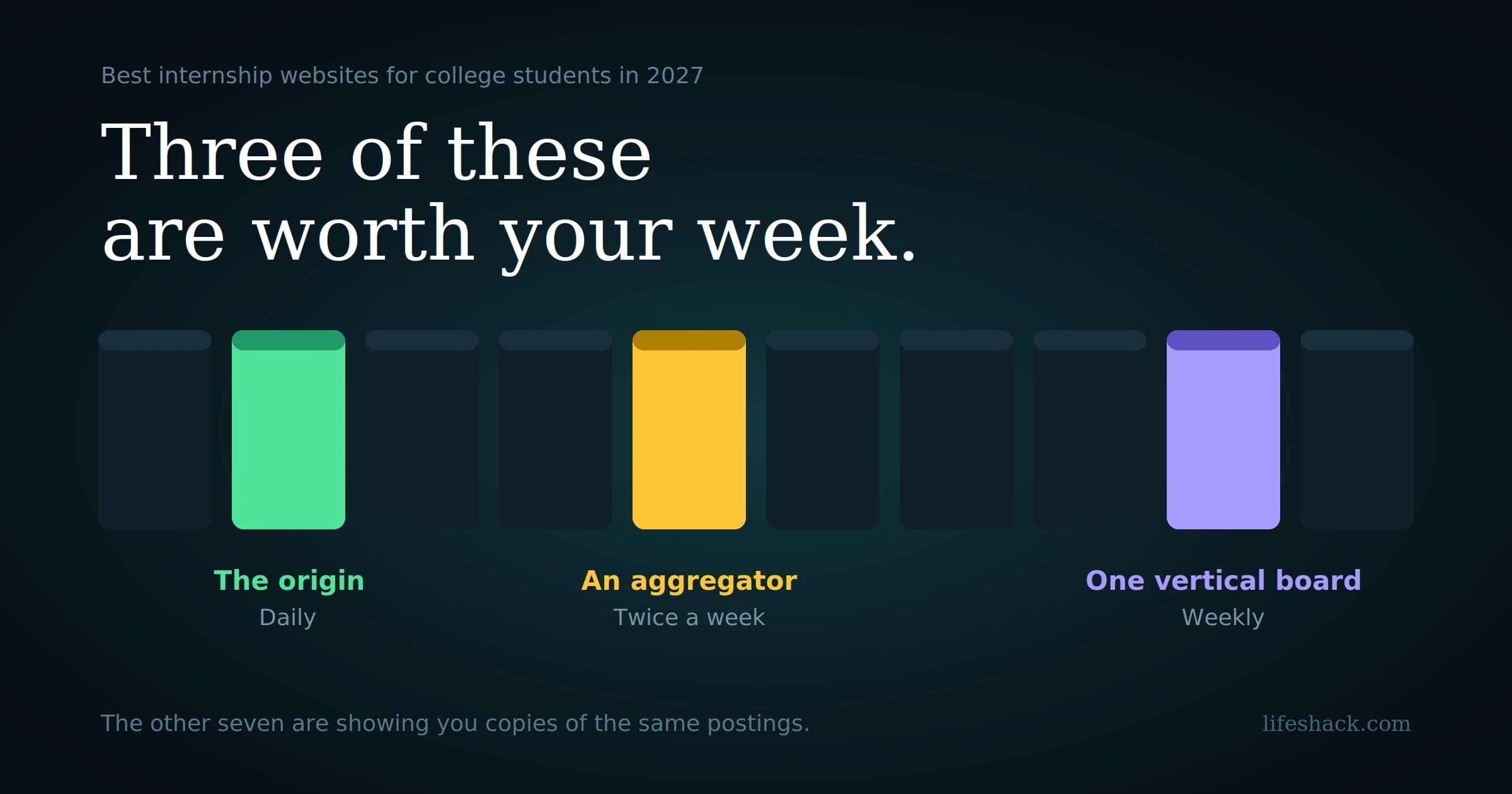
Ten bookmarked sites is a list that stops getting checked within about two weeks. Pick three, cover the three functions above, and give each one a fixed slot in your week.
One origin source, checked daily. Handshake for most students, or the relevant GitHub repository for technical roles. This is where you find listings before the wider pool does, and it is the only one that rewards checking every day.
One aggregator for discovery, checked twice a week. LinkedIn if you are also using it for networking, which you should be. Indeed if you need coverage of small and regional employers.
One vertical board for your field, checked weekly. Wellfound, Idealist, USAJOBS, eFinancialCareers, or your professional association's board.
Then add the part that is not a site at all. Build a list of twenty to thirty target employers and check their career pages directly on a weekly rotation. It yields more than any platform choice and it is the habit most likely to lapse, because it is tedious in a way that scrolling a feed is not.
Set alerts everywhere the platform supports them. In a rolling-review market, being in the first cohort of applicants is worth more than any edit you make to the application itself.
How students run this stack today
The workflow most students land on looks about the same everywhere. Alerts accumulate through the week, and a block of two to four hours on Sunday gets spent working through them with a spreadsheet open and twenty browser tabs in flight. Applications go out until the block is spent.
The stack is designed to surface more roles than that afternoon can hold, and narrowing the search to fit the time available would defeat the purpose of building it. Run properly through October, it will put thirty to fifty viable postings in front of you in a month.
The arithmetic is what breaks it. Each application runs twenty to forty minutes once you count creating an account on an applicant tracking system you have used four times already, retyping a work history the attached resume already contains, answering the same screening questions, and writing the short-answer field. Forty roles across five different systems is fifteen to thirty hours, and the large majority of it is the same information entered again.
Students resolve the gap in one of two ways. Some cut the target list down to what fits the Sunday block and apply to twelve roles in a market where the average posting draws 109 applicants. Others hold the volume and start pasting generic answers into the fields recruiters read, which trades a volume problem for a fit problem.
The underlying reason this keeps happening is that discovery has improved steadily while submission has not changed since the applicant tracking system was invented, so every improvement in how you find roles widens the distance between what you find and what you can send.
Closing the gap between what you find and what you send
The duplicated hours are the constraint, and they produce nothing a recruiter will ever see. Every hour spent retyping an address into a form is an hour not spent on a referral, a company research note, or the short-answer field that a person will read.
We built LifeShack for that layer. It carries one set of your information across Workday, Greenhouse, Lever, iCIMS, Ashby, and the rest of the eleven-plus systems internship programs run on, matches you against live postings, tailors the application, and submits it. The searching and the judgment about where to apply stay yours. What comes off your plate is the part where you type the same graduation date for the fortieth time.
The result is that the target list stops being capped by the Sunday block. A student who finds forty viable postings can apply to forty of them, in the first week each one posts, which is when rolling review has not yet worked through the pool.
If you would rather do it manually, the discipline that makes it work is a fixed weekly block and a canonical data set you keep in one place: dates to the month, institution name, degree field, expected graduation, references, and the four or five short-answer responses you rewrite per employer. Decide which approach you are taking before the season opens rather than in the middle of it.
What most rankings get wrong
They rank sites against each other that do different jobs. An aggregator and a university portal are not competitors, and asking which is better is the wrong question.
They go stale without being corrected. Several widely circulated lists still recommend GitHub Jobs, which shut down in 2021. Check the publication date on any list you read, including this one.
They treat one-click apply as a feature. It lowers your cost per application and everyone else's by the same amount, which is a wash for you and a windfall for the employer's inbox.
They ignore pool exposure entirely. The same posting on a gated university portal and an open aggregator carries completely different odds, and no ranking accounts for it.
They recommend ten sites. Three sites checked consistently will outperform a longer list checked occasionally, and a list of ten guarantees the second outcome.
Frequently asked questions
What is the best website to find internships? For US college students, Handshake is the strongest single site, because listings are frequently posted to your school specifically and the applicant pool per role is far smaller than on open boards. LinkedIn is the best complement for discovery and networking. Neither replaces checking target employers' career pages directly.
Is Handshake better than LinkedIn for internships? They do different jobs. Handshake gives you access to a gated pool and campus-specific postings. LinkedIn gives you reach, recruiter visibility, and the ability to find alumni at a target employer. Most students should use both, with Handshake as the daily check.
Should you apply through a job board or on the company website? Apply on the company's career site whenever the option exists. That is where the posting originates, where the application lands in the system recruiters review, and where you avoid stale or broken aggregator links. Use job boards to discover roles and the employer's site to apply.
Are internship websites free? The major platforms are free to students, including Handshake, LinkedIn, Indeed, Glassdoor, Wellfound, Idealist, eFinancialCareers, and USAJOBS. Be skeptical of any site charging students to view or apply to internship listings.
How do you find internships that are not posted on big job boards? Search the applicant tracking systems directly with queries like site:boards.greenhouse.io intern 2027 or site:jobs.lever.co intern, which return postings on employers' own hosted pages. Also check university career portals, community-maintained GitHub repositories for technical roles, professional association job boards, and target employers' career pages.
What are the best search operators for finding internships? On Google, use site: to search an applicant tracking system directly, quotation marks for exact phrases, and a minus sign to exclude terms, as in site:boards.greenhouse.io intern 2027 -MBA. On Indeed, title:intern removes every posting that only mentions interns in the body text. On LinkedIn, use quotation marks plus the Date Posted and Experience Level filters rather than Boolean strings.
How do you filter internships by visa sponsorship? Exclusion works better than inclusion, since more postings state a restriction than state an offer. Searching an ATS domain with -"no sponsorship" -"must be authorized" removes most roles you would not be eligible for. Adding "will sponsor" finds the smaller set that says so outright.
How many internship websites should you use? Three, plus a direct rotation through your target employers' career pages. One origin source checked daily, one aggregator checked twice weekly, one vertical board for your field checked weekly.
What is a ghost job and how common are they? A listing with no active intention to hire behind it. Estimates range from roughly one in seven to more than a quarter of postings depending on methodology, and the Congressional Research Service noted in 2025 that no official statistics exist. Verify any posting on the employer's own career site before applying.
Do recruiters prefer direct applications over Easy Apply? Some do. One-click applications produce far more volume per posting with far less signal about genuine interest, so applying directly costs you more time and puts you in a smaller pool.
What are the best internship sites for freshmen and sophomores? Your university portal, Wellfound, and Idealist, since startups, nonprofits, and campus employers rarely gate on class year the way structured corporate programs do. Most large summer programs require rising juniors. Searching Greenhouse and Lever directly also surfaces smaller employers that set no class-year floor.
Sources
Handshake 2025 Internship Index and Handshake Internship Report 2026. NACE 2026 Internship & Co-op Report. Greenhouse 2025 Candidate Experience Survey. Clarify Capital analysis of US job listings, 2026. Congressional Research Service, April 2025, on the absence of official ghost-job statistics.