How to Get an Internship With No Experience
by Patrick Da Costa Guimarais • Last Updated 9/24/2026
By Patrick Da Costa Guimarais, founder of LifeShack. Updated September 2026.
An internship is a job category built specifically for people who have not done the job before. That is the entire premise of the arrangement, and it changes what "no experience" means when you are applying to one.
You are not being compared against candidates with three years in the field. You are being compared against other students who also have coursework, a part-time job, and a club position. Every applicant in that pool has no experience. So the thing that separates the ones who get interviews is not experience at all, and chasing it is the wrong project.
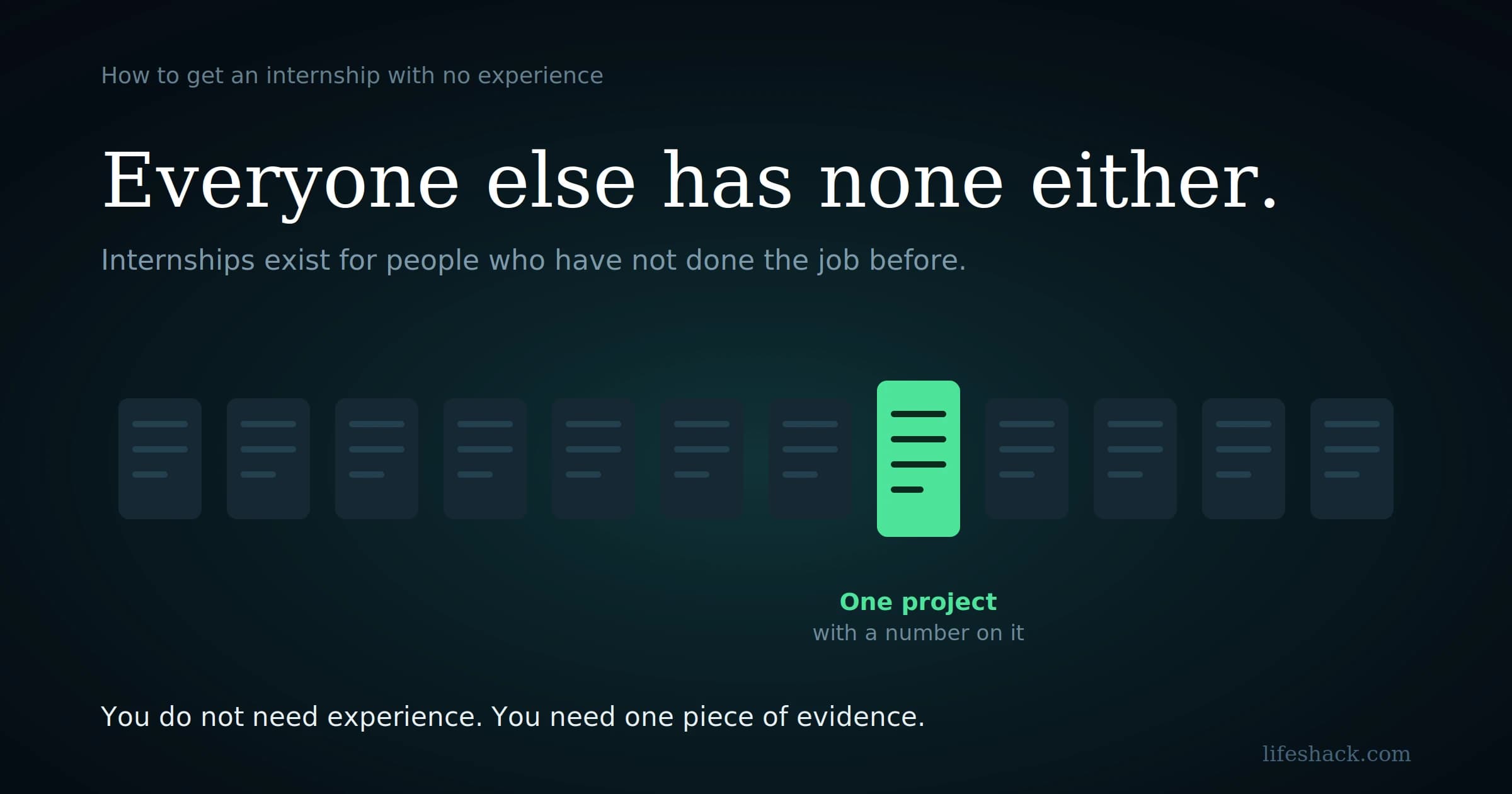
What separates them is evidence. One piece of work you can point to, in the direction of the role, that the other 108 applicants do not have.
This page covers what employers screen for instead of experience, the eligibility wall that gets mistaken for an experience problem, and how to build a usable piece of evidence in about four weeks using resources you already have access to. For the broader case of a graduate entering the workforce, our guide to landing a job with no experience covers that situation, which works differently.
What internship recruiters screen for instead
Eligibility. Class year, graduation date, work authorization, and sometimes a GPA floor. These are structured fields that filter mechanically, and failing one voids the application regardless of everything else.
Evidence of the specific skill. Not a list of skills. A thing you made, ran, analyzed, or shipped that demonstrates one of them. A single project with a result beats a skills section with eight entries.
Signs you will show up. Internships are short and supervision is expensive. Anything showing sustained commitment over months reads as low risk: a job held for three semesters, a sport, an org role you kept, a project you did not abandon.
Specificity about the employer. With thin resumes across the pool, the short-answer field carries more weight than it does at any later career stage. Two sentences that could only have been written about that company separate you from several hundred that could have been written about anyone.
A referral, where one exists. With no experience to differentiate on, a person vouching for you moves more than any resume edit will.
None of those five is experience. Four of them can be improved inside a semester.
The wall is usually class year, not experience
A large share of students who believe they have an experience problem have an eligibility problem, and the rejection looks identical either way.
Most structured summer programs at large companies require rising juniors. A sophomore applying to those is being filtered on a date field before anyone evaluates anything, and no amount of resume work changes it.
How to tell. Pull up five postings you applied to and read the eligibility line. If they specify rising juniors or seniors and you are not one, that was the outcome before you started writing.
What to do instead. Target employers who do not set a class-year floor: startups, nonprofits, campus research, local and regional businesses, government offices, and spring or off-cycle programs. These are also where a thin resume matters least, because the hiring manager is a person with a need rather than a program with a rubric.
Your campus is an experience factory
This is the part that makes an internship search different from a graduate job search, and it goes unused by most of the people who have access to it.
A new graduate looking for evidence has to find it in the open market. You have a campus full of organizations that need work done, cannot pay for it, and will say yes to an undergraduate who asks. None of it is advertised, because the people who need the help are not thinking of it as an opportunity to give away.
Faculty research. Professors run studies that need undergraduates to run assays, clean data, code transcripts, manage samples, and maintain databases. Most of this is never posted anywhere. An email in week two of a semester lands very differently than one in week ten.
Student organizations with real operations. A 200-member org has a budget, a social presence, events with attendance numbers, and sponsorships. Those are finance, marketing, operations, and partnerships, and they usually run on whoever volunteered.
Campus offices. The career center, admissions, athletics, alumni relations, and the student newspaper all run on undergraduate labor and all have work that produces measurable results.
Labs, makerspaces, and shared facilities. Equipment access plus a faculty contact is a project waiting for someone to propose it.
Local businesses within walking distance of campus. Small operations rarely have anyone running their digital presence, their inventory system, or their email list. They are also the easiest yes on this list.
Two scripts get you most of the way.
The faculty ask. Send in the first three weeks of a term, to a professor whose class you have taken.
Subject: Undergraduate research help this semester

Hi Professor [Name],

I took [course] with you in [term] and I'm interested in [the specific
area of their work, named accurately].

I'm looking for research experience this semester and I can commit
[6-8] hours a week through [month]. I have [the one or two relevant
skills: Excel, Python, lab technique, transcription, whatever is true].

Is there anything on your current project that an undergraduate could
usefully take on? Happy to start with whatever is least interesting
and most useful.

[Name], [year], [major]
The local business ask. Walk in or email a small business you already use.
Subject: Free help with your [Instagram / email list / online ordering]

Hi [name],

I'm a [year] at [school] studying [major]. I'm looking to build a
portfolio this semester and I noticed [one specific, accurate
observation about their situation].

I'd like to run your [channel] for the next three months at no cost.
You'd approve everything before it goes out, and I'd track the numbers
so we both know whether it worked.

Would you be open to a short conversation this week?

[Name], [phone]
Free is not a concession here. You are buying evidence with time, and a result you can cite is the entire point.
The four-week build
You do not need a portfolio. You need one piece of proof per track you are targeting, sized to a few weekends, with a number attached.
For marketing. Run a real campaign for a campus organization or a local business. Track reach, signups, or attendance before and after. A single event that went from 40 attendees to 110 is a resume line and an interview story.
For data and analytics. Take a public dataset in a domain you care about, clean it, find three things in it, and publish the writeup. The cleaning is the part that demonstrates the skill and the writeup is the part that proves you can explain it.
For software. Ship something small that ten real people use. Usage matters more than complexity, because usage means you finished, handled feedback, and fixed things.
For finance and consulting. Build a model or a teardown of a company you can talk about for ten minutes. Case competitions run on campus most semesters and produce a deliverable with a date on it.
For design. Redesign something that exists and is bad, and document the reasoning. Three screens with a written rationale beats twenty screens without.
For operations and supply chain. Take a process that runs badly in an organization you belong to, measure it, change it, and measure it again. Checkout lines, event setup, inventory, scheduling.
The constraint that matters is a number and an end date. A project still in progress after six months reads as a project you abandoned.
Where students with thin resumes get hired
Startups. They post four to eight weeks before a start date, rarely set class-year floors, and care about whether you can do the thing. A part-time spring role at a startup frequently carries more responsibility than a structured summer program.
Nonprofits and government. Run on academic calendars, hire heavily for spring, and value commitment over credentials. Many legislative internships exist only in spring, when sessions meet.
Campus employers. The shortest distance between you and a line on a resume, and the least competitive pool you will ever apply into.
Local and regional businesses. A twenty-minute commute is worth more than a recognizable name three states away when you are also taking classes.
Spring and off-cycle programs. Smaller applicant pools, because a role running during the semester rules out anyone carrying a full course load.
Where to find these matters, since none of them post reliably to the large aggregators.
Writing it up
Once you have evidence, the writing is mechanical. Lead with what you did, the tools, the scale, and the result, and put projects above unrelated jobs when the posting is technical or field-specific. Our guide to tailoring a student resume has eight rewrites of the bullets students submit, including class projects, club roles, and part-time work.
The short-answer field is where you make up the remaining distance. With no experience across the whole pool, specificity is the differentiator, and it takes fifteen minutes of research per application to write two sentences that could only be about that employer.
The part that gets hard
The plan above is simple enough for one application: build evidence, target employers without class-year floors, write something specific, apply early.
The difficulty is that the plan only works at volume. Employers who do not set class-year floors are also the ones who post four weeks out and fill in days, which means checking sources daily across a whole season. And a thin resume converts at a lower rate, so you need more applications rather than fewer, at a point in your life with the least free time you will have had so far.
Each application runs about an hour once you count triage, tailoring, the research for the short-answer field, and the twenty to forty minutes every applicant tracking system takes, since each one wants an account created and a work history retyped into fields your attached resume already contains.
LifeShack handles that layer end to end. It searches for roles matching your background and constraints, tailors the resume and cover letter to each posting, submits across the eleven-plus applicant tracking systems these programs run on, including Workday, Greenhouse, Lever, iCIMS, and Ashby, and keeps every application in one place. There is no queue of drafts waiting on your approval and no point where the form comes back to you.
Three questions separate the tools in this category: does it find the roles or do you paste in links, does it tailor per posting or attach the same file, and does it submit or does it prepare and stop. Most stop before submission, which leaves the largest cost where it was.
What stays with you is the evidence. Nothing automates a professor saying yes, or a campaign that moved a number, and those are what make the applications worth sending.
Frequently asked questions
Can you get an internship with no experience? Yes, and it is the normal case. Internships exist for people who have not done the work before, so every applicant in the pool is in the same position. What separates candidates is evidence of one relevant skill, clearing the eligibility criteria, and specificity about the employer.
What counts as experience for an internship? Class projects, faculty research, student organization roles, part-time jobs in any field, volunteering, personal projects, and case competitions. Anything where you did something, at some scale, with an outcome you can describe.
How do freshmen and sophomores get internships? By targeting employers who do not require rising juniors, which rules out most large structured summer programs. Startups, nonprofits, campus research, local businesses, and spring or off-cycle roles are the realistic paths, and they are also less competitive.
How long does it take to build relevant experience? One usable piece of evidence takes about four weeks of part-time effort. A campaign with tracked numbers, a cleaned dataset with a writeup, or a small shipped tool with real users are all achievable inside a semester alongside classes.
Is an unpaid internship worth it to get experience? Sometimes, and price it honestly. At for-profit employers, unpaid arrangements are governed by the Department of Labor's seven-factor primary beneficiary test, and academic credit does not make one lawful on its own. Campus and local projects often produce comparable evidence without the commitment.
Should you say you have no experience in an application? No. Describe what you have done rather than framing what you have not. The employer already knows the pool is students, since that is who the program is for.
How many internships should you apply to with no experience? More than a student with a strong resume, since your conversion rate starts lower. Forty to eighty across a season is the working range, weighted toward employers without class-year requirements.
What if nothing has come back after forty applications? Diagnose rather than add volume. The six most common causes are eligibility, timing, targeting, resume language, thin evidence, and volume, in roughly that order of likelihood.