Why Am I Not Getting Internship Interviews?
by Patrick Da Costa Guimarais • Last Updated 9/24/2026
By Patrick Da Costa Guimarais, founder of LifeShack. Updated September 2026.
Before diagnosing anything, get the baseline right, because a lot of students conclude something is wrong with them when the numbers say otherwise.
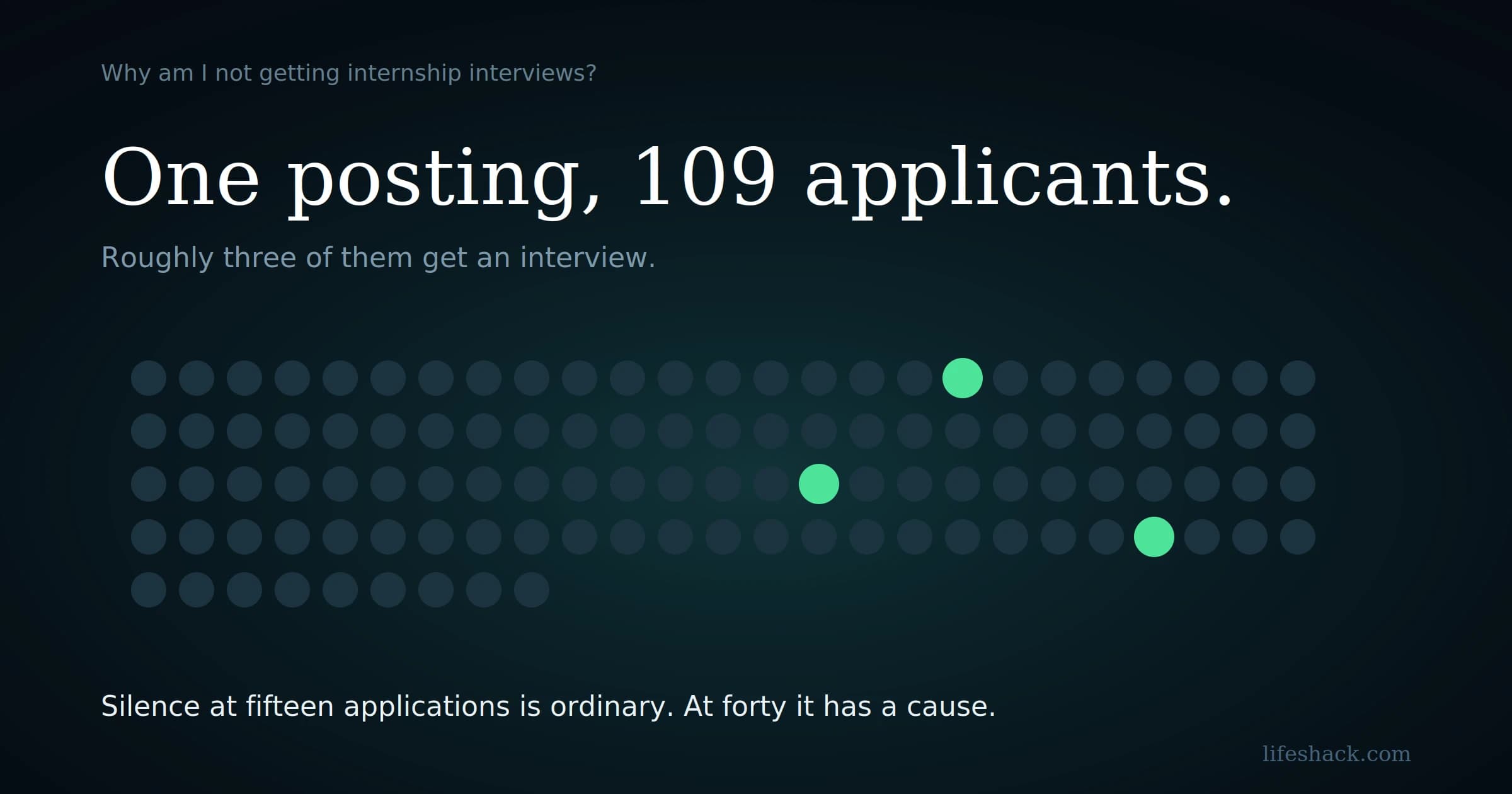
Handshake recorded an average of 109 applications per internship posting in 2024-25, up from 62 the year before and 43 the year before that. Technology postings averaged 273 applicants each and financial services drew 192. Employer-side data puts applicant-to-interview conversion near 3% across all applicants for a given role.
At those rates, fifteen applications producing zero interviews is an ordinary outcome rather than evidence of a problem. If that is where you are, the answer is usually volume and timing, and the rest of this page will still be useful in a few weeks.
If you are past forty applications with nothing back, something specific is wrong, and it is almost always one of six things. They are listed below in order of how often they turn out to be the cause, which is roughly the reverse of the order students investigate them in.
Start with your rate
Divide the applications that produced any interview by the total you have sent, then multiply by 100.
Zero interviews from under 20 applications. Too early to diagnose. Keep applying and recheck at 30.
Zero interviews from 40 or more. Work through the six causes below in order.
Under 5% after 40. Same, and do not add volume until you find the cause, since more applications at a broken rate mostly consumes your fall.
Between 5% and 10%. The materials are working. Your issue is volume or timing, which means causes two and six.
Above 10% but no offers. Your applications are working and the problem is downstream, which means interview preparation rather than anything on this page.
Cause one: you are failing the eligibility fields
This is the most common cause and the easiest to overlook, because the rejection looks identical to every other rejection.
Class year, expected graduation date, work authorization, GPA minimums, and location are structured screening questions. They filter mechanically before any human reads your resume, and getting one wrong voids the application no matter how strong everything else is.
The test. Pull up five postings you applied to and read the requirements section line by line. Are they open to your class year? Does your graduation date fall inside the window they specify? Do they state a GPA minimum you clear? Do they sponsor, if you need it? Is the location one you selected as acceptable?
The fix. Most large summer programs require rising juniors, which rules out many freshmen and sophomores regardless of merit. If that is the wall you are hitting, redirect to startups, nonprofits, campus research, and local employers, which rarely set a class-year floor. If sponsorship is the issue, filter for it explicitly rather than applying and hoping.
Cause two: you are arriving late
Internship programs review on a rolling basis. Requisitions fill as qualified applicants come in, and the posted deadline functions as a backstop rather than the moment decisions get made.
An application submitted in the first week of a posting competes against a small pool. The same application in week eight competes against everyone plus a recruiter who has already advanced five candidates to interview, which is a different contest with identical materials.
The test. Look at your last twenty applications and find the posting date for each. If most are more than three weeks old at the time you applied, this is your cause.
The fix. Set daily alerts rather than weekly ones, check your university portal every day during the window, and apply within 48 to 72 hours of finding a strong-fit role. Where to look so that postings reach you earlier covers the sources that surface roles before the large aggregators index them.
Cause three: you are applying to the wrong roles
Volume applied to poorly matched postings produces a low rate that looks like a materials problem and is not.
The test. Take ten applications and ask, for each, whether you met most of the listed requirements and whether you could write two specific sentences about why that employer. If the honest answer is no on either count for more than three of them, targeting is your cause.
The fix. Narrow to two tracks and apply to everything inside them rather than spreading across five. A student applying to marketing, finance, consulting, software, and operations roles has five half-built resumes and no depth in any of them. Two tracks with evidence behind them will outperform five without.
Cause four: your resume is not surfacing the posting's language
Screening runs in layers. A posting gets parsed into structured fields, matched against the job description's keywords and skills, and in many systems ranked before a recruiter opens the shortlist.
The test. Put a posting and your resume side by side. Circle every tool, platform, and skill the posting names. Count how many appear on your resume in the posting's own wording, for things you have done. Under half is a problem.
The fix. Mirror the posting's exact terms where the underlying experience is real, and leave out the ones where it is not. Our guide to tailoring a student resume covers what to change when you have a class project and a part-time job rather than three previous roles, and the ATS errors that cost people interviews covers the formatting that determines whether your file parses at all.
Keyword stuffing has stopped working and can flag an application as manipulative. The terms only help where there is something behind them.
Cause five: your evidence is thin
This is the cause most people jump to and it is rarely the top one. When it does apply, it shows up in a specific way: your resume claims skills with nothing underneath them.
The test. For every skill on your resume, can you point to a line elsewhere on the page that proves it? A skills section listing Python, SQL, and Tableau with no project, course, or role demonstrating any of them reads as aspiration.
The fix. Build one piece of proof per target track, sized to a few weekends. Run a real campaign for a campus organization and report the numbers. Clean a public dataset and publish what you found. Take over a local business's social accounts for a semester. Ship a small tool and get ten people using it. One project with a result attached does more than five listed skills.
This is also the slowest fix on the page, which is why it is worth ruling out the four above first.
Cause six: you have not applied to enough
A genuine cause, and less often the one than it first appears, which is why it sits last rather than first.
The test. Count. Under 40 applications in a season, with the other five causes ruled out, volume is your constraint.
The fix. How many internships to apply to and how to pace them covers the targets and the weekly cadence.
When it is not you
Some of this is structural and worth naming so you do not internalize it.
Postings per student have fallen while applications per posting have more than doubled, so the same effort produces fewer interviews than it did three years ago. Certain fields are worse than others, with technology at 273 applicants per posting. On-cycle finance and consulting recruiting closes almost a year ahead, so missing that window is a calendar problem rather than a merit one. And target-school status measurably affects interview rates, which is real, unfair, and not something you can fix this semester.
None of that means stopping. It means calibrating what a normal rate looks like, so you diagnose the things you can change rather than concluding you are the problem.
The two-week reset
If you have worked through the causes and found yours, here is the sequence.
Days one and two. Audit twenty past applications against causes one, two, and three. The answer is usually in there, and all three are cheap to fix.
Days three and four. Rebuild the base resume against two target tracks rather than five. One page, evidence under every claimed skill.
Day five. Rebuild the target list. Thirty employers weighted toward the ones that fit your class year and constraints, sorted by expected posting date.
Days six and seven. Set daily alerts everywhere that supports them, including your university portal.
Week two. Apply to fifteen roles, all of them posted within the last ten days, all inside your two tracks. Then measure again at thirty.
Measure again at thirty rather than at the end of the season, since the point of a reset is finding out quickly whether the change worked.
The part that makes this hard to sustain
The two most common causes on this page, arriving late and not applying to enough well-matched roles, are both throughput problems rather than quality problems.
Applying early requires checking sources daily and turning an application around within two or three days of a posting going live. Applying to enough requires doing that forty to eighty times inside a ten-week window. Each application is roughly an hour once you count triage, tailoring, company research, and the twenty to forty minutes every applicant tracking system takes, since each one wants an account created and a work history retyped into fields your attached resume already contains.
That is why a reset like the one above tends to hold for about three weeks before the semester reclaims the hours.
LifeShack handles that layer end to end. It searches for roles matching your background and constraints, tailors the resume and cover letter to each posting, submits across the eleven-plus applicant tracking systems internship programs run on, including Workday, Greenhouse, Lever, iCIMS, and Ashby, and keeps every application in one place. There is no queue of drafts waiting on your approval and no point where the form comes back to you.
If you are comparing tools, three questions separate them: does it find the roles or do you paste in links, does it tailor per posting or attach the same file, and does it submit or does it prepare and stop. Most stop before submission, which leaves the largest cost exactly where it was.
What stays with you is choosing the tracks, building the evidence, and preparing for the interviews that come back. Those are the parts that move your rate, and they are worth the hours a semester can spare.
Frequently asked questions
Why am I not getting internship interviews? The six most common causes, in order: failing a structured eligibility field such as class year or graduation date, applying late in a rolling-review window, targeting roles that do not match your background, a resume that does not mirror the posting's language, thin evidence behind claimed skills, and too few applications. Check them in that order, since the first three are the most common and the cheapest to fix.
How many applications before I should worry? Forty. Below twenty, zero interviews is statistically ordinary given an average of 109 applicants per posting. At forty or more with nothing back, work through the causes systematically.
Is my resume the problem? Possibly, and it is less often the cause than students assume. Rule out eligibility, timing, and targeting first, because all three are faster to fix and all three produce the same silence.
What is a normal application-to-interview rate for internships? Employer-side benchmarks put conversion near 3% across all applicants for a given role. For an individual student, 5% to 10% indicates the materials are working and above 10% indicates strong targeting.
Why do I get rejected instantly? An instant rejection usually means a structured screening field ruled you out: class year, graduation date, work authorization, GPA minimum, or location. The speed is the signal, since no human was involved.
Does applying to more internships help if I am getting no interviews? Only after you have found the cause. Adding volume at a 2% rate mostly consumes your season. Fix the input, then increase it.
Can freshmen and sophomores get internship interviews? Yes, and most large summer programs require rising juniors, which is a common invisible wall. Startups, nonprofits, campus research, and local employers rarely set a class-year floor and are the better target.
Should I follow up after applying? It rarely changes a screening outcome, and a message to an alum on the team frequently does. A referred application converts at a much higher rate than a cold one, which makes that the better use of the same fifteen minutes.
Sources
Handshake 2025 Internship Index and Handshake Internship Report 2026. NACE 2026 Internship & Co-op Report. CareerPlug recruiting metrics on applicant-to-interview benchmarks.